
What is a Super Heinz bet? A full look at 120 bets across seven picks
 Available in US
A Super Heinz is a full-cover multiple bet that takes seven selections and lays 120 bets across them in every combination of two or more picks. Twenty-one doubles, thirty-five trebles, thirty-five four-folds, twenty-one five-folds, seven six-folds and a single seven-fold make up the package, and because every line contains at least two selections, a single winning pick returns nothing on its own. The shape matters because it sets the unit stake: a £2 line stake costs £240 in total across the 120 bets, and a £1 line stake cuts that to £120. There are no single-bet lines to absorb a solitary winner, which is what distinguishes a Super Heinz from a Lucky 63 — the Lucky 63 adds six singles on top.
Verified against the UK Gambling Commission’s public register on 27 October 2026.
The British framework that decides who is allowed to take the bet
Online sportsbooks serving customers in Great Britain operate under a Gambling Commission remote licence issued under the Gambling Act 2005. The Commission is the regulator for England, Scotland and Wales; Northern Ireland sits outside that Act under its own older legislation, so a brand licensed for Great Britain is not licensed for Northern Ireland, and the converse holds. Several current betting brands run from Malta, Gibraltar or Curaçao, but the point-of-consumption rule under the Gambling (Licensing and Advertising) Act 2014 means that whichever jurisdiction hosts the company, taking remote bets from a British customer requires a Commission licence. A Curaçao or Maltese remote licence is not a substitute.

The Commission grants licences in categories. A remote general betting standard (real events) licence covers fixed-odds sports betting; a remote betting intermediary licence covers betting exchanges; pool betting, virtual events and spread betting each have their own categories. There is no statutory list of permitted bet types: the licence covers a category and the operator offers markets within it. A Super Heinz is permitted wherever the bookmaker offers multiples on the underlying markets, which in practice means anywhere the operator publishes horse racing, football, tennis, greyhound or similar pre-match or in-play odds. Whether an individual bet is accepted depends on each operator’s own trading controls.
Statute
A Super Heinz in Great Britain is settled under the operator’s own terms. The framework is the Gambling Act 2005 together with the Commission’s Licence Conditions and Codes of Practice, not a statute specific to multiple bets.

The Gambling Act 2005 sets the licensing regime, the age limit at 18, the identity-verification duty that applies before the first deposit or gamble, and the offence of providing gambling without the required licence. From May 2019 the identity check covers free bets and bonuses too, so even a no-deposit offer is gated behind a verified name, address and date of birth. The 2014 Act extends the regime to operators based anywhere in the world if their remote facilities reach a British customer.
A Super Heinz sits within that framework the same way any other multiple bet does. The bet itself is a contract between the operator and the customer, and the Commission polices the contract’s terms through its codes of practice rather than dictating its content. Non-runner and void-selection rules are an example: when a single pick in a Super Heinz is void, the line drops to the next-lower combination, so a six-fold reduces to a five-fold on the remaining six runners and the seven-fold becomes a six-fold. The Commission does not set that rule; the operator’s own non-runner policy does.
What the regulator does police is everything around the bet: identity checks, source-of-funds questioning at higher spend, the GAMSTOP self-exclusion link that every online operator must carry, the credit-card ban that has applied since 14 April 2020, the 10x wagering-requirement cap that took effect on 19 January 2026, and the prohibition on mixed-product promotions that bundle, say, a sports bet with casino free spins. A Super Heinz settled in cash is unaffected by those promotion rules. The same bet placed with a free-bet token may be affected, and a bettor using free bets should read the operator’s bonus terms.
Jurisdiction
Every operator reviewed on this page holds a Gambling Commission remote licence. The licence account number sits on the Commission’s public register alongside the licence holder’s company name and the domains the licence covers, and the register is searchable by business name, trading name, domain or account number. Several brands can run under one licence holder — Ladbrokes and Coral are commonly cited as running under LC International Limited, Paddy Power and Betfair under Flutter Entertainment’s various subsidiaries — and that does not make them separate operators from the Commission’s point of view. The licensed entity is the company; the trading names are the brand surface.
A British licence alone does not protect the customer in every case. Customer funds sit with the operator and the rules around their segregation are the operator’s, not the Commission’s, so a licensed brand that runs into insolvency may not return funds in full. The Commission can revoke a licence, fine the operator, or work with payment providers to disrupt an unlicensed operator, but a customer who has already lost money to a failed operator has limited British recourse. The Commission’s complaints route covers licensed operators in scope and not unlicensed ones, which is the practical reason a British bettor usually chooses a licensed brand.
Enforcement
The Commission enforces the regime. Sanctions include licence suspension, revocation, financial penalties and prosecution under section 33 of the Gambling Act 2005 for providing gambling without the required licence. There is no statutory offence aimed at a customer who places a bet with an unlicensed brand: the law targets the operator. Enforcement is disruption rather than blocking: cease-and-desist notices, search-engine referrals, work with registrars, hosts and payment providers, and the court-order DNS blocking powers the Commission has now been given. ISP-level blocking on demand is not in routine operation.
A Super Heinz is, in regulatory terms, no different from a single or an accumulator. It is permitted wherever the operator offers the underlying markets and the picks themselves are permitted events. The same framework applies to the non-runner rules, the each-way settlement on horse racing, the void-selection rule and the bonus terms that may be attached to a free bet.
Safeguards that sit around a Super Heinz, whether you use them or not
Player protection in Great Britain is layered. GAMSTOP, the national multi-operator self-exclusion scheme, has been a mandatory licence condition for online operators since 31 March 2020, and every GB-licensed brand is part of it. Self-exclusion is for six months, one year, five years, or five years with auto-renewal, and once the chosen minimum period is over the exclusion stays in place for a further seven years unless the customer asks GAMSTOP to remove it. GAMSTOP covers online sites and apps; betting shops use a separate scheme. Self-exclusion at one operator does not, on its own, block every other brand — GAMSTOP exists to make that block operate across them all.
GamCare runs the National Gambling Helpline, and GambleAware funds treatment and education. The NHS runs regional gambling clinics, and Gamblers Anonymous runs peer-support meetings. None of these is a statutory body, but the Commission expects licensed operators to point customers toward them, and a brand that did not carry those links would fail its social responsibility code.
The financial vulnerability check
The Commission’s financial vulnerability check, in force since 30 August 2024 under LCCP condition 3.4.4, applies to licensed remote betting once a customer’s deposits minus withdrawals exceed £150 in a rolling 30 days. The check is a public-record check — bankruptcy, county court judgments, similar registers — and is not an income check and not a credit reference check. The “financial risk assessments” or “affordability checks” of the press are a separate, staged plan announced by the Commission; they have no start date as of 2026 and have not been brought into force. The vulnerability check is the threshold that triggers a check; it is not a deposit ceiling.
Deposit limits and stake limits
The Commission’s Remote Technical Standards require operators to offer a gross deposit limit set on a fixed time frame; the first changes took effect on 31 October 2025, a second phase was postponed to 30 September 2026, and whether that second phase is live is not settled. There is no state-set ceiling on either deposits or losses: limits are the customer’s choice. A Super Heinz carries the operator’s own maximum-stake policy, which is set per customer and per market rather than fixed by statute.
The credit card ban
Credit cards are banned for gambling in Great Britain since 14 April 2020 under LCCP condition 6.1.2, including credit-card-funded payments through an e-wallet. Debit cards, bank transfers and most e-wallets remain in scope. The ban sits inside the Super Heinz settlement the same way it sits inside a single: the operator declines the credit card at deposit, not at bet placement.
What protection an unlicensed brand cannot offer
A bookmaker licensed in Curaçao, Malta, Anjouan or similar does not give a British customer GAMSTOP coverage, a Commission complaints route, an approved dispute-resolution body, British consumer redress if funds are withheld, the 10x bonus cap, or the £150 vulnerability-check regime. That is the practical reason the regulator exists: a licensed brand is one the Commission can sanction, suspend or revoke, and the sanctions reach the customer’s protection. An unlicensed brand is not subject to the same reach, and the customer carries the risk.
How a free-bet promo settles against a Super Heinz
Free bets are not refundable in cash on the stake when they win. A £10 free bet at odds of 3/1 returns £30 in profit with the £10 stake not paid back, not £40 in return. That distinction is what makes a free-bet token a marketing incentive rather than a stake replacement, and it is the reason operators issue them as loss-leaders: the bettor’s downside on a losing free bet is zero, and the upside is the profit, with the stake kept by the operator.
A free bet used on a Super Heinz applies once to the package as a whole: the bookmaker treats the token as a single stake at the combined odds, and the resulting win pays out in profit only. The “free-bet value” calculation that the betting calculators run is value = free-bet amount × (odds − 1) ÷ odds × payout share of that market, with the payout share being the inverse of the overround. At 3/1 (4.00 decimal) with a 95% payout share on a £10 free bet, the expected value of the token is roughly £7.13 — the average the bettor’s maths clears over many bets, not a guaranteed return.
Wagering requirements and the 10x cap
A free bet with a wagering requirement demands turnover before any profit is withdrawable. Until 19 January 2026 the requirement was set by each operator, sometimes to 40x or 50x the bonus amount. From that date the Commission’s promotion rules cap wagering requirements at 10x the bonus. A £10 bonus at 50x used to demand £500 of qualifying bets; under the 10x cap no bonus can require more than £100 of turnover per £10 of bonus. The cap applies to wagering requirements: it does not change the calculation of what the bonus pays back, and it does not turn a free bet into cash.
Mixed-product promotions are banned from the same date. A free bet that comes bundled with free casino spins, for example, would breach the rule, and a brand offering one is in breach. A straight sports free bet with a turnover condition is in scope.
A worked check on turnover
QuinnBet credits free bets valid for 7 days, usable on any market at odds of 1/2 (1.50) or greater, with a maximum price of 50/1 and accumulators permitted while Trixies, Patents and Yankees are not. A £20 free bet at the minimum permitted odds of 1/2 demands turnover of £20 × 1 = £20 before profit is withdrawable; at odds of 5/1, the same turnover of £20 keeps the gross profit at £100 but with a higher variance.
A Super Heinz under a free-bet token is not a typical use case. The 120-line stake cannot be paid from a £10 or £20 free-bet balance, because the operator applies the token as a single unit and the unit stake on a Super Heinz is by line, not by package. A bettor wanting to use a free bet on a multi-line bet is more likely to use it on a Lucky 15 or an accumulator than on a Super Heinz.
What a free bet is, and is not
A free bet is a token that lets the bettor place a bet without risking their own cash on the stake. The stake is not returned on a win. A “risk-free” bet refunded as a free bet is not a refund in money. An enhanced-odds offer pays the additional value as a free token, not as cash. The “no wagering” free bet pays profit only — the same calculation as a token with a turnover condition, except that the profit is withdrawable immediately.
None of these tokens is a substitute for a cash stake. A Super Heinz settled against cash pays the stake back on every winning line; the same Super Heinz settled against a free-bet token returns the profit only and keeps the token. The token’s value to the bettor is the profit expected over many bets at the stated odds, with the bookmaker’s margin already inside the price.
Strategy talk, and why it does not turn the price
A “strategy” for a Super Heinz is mostly arithmetic, because the bet has no skill component beyond picking selections and the math is fixed. Seven picks make 120 lines; two picks that win return a double on those two; three picks that win return a treble plus three doubles; and the bet wins more the more picks that win. A 7/7 winner pays out a single seven-fold line plus the cumulative return on every line below it. A 2/7 winner returns only one double. A 1/7 winner returns nothing.
Bankroll and staking
The unit stake on a Super Heinz is the line stake. A £2 unit stake costs £240 in total; a £1 unit stake costs £120. The book’s maximum payout policy is the hard ceiling, because a 7/7 winner pays out the seven-fold at the unit stake plus the returns on every lower line, and that total can be very large at long odds. Operators set a maximum payout per customer per day or per bet, and a Super Heinz at long odds is the bet most likely to brush that ceiling. Staking the package as a single line at the cumulative odds — rather than 120 lines at the unit stake — is the alternative the operator offers when it accepts the bet, but most operators quote a Super Heinz on the full-cover basis.
Bankroll strategy on a Super Heinz is more about variance than edge. The bet pays out best when many of the seven picks win; the expected value over many bets is the product of the underlying odds minus the bookmaker’s margin on each market. The bookmaker’s margin sits inside every price, and no combination of picks recovers it. A Super Heinz on seven short-priced favourites has a high chance of returning a small amount and a low chance of returning nothing; the same package on seven outsiders has the opposite shape. Neither has positive expected value against a competent bookmaker’s prices.
Heinz and Goliath by comparison
A Heinz is the same full-cover shape with one fewer pick — six selections, 57 bets: 15 doubles, 20 trebles, 15 four-folds, 6 five-folds and 1 six-fold. A Goliath is the same shape with one more pick — eight selections, 247 bets: 28 doubles, 56 trebles, 70 four-folds, 56 five-folds, 28 six-folds, 8 seven-folds and 1 eight-fold. The Super Heinz is the middle of the three. Compared with a Lucky 63 on seven picks, the Super Heinz drops the six singles and the same 120 multi-line bets remain. Compared with a Trixie on three picks, the Super Heinz is the larger family member: 3 picks, 4 bets; 7 picks, 120 bets. The math is the math; the question is whether the bettor wants the singles that the Lucky 63 adds.
Why no system wins
The Commission licenses the operator; it does not license the bet. There is no edge that an arrangement of bets creates: the bookmaker’s margin is inside every price, and no combination of prices recovers it. A Super Heinz on long-priced selections is a bet that pays out rarely and pays out large when it does; a Super Heinz on short-priced favourites is a bet that returns often and returns small. The arithmetic of expected value does not move with the arrangement.
The “tips” sold by tipster services in Great Britain are not licensed. The Commission’s licence covers the operator’s sportsbook, not the analysis the operator or any third party publishes. A tipster who sells picks is making a marketing claim; the claim is not policed by the regulator. A bettor who follows tips is taking the tipster’s word; the regulator has not tested it.
A Super Heinz on the betting slip, and how it settles
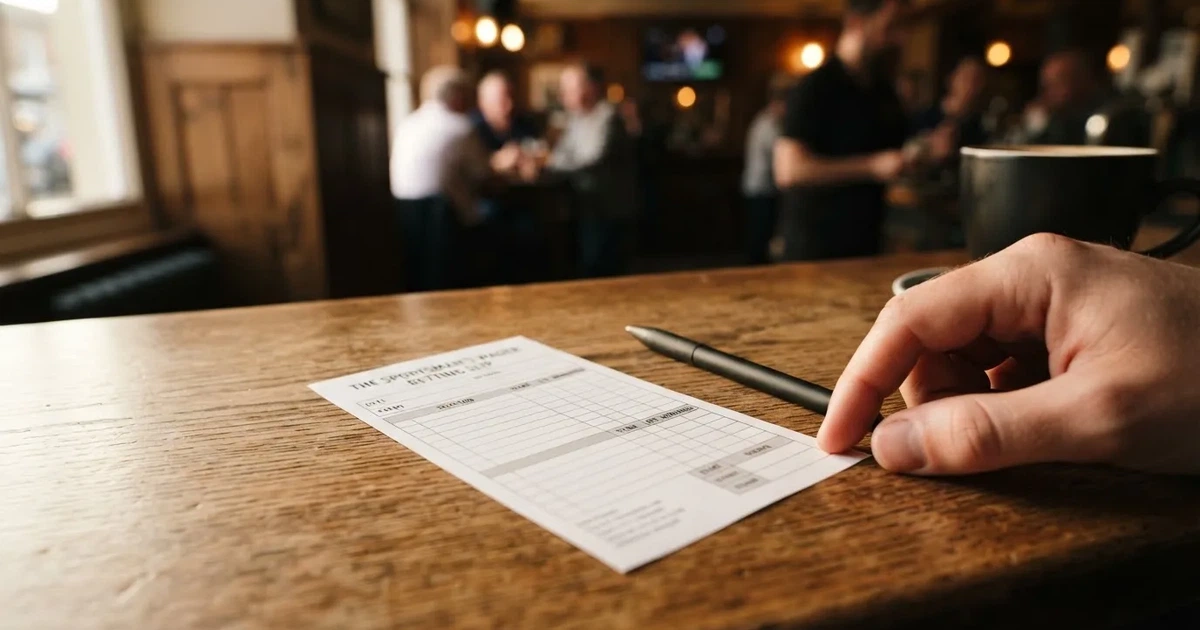
A Super Heinz is a single betting decision that produces 120 separate bets. On the slip, the bettor picks seven selections and selects “Super Heinz” as the bet type; the slip shows the unit stake and the total stake (unit × 120). The bookmaker accepts the package as a single transaction. Each of the 120 lines is settled on its own: a double on picks 1 and 2, a treble on picks 1, 2 and 3, and so on up to the seven-fold on picks 1 through 7.
The structure, from double to seven-fold
Twenty-one doubles cover every pairing of the seven picks: AB, AC, AD, AE, AF, AG, BC, BD, BE, BF, BG, CD, CE, CF, CG, DE, DF, DG, EF, EG, FG. Thirty-five trebles cover every triple. Thirty-five four-folds cover every quadruple. Twenty-one five-folds cover every quintuple. Seven six-folds cover every sextuple. One seven-fold covers the full set. There are no singles and no single-line bets; the smallest winning line is a double.
The total stake is the unit stake multiplied by 120. A £1 line stake on a Super Heinz costs £120; a £2 line stake costs £240; a £0.10 line stake costs £12. Returning numbers are unit stake × 120 × price × payout share for the line that wins — and most lines do not win.
Settlement process for a Super Heinz
A 7/7 winner returns the seven-fold plus every lower line on which the seven picks all won. The seven-fold line settles at unit stake × 120 × combined odds of all seven picks; every double, treble, four-fold, five-fold and six-fold line on those seven picks also settles as a winner, and the cumulative return can be very large. A 6/7 winner returns every line that does not include the losing selection, which is a six-fold on the six winners, fifteen five-folds on the six winners, twenty four-folds on the six winners, fifteen trebles on the six winners, six doubles on the six winners — and nothing on the lines that included the loser. A 5/7 winner returns every line that draws from the five winners. The shape of the return follows the binomial coefficients: with k winners out of seven, the number of winning lines is the sum of the binomial coefficients from 2 to k.
Non-runner and void rules
A non-runner in a Super Heinz drops the affected pick to the next-lower combination. A seven-fold with one non-runner becomes a six-fold on the remaining six; a six-fold with one non-runner becomes a five-fold, and so on down to a double, which becomes a single on the remaining pick — and a single is not a line on a Super Heinz, so the bet settles on the remaining line at the single’s price. The bookmaker’s Rule 4 deduction, used on horse racing when a runner is withdrawn, reduces the price on every line that included the non-runner by an amount set by a published table.
Each-way on a Super Heinz
An each-way Super Heinz doubles the unit stake across 240 lines (each-way is two bets of equal stake, so each-way on a Super Heinz is 120 win lines plus 120 place lines). The place part pays out at a fraction of each pick’s win price — usually 1/4 or 1/5 of the odds, depending on the race — and the cumulative return is correspondingly larger than a win-only Super Heinz. The place part is more likely to win because the place criteria are easier to meet, but it pays out at the reduced fraction.
Cash out
Most GB-licensed bookmakers offer cash out on a Super Heinz, with the cash-out figure changing as the picks are settled. A 7/7 winner is cashed out at the full return minus the bookmaker’s margin; a 6/7 winner at a smaller amount; a 5/7 winner at a smaller amount still. The cash-out value is the bookmaker’s quote and not the bettor’s calculation. A bettor who holds to settlement removes the bookmaker’s margin from the cash-out calculation and keeps the full return.
Bet builder
A bet builder, also called a same-game multi, is a multi-leg bet on outcomes within a single match. A Super Heinz on bet builders is unusual: the seven selections are usually drawn from different events, and the lines cross events. A Super Heinz where every pick is a bet builder leg on a different match is a permitted structure where the operator offers the bet, and the same full-cover math applies.
A worked example, and what it pays back
A Super Heinz is built on the rule that the odds on the multiple are the product of the odds on the legs. Seven picks at the illustrative odds of 1/2 (1.50), 1/2, 1/2, evens (2.00), evens, 6/4 (2.50) and 6/4 give a seven-fold combined price of 1.50 × 1.50 × 1.50 × 2.00 × 2.00 × 2.50 × 2.50 = 56.25. A £2 line stake on the seven-fold line returns £2 × 56.25 = £112.50 if all seven picks win, plus the cumulative return on every lower line that the seven picks also won.
A more useful worked check uses a single double within the package. Picks 1 and 2 at 1/2 and 1/2 give a double at 1.50 × 1.50 = 2.25. A £2 line stake on that double returns £2 × 2.25 = £4.50 if both picks win and zero if either loses. The bookmaker’s margin sits inside each price; at 1.5 and 1.5 the overround is 1/1.5 + 1/1.5 = 0.667 + 0.667 = 1.333, or a 33.3% margin on this two-outcome market — which is high for a typical sportsbook and not a quoted price for any specific event.
Worked example: a 7/7 winner at illustrative prices
Pick 1 at 1/2 (1.50), pick 2 at 1/2 (1.50), pick 3 at 1/2 (1.50), pick 4 at evens (2.00), pick 5 at evens (2.00), pick 6 at 6/4 (2.50), pick 7 at 6/4 (2.50). Combined odds of the seven-fold: 1.50³ × 2.00² × 2.50² = 3.375 × 4 × 6.25 = 84.375. At a £2 unit stake the seven-fold line alone pays £168.75. The cumulative return across every winning line on a 7/7 winner is the sum of every combination of the seven picks at their combined odds — and that sum is dominated by the seven-fold and the six-folds.
As a band, the total return on a 7/7 winner at these illustrative prices is in the order of low thousands of pounds at a £2 unit stake, while a 2/7 winner returns in the order of a few pounds. A 1/7 winner returns zero, because there are no singles in a Super Heinz.
The band depends on the prices. At shorter prices — every pick at 1/2 — a 7/7 winner at £2 unit stake pays out less; the seven-fold alone is 1.5⁷ = 17.09 and the cumulative total is in the order of low hundreds of pounds. At longer prices — every pick at 6/4 — a 7/7 winner pays out substantially more; the seven-fold is 2.5⁷ = 610.35 and the cumulative total is in the order of tens of thousands of pounds at £2 unit stake. The maths is the same; the numbers move with the prices.
Why the band, not the figure
The figure is illustrative. Real prices depend on the operator, the event and the market, and the prices above are not a quoted price from any operator. A real Super Heinz with seven football match-result picks at the operator’s prices on the day would pay out what those prices say, and the band remains the same shape: a 7/7 winner pays out large, a 2/7 winner pays out small, a 1/7 winner pays out nothing.
The single condition that decides the band is the prices of the seven legs. At short prices across the board the Super Heinz is a high-frequency, low-payout bet; at long prices it is a low-frequency, high-payout bet; at a mix it is a medium-variance bet. The bookmaker’s margin sits inside every price and is unchanged by the structure. A Super Heinz does not recover the margin; it multiplies it.
How the top 10 UK bookmakers stack up on a Super Heinz
A Super Heinz is offered by every UK-licensed bookmaker that takes multiples on the underlying events. The ten operators below each hold a Gambling Commission remote licence and appear on the Commission’s public register; the licence number is the checkable test. The order is editorial — set by the angle this page takes — and is not a ranking by odds, payout speed or product quality. Several of the brands cover a Super Heinz by default; others treat it as a multiple-bet type alongside the Lucky 15, the Heinz and the Goliath.
Landsca
| Brand | Licence status and holder | Position on the Super Heinz |
|---|---|---|
| Ladbrokes | Gambling Commission remote licence, account 54743, held by LC International Limited | Super Heinz covered by the multiple-bet slip; odds boosts, acca boosts and Best Odds Guaranteed on UK and Irish horse racing are the headline features |
| BetMGM | Gambling Commission remote licence, account 39198, held by LeoVegas Gaming PLC | Super Heinz covered; the welcome offer pays out four £10 free bets tied to football accumulators and sports multiples, valid for 7 days at minimum odds with opt-in required |
| NetBet | Gambling Commission remote licence, account 39170, held by Netbet Enterprises Limited | Super Heinz covered alongside daily boosts, profit boosts and a Bet Builder with instant dynamic odds |
| Fitzwilliam Sports | Gambling Commission remote licence, account 48760, held by SBKI Limited | Super Heinz priced on Oddschecker averages per selection; Apple and Google apps available |
| Fitzdares | Gambling Commission remote licence, account 400, held by Fitzdares Limited | Super Heinz covered alongside cash out, Lucky 15s, antepost markets and specials on horse racing, football, tennis, rugby, cricket, golf and American football |
| Kwiff | Gambling Commission remote licence, account 44448, held by Eaton Gate Gaming Limited | Super Heinz covered with the Supercharge feature able to boost the odds on a settled bet from 2/1 to 20/1 on any sport |
| Octobet | Gambling Commission remote licence, account 62545, held by Octopus Game Limited | Super Heinz covered with Best Odds Guaranteed on UK and Irish horse racing capped at £150 per customer per race |
| Matchbook | Gambling Commission remote licence, account 39504, held by Triplebet Limited | Super Heinz on a betting exchange; customers bet against other users, with Bet Builder, multiples and in-play betting plus live streaming on horse racing and greyhounds |
| Betfred | Gambling Commission remote licence, account 39544, held by Petfre (Gibraltar) Limited | Super Heinz covered alongside Bet Builder, Sub Switch, Racing Post data and Extra Places |
| QuinnBet | Gambling Commission remote licence, account 61011, held by QuinnBet (Gibraltar) Limited | Super Heinz covered; free bets valid for 7 days at minimum odds of 1/2 and maximum odds of 50/1, with accumulators permitted and Trixies, Patents and Yankees excluded |
The licence row is the test of whether the brand is allowed to take a bet in Great Britain. The right-hand column is what the operator’s own terms and product page state on Super Heinz coverage and the surrounding multiple-bet products. None of the columns is a recommendation: a licence is a regulatory status, not a quality mark, and the right-hand column is each operator’s own positioning.
Selection
The selection lands at Ladbrokes as the broadest brand in the set: horse and greyhound odds boosts, Best Odds Guaranteed, in-play betting and acca boosts across the same product surface, and a Super Heinz that sits inside the multiple-bet slip alongside every other combination. The headline feature is the price boost on the racing product and the Best Odds Guaranteed on UK and Irish racing, which is a structural promise that the starting-price return will not be lower than the price taken at bet placement.
The verdict: the Ladbrokes Super Heinz is worth taking for a bettor who wants a Super Heinz alongside racing features. The brand is licensed, the multiple-bet slip covers the bet type, and the racing features are independent of whether the bettor uses them. A bettor who does not bet on horses has no use for the racing features.
Selection (2)
The selection lands at BetMGM as the brand behind a four-£10-free-bet welcome offer. The welcome offer pays out four £10 free bets — two football accumulators of four or more selections and two sports multiples of two or more — to new UK customers who deposit £10 or more and place a sports bet within 7 days, with minimum odds on the qualifying bet and an opt-in. The four tokens are valid for 7 days. The Super Heinz itself is covered by the multiple-bet slip.
The verdict: the BetMGM Super Heinz is worth taking for a bettor who will use the welcome offer. The four free bets apply to accumulators and multiples, and a Super Heinz is a multiple. The 7-day window is the constraint: tokens unused inside 7 days expire. A bettor who will not place a sports bet within 7 days of depositing gets nothing.
Selection (3)
The selection lands at NetBet as the brand with daily and profit boosts alongside the multiple-bet slip. The product surface is the Super Heinz on the multiple-bet slip, daily price boosts and profit boosts, a Bet Builder with instant dynamic odds and sports stats for major leagues. The Super Heinz is one of the standard combination bets; the differentiator is the boost catalogue.
The verdict: the NetBet Super Heinz is worth taking for a bettor who values boost frequency. The brand runs daily boosts and profit boosts on the sportsbook, and a Super Heinz settled inside a boost window can pick up the boosted price on one or more legs. A bettor who never looks at the boost catalogue pays the standard price and the boost is unused.
Selection (4)
The selection lands at Fitzwilliam Sports as the brand that prices against Oddschecker’s average per selection. The pricing model is the differentiator: each selection is priced against the Oddschecker average, which is the median of the prices available across the GB market. The Super Heinz pays out what the Oddschecker-average price pays out. The brand is licensed, the apps are available on Apple and Google, and the multiple-bet slip covers the Super Heinz.
The Fitzwilliam Sports Super Heinz fits a bettor who wants the median price on every leg. The Oddschecker average is not the best price in the market; it is the median. A bettor who shops for best odds on every leg pays a different price; a bettor who wants the median pays Fitzwilliam’s price.
Selection (5)
The selection lands at Fitzdares as the brand covering the broadest event set in the comparison. The product covers horse racing, football, tennis, rugby, cricket, golf and American football, with cash out, Lucky 15s, specials, antepost markets and in-play live odds. The Super Heinz is one of the multiple-bet types alongside the Lucky 15 and the Yankee.
Fitzdares offers a Super Heinz option for a bettor who wants the broadest event set. The brand covers horse racing to American football, and the Super Heinz can be built across any seven events on those sports. A bettor who bets only on football is paying for an event surface they do not use.
Selection (6)
The selection lands at Kwiff as the brand with the Supercharge feature. Supercharge is a randomly triggered odds boost that can lift the price on a settled bet from 2/1 to 20/1, applying to single or multi bets on any sport. The Super Heinz is the multiple-bet type; the Supercharge is the price feature. The brand is licensed, the app carries a 17+ age rating, and the Super Heinz is covered.
Kwiff’s Super Heinz is a viable choice for a bettor who values the Supercharge lottery. The boost is randomly triggered and the price movement is the bettor’s upside on top of the standard Super Heinz return. A bettor who cannot accept random price boosts on settled bets should pick a brand that does not run Supercharge.
Selection (7)
The selection lands at Octobet as the brand with Best Odds Guaranteed on UK and Irish horse racing. The BOG is capped at £150 per customer per race, which is the upper limit on the price-promise; a starting-price return above the taken price is paid at the higher price. The Super Heinz is the multiple-bet type; the BOG is the racing-side feature.
The Octobet Super Heinz is suitable for a bettor who bets on UK and Irish racing inside the £150-per-race cap. Above the cap the BOG does not apply and the bettor gets the starting price only. A bettor whose horse-racing stake exceeds £150 per race is partly exposed to starting-price SP.
Selection (8)
The selection lands at Matchbook as the only betting exchange in the set. A betting exchange is a different structure: the bettor backs or lays against other users, with the exchange taking a commission on net winnings rather than building a margin into every price. The Super Heinz on a betting exchange is built from the back side of the market, with the exchange acting as the counterparty rather than the bookmaker. Matchbook covers horse racing and greyhounds live, plus Bet Builder, multiples and in-play betting.
For a bettor who understands exchange pricing, the Matchbook Super Heinz is an option. The price is the back side of the market, the exchange takes a commission on net winnings, and the bettor’s upside is the difference between the back and lay prices rather than the bookmaker’s margin. A bettor who has only used a traditional sportsbook should not start with a Super Heinz on an exchange.
Selection (9)
The selection lands at Betfred as the brand with the broadest product surface in the comparison. Bet Builder, Sub Switch, Racing Post data, Extra Places, live casino and bingo are the headline features; the Super Heinz is one of the multiple-bet types. Sub Switch is the substitute-pick feature, allowing the bettor to swap out a pick on a settled bet, which is rare across the comparison.
Betfred provides a Super Heinz for a bettor who wants the Racing Post data and Sub Switch. The product surface is broad and the Super Heinz is one of many bet types; a bettor who uses the Sub Switch feature on a Super Heinz has options a bettor at a single-feature brand does not. A bettor who bets only on football pays for a product surface they do not use.
Selection (10)
The selection lands at QuinnBet as the brand with the most explicit free-bet terms. Free bets are valid for 7 days from credit, usable on any market at odds of 1/2 (1.50) or greater, with a maximum price of 50/1; straight accumulators are allowed but Trixies, Patents and Yankees are not. The Super Heinz is a multiple-bet type that sits inside the policy: the Super Heinz is not a Trixie, Patent or Yankee, so a free bet is usable on the Super Heinz at minimum odds of 1/2 and maximum odds of 50/1.
The QuinnBet Super Heinz serves a bettor who wants to use a free bet on a Super Heinz. The brand’s terms cover the bet type explicitly, the minimum odds are achievable on most short-priced favourites, and the maximum-odds cap does not bite on a 7/7 winner at evens or shorter. A bettor whose Super Heinz legs include a selection above 50/1 is in breach.
The price, the margin and what it costs the bettor
The bookmaker’s margin sits inside every price. A margin is the share of every pound staked that the bookmaker keeps on average across many bets, and it is calculated as 1 minus the payout share. The payout share is 1 ÷ (1/odds₁ + 1/odds₂ + … + 1/oddsₙ) over every outcome of the market, and for a two-outcome market at odds 1.5 and 1.5 the payout share is 1 ÷ (0.667 + 0.667) = 1 ÷ 1.333 = 0.75, which is a margin of 25%. At 1.91 and 1.91 — close to the “evens” line on a tight market — the payout share is 1 ÷ (0.524 + 0.524) = 0.955, or a margin of 4.5%.
The margin is a property of the market, not the bet. A 1X2 football match-result market might carry a 5% margin; an each-way horse-racing market might carry 15% to 20%; a Super Heinz across seven football 1X2 markets is the product of the seven market margins. A 7/7 winner at 5% margin across seven markets is the product 0.95⁷ = 0.698, or a 30.2% margin on the seven-fold line. A 2/7 winner that pays out as one double is the single-market margin; a 6/7 winner that pays out a six-fold and the lines below is the product of six market margins.
What the bettor pays
A Super Heinz at a 5% margin across the seven markets costs the bettor 5% of the stake on each market on average. Over many bets, the bettor loses 5% of turnover on each market. The structure does not change the margin; it multiplies it. A 7/7 winner recovers the entire stake across all 120 lines but pays the bookmaker’s margin on every one; a 2/7 winner recovers a small amount and pays the margin on the 119 lines that did not win.
The decimal-odds convention
Odds on this page are stated in decimal form. Fractional odds convert to decimal as a/b → a ÷ b + 1; 5/1 → 6.00, 11/4 → 3.75, evens → 2.00, 1/2 → 1.50, 6/4 → 2.50. The bookmaker’s margin calculation uses the same formula in either format, and the resulting payout share is the same. The price is the price; the format is the convention.
Snapshot caveat
The illustrative prices above are not quoted prices from any operator or any event. A real Super Heinz is priced at the operator’s prices on the day of the bet, and those prices depend on the event, the market, the operator and the time of day. The margin band depends on the operator: a sharp operator runs a 3% to 5% margin on a major football 1X2; a recreational operator runs a 6% to 8% margin on the same market. The bettor’s cost depends on which operator takes the price.
Licensing: the public register as the test
The Gambling Commission’s public register is the test of who holds a licence. It is searchable by business name, trading name, domain or account number, and it lists the licence type, the categories covered, the licence holder’s company name and the registered company number. A licence that does not appear on the register does not exist; a licence that appears is the test. The register is publicly accessible and the access date is the relevant date for any count of licensed operators.
Why the test matters
A GB licence is the only route into the GAMSTOP, the Commission’s complaints process, the approved dispute-resolution bodies and the bonus-cap framework. An unlicensed brand offers none of those. The bettor can verify the licence at any time: the register is the test. A brand’s marketing claim of “licensed by the Gambling Commission” is verified by the register, and a brand whose marketing claim does not match the register is misleading. The Commission’s enforcement powers include revoking the licence of any operator that misleads.
What the licence does not guarantee
A licence does not guarantee solvency. Customer funds sit with the operator, and the segregation rules are the operator’s, not the Commission’s. A licensed brand that runs into insolvency may not return customer funds in full; the Commission’s role is to revoke the licence, not to underwrite the operator’s liabilities. A bettor who reads the operator’s customer-funds policy knows where the funds sit; a bettor who does not read the policy does not know.
A single test, applied at the account level
The register is searchable by account number, and the licence covers a company rather than a brand. A Super Heinz placed at a brand under a licensed company is settled under that licence; a Super Heinz placed at a brand whose parent company does not appear on the register is not. The check is the check; the brand is the surface.
Frequently asked questions on the Super Heinz
What is a Super Heinz bet?
A Super Heinz is a full-cover multiple bet that takes seven selections and lays 120 bets across them in every combination of two or more picks. Twenty-one doubles, thirty-five trebles, thirty-five four-folds, twenty-one five-folds, seven six-folds and one seven-fold make up the package, with no single bets included. The unit stake is the per-line stake; the total stake is unit × 120.
What is a Heinz bet?
A Heinz is the same full-cover shape with one fewer pick — six selections, 57 bets: 15 doubles, 20 trebles, 15 four-folds, 6 five-folds and 1 six-fold, with no singles. The Super Heinz adds the seventh selection and lifts the package from 57 lines to 120. The math is the same; the number of picks moves.
How many bets in a Super Heinz?
A Super Heinz contains 120 bets: 21 doubles, 35 trebles, 35 four-folds, 21 five-folds, 7 six-folds and 1 seven-fold. The smallest winning line is a double, and a single winning selection on its own returns nothing. A 7/7 winner returns the seven-fold plus every lower line; a 2/7 winner returns one double.
How can it be checked that a bookmaker holds a Gambling Commission licence?
The Commission’s public register is searchable by business name, trading name, domain or account number, and lists the licence type, the categories covered and the licence holder’s company name. A licence that appears on the register is verified; a licence that does not appear is not. Every operator reviewed on this page holds a Commission remote licence and the account number is the verification.
How is the return on a bet worked out from the stake and the odds?
The return on a winning bet is stake × odds. For a single at 5/1 (6.00) with a £10 stake, the return is £60 and the profit is £50 (the stake is included in the return). For a multiple, the odds on the legs multiply into one price and the same formula applies. A Super Heinz settles 120 lines on its own, with each line settled separately on the cumulative odds of the legs it includes.
What is the bookmaker’s margin and how can it be seen in the odds?
The margin is the share of every pound staked that the bookmaker keeps on average, calculated as 1 minus the payout share. The payout share is 1 ÷ (1/odds₁ + 1/odds₂ + … + 1/oddsₙ) over every outcome of one market, and the margin is the difference from 1. A two-outcome market at 1.91 and 1.91 has a payout share of 0.955 and a margin of 4.5%; the same market at 1.5 and 1.5 has a margin of 25%. The margin is hidden in the prices; the calculation brings it out.
Bet types & in-play – Grey Hound
Content created by the «Grey Hound» team
