
Darts betting online in 2026: how the markets work, where the value sits, and what ten UK-licensed bookmakers actually offer
 Available in US
Data current as of 27 October 2026 and verified against the Gambling Commission’s public register of remote betting licences.
Darts looks like one of the simpler sports to price. Twenty segments, a double to finish, two players standing still. In practice, the markets around a televised darts tournament move fast, the bookmaker’s cut sits inside every quote, and the difference between a £10 stake that returns £19 and one that returns £21 is the difference between a market priced at 95% and one priced at 90% — a margin the headline number alone never shows. This page is a working guide to betting on darts online in 2026, written for UK punters who want to know what the markets are, how the prices are built, and what the leading ten UK-licensed bookmakers actually do once you open an account.
The angle throughout is choice — what paths exist and who each one suits. A beginner who has never priced a checkout gets a different walkthrough than a regular who already prices 180s in their head, and the ten bookmakers reviewed further down split along similar lines: some are obvious homes for the live in-play market, others for outright festival betting, others for the accumulator builders that pair a football acca with a darts treble. Each one is judged on its own terms.
How darts betting odds actually work
Decimal odds are the cleanest way to think about a price, and every UK bookmaker displays them. A price of 1.90 means a £10 stake returns £19 — the original £10 plus £9 of profit. A price of 6.00 means a £10 stake returns £60. The “return” is what lands back in your account if the bet wins; the “profit” is the return minus the stake. A double at 11/4, three places, becomes 3.75 in decimals, and a 5/1 shot becomes 6.00. The conversion is the same in both directions: a/b in fractions becomes a ÷ b + 1 in decimals. The bookmaker’s job is to set prices that, after all outcomes are paid, leave a margin. Your job is to see the margin before you place the bet.
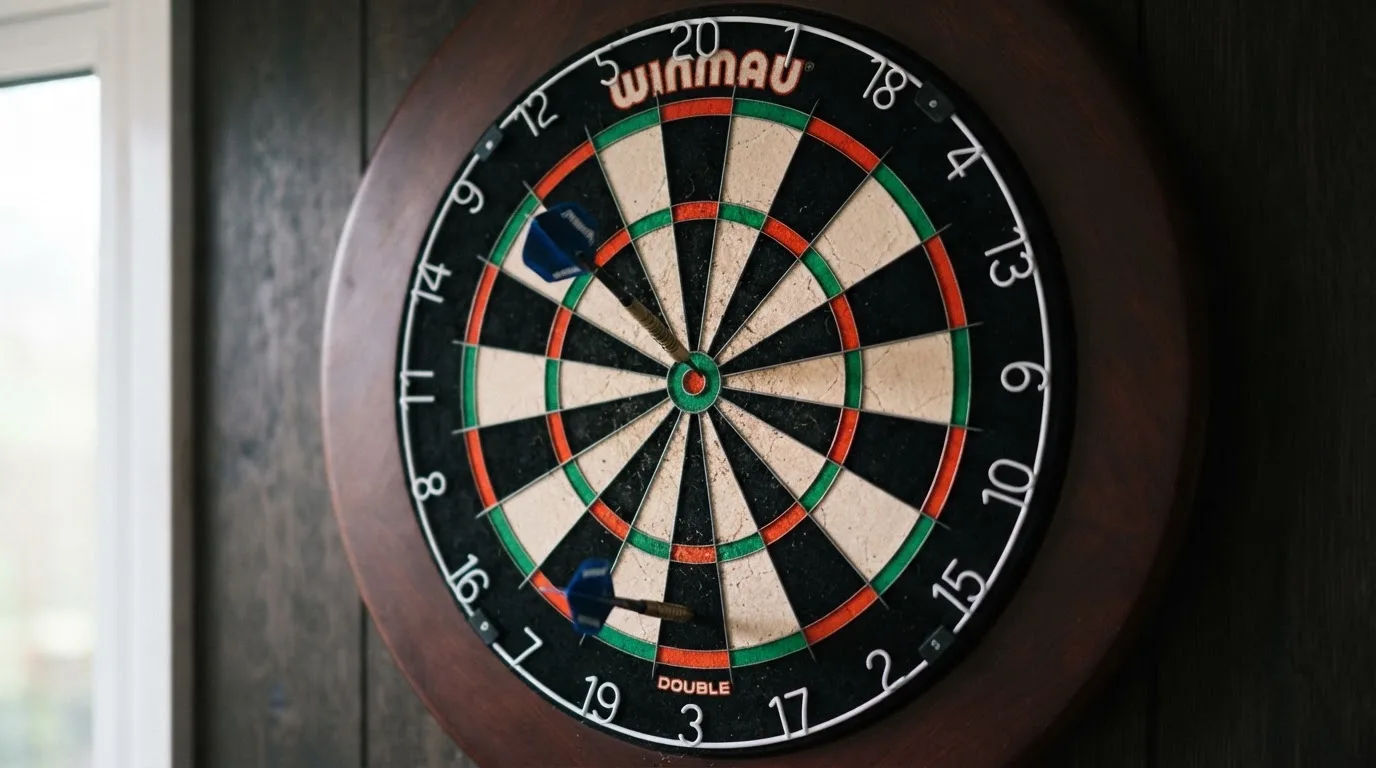
A single two-way market — a match between two players with no draw — illustrates the point cleanly. Take a match priced at 1.90 and 1.90 on each player. If those prices were truly “fair”, the implied probabilities would add to exactly 100%, the bookmaker’s cut would be zero, and every pound wagered would, on average, come back. They don’t. Each price of 1.90 implies a probability of 1 ÷ 1.90 = 0.5263, or 52.63%, so the two prices imply 105.26% in total. That extra 5.26% is the bookmaker’s margin — the slice of every pound staked that the book keeps, on average, before paying out winners. The fair share a punter can expect back is the reciprocal of that 105.26%, which is 95.0%. Put another way: out of every £100 wagered on that market, the book keeps roughly £5.26 and returns £94.74 to winners.
The same arithmetic explains why tighter prices — 1.85 instead of 1.90 — carry a larger margin, and why an outsider at 6.00 looks generous until the rest of the market is checked. A market with a margin below 5% is competitive for the betting market as a whole, where darts outrights in major championships tend to drift higher because the field is wide and prices are correlated. The single rule to carry forward is that the implied probabilities on every market should be summed; the gap above 100% is what the book keeps, and a smaller gap means more of every pound wagered comes back to winners.
The fixtures that fill a darts betting calendar
The PDC World Darts Championship is the centre of the year’s calendar. The 2026 championship ran from 11 December 2025 to 3 January 2026 at Alexandra Palace, London, with 128 players in the draw — up from 96 — and a prize fund of £5,000,000, of which £1,000,000 went to the winner. The final was a rout: Luke Littler beat Gian van Veen 7–1 in sets. The structure of the rounds is what shapes the outright market: rounds 1 and 2 were first to 3 sets, rounds 3 and 4 first to 4, quarter-finals first to 5, semi-finals first to 6, the final first to 7. That long tail is exactly why pre-tournament each-way terms on a deep run matter — a player does not need to win the title to make a punt pay.
Around the Worlds the PDC runs a year-long tour of televised events, with the Premier League Darts as the most prominent weekly showcase. The World Darts Federation runs its own calendar alongside, including the World Masters and the World Cup. Outright markets on these events open weeks in advance — “ante-post” — and prices shorten as the field narrows. Non-runner rules apply, and a withdrawal before the first game can return the stake or settle the bet at a Rule 4 deduction, depending on the bookmaker. The lesson is straightforward: ante-post prices look tempting, but a withdrawal changes the calculus, and reading the small print once is cheaper than finding out the hard way.
What kinds of bets you can place on a darts match
Match winner is the simplest market — pick the player, take the price. It settles when the match does, in sets or legs depending on the round. Most bookmakers also offer a 180s market: a 180 is the highest single visit in darts, three treble-20s, and the market is usually “most 180s” between two players, or “over/under” a total for a named player across the match. Handicap betting gives one player a leg or set head start on the betting line — van Vuelling might be priced as a one-set handicap at the Ally Pally, and the line is set so the two sides of the handicap trade close to evens. Correct score markets cover set-by-set scores at the bigger events.
In-play markets cover everything the pre-match markets cover, with prices moving leg by leg. A bookmaker with a strong in-play product — fast prices, a deep market, the option to cash out partway through a leg — gives a regular a very different experience than a book that simply takes the match winner and updates once a set. Cash out is offered by most of the brands reviewed below, and it is worth knowing how it works before relying on it: the cash-out figure is the bookmaker’s own valuation of the bet at that moment, not the “true” price of the position. A cash out at £45 on a bet that would pay £100 at full-time is not a 45% offer — it is the price at which the book is willing to close the position right now, and the gap between the cash-out figure and the live price is part of the in-play margin.
Bet Builder is the brand name most UK bookmakers use for the same-game multi: a single bet that combines several markets on one match — match winner, most 180s, total legs — at multiplied odds. The legs multiply into one price, the bet wins only if every leg wins, and the margin on a Bet Builder is typically higher than the margin on any single leg, because each leg carries its own cut and those cuts compound. That is the trade for the convenience of one stake on a tailored position. Accumulator insurance, where one leg can lose and the stake is returned as a free bet, is the partial answer to that compound margin — but it is a free bet, not cash, and the stake does not come back.
The price of the bookmaker’s edge, in one example
Take an illustrative two-way market priced at 1.90 and 1.90 — a deliberately even book, the kind a bookmaker might quote on a match expected to be close. The implied probability on each side is 52.63%, the two sides add to 105.26%, and the bookmaker’s margin is therefore in the region of 5%. The fair return to backers across many bets, before any individual outcome is known, is around 95p per £100 staked. That is the cost of the price — and on a market with a wider spread of prices, an outsider at 9.00 and a favourite at 1.20, the implied probabilities are 11.11% and 83.33%, which also add to 94.2% and therefore give a margin of 5.8%. Margins on darts outrights, with 128 players in the Worlds draw, tend to sit a few points higher because the field is wider and prices correlate — a long-shot withdrawal cascades through the book.
The practical consequence is that two markets on the same match can pay very different effective odds for the same nominal price. A 1.90 line is not always a 1.90 line; it depends on what sits beside it, and on what sits in the rest of the market on the same event. A punter who compares single-book prices without comparing the margin that surrounds them is reading the wrong column.
How live betting and cash out change the picture
Live darts betting has matured into one of the more interesting in-play products. Prices move leg by leg, sometimes within a visit, and a player who wins the first set in a first-to-seven final trades shorter than they did at the off. Most UK-licensed bookmakers now offer an in-play product on televised PDC events, and several offer a deeper one on the bigger tournaments. The mechanics are simple: the bet is placed against the live price, the market is suspended briefly while the bookmaker reprices, and the bet settles in the normal way at the end of the event.
Cash out is the second leg of the in-play product. It is the bookmaker’s offer to close the bet at a figure the book sets, before the event settles. The offer reflects the bookmaker’s view of the current probability of the bet landing — usually with a spread of its own — and the gap between the cash-out figure and the live price is part of the in-play margin. Cash out is not “free money”; it is the bookmaker taking the other side of your position at its price, with its margin inside it. For a regular in-play customer the question is whether the cash-out figure is reasonable relative to the live price and to the time remaining in the event. There is no formula; the comparison is the comparison.
Streaming is part of the in-play package at the bigger brands: live coverage of the World Championship, Premier League nights, the World Matchplay and the World Grand Prix, with markets updating underneath. A free-to-view stream is a real advantage over a book that requires a positive account balance to watch, and the depth of coverage is one of the ways the brands below separate from each other.
What a darts betting offer is actually worth
A welcome offer on a darts account typically takes one of three forms: a free bet credited after a qualifying wager, enhanced odds on a named market, or a deposit match that issues bonus funds. Each carries a different cost, and the cost is in the small print.
A free bet, in the UK market as it stands, does not return the stake with winnings. A £10 free bet at 3.00 returns £30 on a win — £20 profit, but the £10 stake stays with the bookmaker. That is the first thing to internalise. The value of a free bet, on average, is the free-bet amount times the price minus one, divided by the price, times the payout share of the market. Put plainly: at a price of 3.00 on a market with a 95% payout share, a £10 free bet is worth roughly £10 × (3.00 − 1) ÷ 3.00 × 95% = £6.33, on average. Lower prices reduce the average; higher prices increase it. The free bet is a real edge over placing your own cash at the same price, but it is not the headline figure the marketing copy suggests.
Wagering requirements turn a bonus into a question of how much betting it takes to clear it. The UK rule, in force since 19 January 2026, caps wagering requirements at 10x: a £10 bonus at 50x would have required £500 of qualifying bets before any withdrawal; under the cap, no more than £100 of qualifying bets are required. Even at 10x the rule is a tax on the punter’s time. Each qualifying bet is placed at a margin, and the cumulative cost of clearing the bonus is the required turnover times the market margin — the bookmaker’s expected cut on every pound of qualifying bets. A £10 bonus with 5x wagering on a market priced at 1.90 with a 5% margin costs roughly £50 × 5% = £2.50 in expected house edge before the bonus is cleared, and the punter ends with the bonus minus that expected cost, plus or minus whatever variance the betting produced.
Enhanced odds are the simplest offer, in mechanics: a named selection at a higher price than the standard market, usually settled as a free bet if it wins, sometimes as cash. The expected value is the same arithmetic as the free bet, with the larger price in the formula. A 25/1 enhanced price on a 20/1 shot, settled as cash, has a positive expected value of the price difference in cash; settled as a free bet, the value is roughly 80% of that difference.
What it costs to bet — deposits, limits and the rules a UK book follows
Every UK-licensed bookmaker verifies a customer’s name, address and date of birth before the first deposit. There is no anonymous play at a licensed site. The check happens at sign-up, before a deposit can be made or a free bet used. Source-of-funds questions at higher spend are normal under anti-money-laundering rules and are not, by themselves, a sign of trouble.
A credit card has not been a permitted deposit method for gambling in Great Britain since 14 April 2020, and that ban covers credit-card-funded e-wallet deposits. Debit cards, bank transfers and most e-wallets are unaffected. The deposit floor is set by each bookmaker: DAZN Bet, for example, accepts deposits from £5 by debit card, Apple Pay, Paysafecard, Trustly and Skrill, and from £20 by PayPal, with no fees charged for deposits. The maximum stake is the bookmaker’s call: there is no statutory cap on stakes in sports betting in Great Britain, and a bookmaker can restrict or close a customer’s account on its own terms.
The financial vulnerability check is a different mechanism. Since 21 April 2025, when a customer’s deposits minus withdrawals exceed £150 in a rolling 30 days, the operator runs a public-record check — for example, bankruptcy or county court judgments — before further deposits are accepted. It is not an income check and not a credit reference check; the published information is the input. The affordability checks that have appeared in the press sit in a separate, announced and staged plan with no start date as of this writing — write that they have been announced and have no published start date, not that they are in force. Deposit limits are the customer’s choice, with operators required to offer the tools to set them; there is no state-set deposit ceiling.
Where to get help, and what a self-exclusion covers
GAMSTOP is the UK national self-exclusion scheme, free to use and available to anyone who wants to bar themselves from every UK-licensed online operator at once. Periods are six months, one year, five years, or five years with auto-renewal, and after the minimum period the exclusion stays in place for a further seven years unless the customer asks GAMSTOP to remove it. GAMSTOP covers online sites and apps; betting shops use a separate in-shop process. Every UK-licensed remote bookmaker is a GAMSTOP member, which is the protection a licensed site offers that an unlicensed one does not.
The other side is support. GamCare runs the National Gambling Helpline; GambleAware funds treatment and research; the NHS runs gambling clinics across Great Britain; Gamblers Anonymous runs local meetings. Help is free and confidential. Several of the brands reviewed below link to these services from a footer or a safer-gambling page — a small sign, but a useful one when comparing accounts.
What “licensed in Great Britain” actually means
The Gambling Commission is the regulator. It licenses every commercial gambling operator in Great Britain (England, Scotland and Wales) under the Gambling Act 2005, and the public register is the test of who holds a licence. Since the Gambling (Licensing and Advertising) Act 2014, an operator whose remote facilities are used in Great Britain needs a Commission licence wherever it is based; a Curaçao, Maltese or Gibraltar licence does not substitute. A licence has a category, and the relevant one for an online sportsbook is “remote general betting standard (real events)”. A betting exchange adds “remote betting intermediary”. The Commission’s register can be searched by business name, trading name, domain or account number, and any brand that holds a GB remote licence appears on it.
A British punters who wants to check whether a brand holds a GB licence searches the public register. A matching licence number on the register is the answer; a brand’s own claim to be licensed is not enough, because the Commission’s requirement is for the licence to be in force against the trading name shown on the site, not for the brand to make the claim. The licence number alone is a number, not a confirmation; what confirms is the licence number sitting against the right licensee on the register.
A note on the alternatives. Unlicensed sites exist in this form — they are accessible from Great Britain, they are not licensed by the Commission, and a customer who uses them loses the Commission’s consumer-protection cover. There is no GAMSTOP coverage, no Commission complaints route, no approved dispute-resolution body, no British consumer redress if funds are withheld, and the operator is not bound by the 10x bonus cap or the £150 vulnerability check. None of that makes using an unlicensed site an offence aimed at the customer; the law targets the operator. The honest framing is that a licensed site means checks, limits and a complaints route, while an unlicensed site means none of those and the real possibility of loss of funds. Neither is the default “safe choice”.
| Brand | Gambling Commission remote licence number and licence holder | what the operator’s own terms state on the key’s subject |
|---|---|---|
| 10bet | 043173-R-322899-023 (Blue Star Planet Limited) | sports covering football, tennis, and horse racing with Cash out and Bet Builder |
| Sky Bet | 067370-R-341330-005 (SBG Sports Limited) | welcome offer with free bets valid for 30 days on singles and each-way markets |
| DragonBet | 064908-R-339041-003 (DragonBet Ltd) | app-focused with Welsh football, rugby, and American football markets |
| 888sport | 039028-R-319297-014 (888 UK Limited) | sportsbook template with daily boosted odds and BetFinder form tools |
| Fafabet | 057385-R-333191-006 (Taichi Tech Limited) | best odds guaranteed on UK and Irish horse racing from 9am |
| Star Sports | 009177-R-104555-019 (Star Racing Limited) | trader-led service with telephone betting available on 08000 521 321 |
| Coral | 054743-R-330863-014 (LC International Limited) | sports welcome offer with £40 in free bets for new customers |
| Betfair | 039439-R-319330-013 (PPB Counterparty Services Limited) | exchange betting alongside sportsbook with live streaming and 90 Minute Payout |
| DAZN Bet | 048756-R-327274-019 (DZBT Limited) | streaming-focused with a £5 minimum deposit for most payment methods |
| Kalooki Sportsbook | 057730-R-333396-005 (Kalooki Sportsbook Limited) | focused sportsbook with integrated safer-gambling tools |
The ten brands below all hold a Gambling Commission remote licence for betting on real events in Great Britain. They are presented in that order and reviewed on their own terms, not on a single ranking. Each block closes with a verdict on who the brand suits.
1. 10bet — broad sportsbook with the modern feature set
10bet’s sportsbook covers football, tennis and horse racing alongside a wider programme, and the live product carries Cash Out, Bet Builder and Live Streaming on selected events. The licence on the Commission’s public register is held by Blue Star Planet Limited under account 43173, with categories including remote general betting standard (real events). The site’s own coverage is the modern multi-feature layout: a single account lets a regular move from a pre-match treble to a Bet Builder to an in-play single without changing platforms. Deposits and withdrawals follow the standard UK bookmaker model, with debit cards, bank transfers and the usual e-wallets.
For darts specifically the depth of the outright markets at the major championships and the in-play product on Premier League nights is what carries the day, and 10bet’s wider sportsbook is the strength for a punter who splits their action across sports. The brand suits the regular who wants one app for everything; it is not the specialist darts shop.
2. Sky Bet — the clean welcome and the tight free-bet rules
Sky Bet’s sports welcome is the £20-in, get-the-free-bets model, with a free-bet stack issued after the qualifying wager. The small print is worth more than the headline: the free bets expire 30 days after crediting, are limited to single or each-way markets (multiples are excluded), and virtuals are out. The free bet is non-withdrawable, and the stake does not return with winnings — so a £10 free bet at 3.00 returns £30 on a win, with the £10 stake staying with the bookmaker. The licence is held by SBG Sports Limited under account 67370.
For a darts punter the Sky Bet product is solid: a deep Premier League and Worlds offering, a straightforward in-play product, and a single or each-way restriction on free bets that nudges the punter towards singles rather than accas. The brand is an efficient home for singles and accumulators, though fans of complex builders might seek more depth.
3. DragonBet — Welsh roots, with the modern in-play set
DragonBet’s app is published by DragonBet Ltd and the brand pitches itself around Welsh football and rugby, with horse racing, American football, in-play betting and a bet builder sitting alongside. The licence is held by DragonBet Ltd under account 64908. The product is the modern in-play layout, with prices moving leg by leg on the bigger televised darts events.
For a darts punter the angle is the bet builder combined with the in-play product and the racing coverage. The regional focus gives it a unique character, though international darts enthusiasts may prefer a site with a broader global spread.
4. 888sport — the standard feature set with the racing angle
888sport’s offering is the modern sportsbook template: pre-match and in-play betting, Cash Out, Bet Builder, racing streams, BetFinder form tools, a live bet feed and daily boosted odds. The licence is held by 888 UK Limited under account 39028. The boosted-odds feed is the small daily angle, and the racing streams are the racing angle.
For darts the brand’s draw is the boosted odds and the live bet feed; the in-play product is solid on the bigger events. The daily boost and live feed make it a reliable companion for a regular evening of darts, provided the punter doesn’t require niche outright markets.
5. Fafabet — best odds guaranteed on UK and Irish racing
Fafabet’s standout term is Best Odds Guaranteed on UK and Irish horse racing: from 9am on race days, if the starting price (SP) is bigger than the price taken at the time of the bet, the bigger price is paid. The licence is held by Taichi Tech Limited under account 57385. The wider sportsbook is a smaller-house product with the usual deposit and withdrawal set.
For a darts punter, BOG on racing is irrelevant; for a punter who splits action between racing and darts, the racing term is the differentiator. The racing-first focus makes it a specific choice; for a pure darts specialist, other platforms offer a more expansive outright menu.
6. Star Sports — the phone-first service
Star Sports offers a service rare among modern UK bookmakers: customers can speak to a trader on 08000 521 321 to open an account, place bets or ask queries, with email support at [email protected] alongside. The licence is held by Star Racing Limited under account 9177, and the brand runs as a smaller, trader-led bookmaker with the standard online product underneath.
For darts the listing carries what the published sources describe — the brand’s online product covers the televised PDC calendar. The phone service is the angle for a punter who wants a human on the other end of the line for a big ante-post bet or a market that the site does not price. The personal service remains its strongest differentiator, offering a human touch that the app-only giants cannot replicate.
7. Coral — the £20-in, £40-back welcome on a major brand
Coral’s sports welcome offer is the cleanest in the market: “Get £40 in Free Bets when you bet £20”. The terms are a deposit and a sports bet of £20 or more at minimum odds of 2.0 (1/1), with £40 in free bets issued within 7 days of the qualifying bet settling and expiring 7 days after issue, for new GB customers who opt in. The licence is held by LC International Limited under account 54743, with categories including remote general betting standard (real events) and remote betting intermediary.
For a darts punter the brand carries the depth of a major bookmaker — full outright coverage on the PDC calendar, an in-play product, a bet builder, and the platform’s existing scale. Coral and Ladbrokes run under the same licensee (LC International Limited), which is worth knowing if a punter holds an account at both. The brand suits a regular who wants the major-bookmaker depth with the standard welcome; it is less ideal for the punter who wants a high-value bonus, as the offer structure is free bets with non-returned stakes.
8. Betfair — exchange depth plus sportsbook features
Betfair’s sportsbook offers in-play betting, Bet Builder, free live streaming of events such as UK and Irish horse racing and football within the app, and a 90 Minute Payout market on football (stake returned if the backed team goes 2-0 up). The licence is held by PPB Counterparty Services Limited under account 39439, and Betfair’s exchange sits alongside the sportsbook under the wider PPB group; the exchange uses the betting intermediary licence category.
For darts, the sportsbook carries the usual pre-match and in-play set on the televised events, and the exchange is the deeper market for a punter who wants to lay or trade positions rather than back them. The exchange depth is a distinct tool for the active trader, distinguishing it from the straightforward sportsbook-only competition.
9. DAZN Bet — the streaming tie-in and the £5 deposit floor
DAZN Bet’s deposit floor is on the accessible end: £5 by debit card, Apple Pay, Paysafecard, Trustly and Skrill, and £20 by PayPal, with no fees charged for deposits. The licence is held by DZBT Limited under account 48756, and the brand sits alongside DAZN’s streaming product. The sportsbook is the standard in-play and bet builder set on the bigger televised events.
For a darts punter, the DAZN tie-in is the angle: a streaming-first product with the sportsbook built underneath. The £5 deposit floor is the accessibility angle for a punter who wants a low minimum on the account. The stream-integration is a clear value-add for the regular viewer, prioritizing convenience over the most granular market selection.
10. Kalooki Sportsbook — the focused book with the modern checks
Kalooki Sportsbook is operated by Kalooki Sports Book Ltd (company number 12938274), licensed by the Gambling Commission under account 57730, and is a GAMSTOP member. The product is a focused sportsbook with the standard identity and source-of-funds checks before the first deposit. The licence is held by Kalooki Sportsbook Limited.
For a darts punter, the brand is a smaller, focused alternative to the mega-brands, with the modern player-protection suite attached. The brand suits a punter who wants a smaller-house product and the standard safer-gambling tools; it is less suited to a punter who wants the depth of a major bookmaker on the PDC calendar.
Putting the price of an offer to work — a worked example
Suppose a £20 deposit triggers a £20 free bet, with a 5x wagering requirement on the bonus at minimum odds of 1.80, on a market with a 5% margin. The required turnover is £20 × 5 = £100. At an average stake of £5 per bet, that is 20 bets at a minimum price of 1.80. The market margin of 5% means the bookmaker keeps roughly £5 of every £100 of qualifying bets in expected house edge; over £100 of qualifying bets the expected cost of clearing is around £5, before any outcome is known. The free bet, used at a price of 3.00 on a market with a 95% payout share, has an expected value of about £20 × (3.00 − 1) ÷ 3.00 × 95% = £12.67, on average. The arithmetic, taken together, is the bonus’s expected value minus the expected cost of clearing, minus whatever edge the punter has on the qualifying market — a number that ends close to single-digit pounds in most realistic scenarios. The free bet is real money; it is not the headline figure.
What a serious regular actually checks before opening an account
Three things separate the brands on this page from each other in practice, beyond the welcome.
The first is the in-play product. A bookmaker with a deep in-play set on the televised PDC events — match winner, most 180s, next set, race to three legs, handicap lines moving leg by leg — gives a regular a very different experience than a book that simply takes the match winner and updates once a set. The depth of the in-play product is the single biggest separator between the brands reviewed above.
The second is the bet builder and the accumulator angle. Most modern UK bookmakers offer a bet builder on darts matches, and the question is whether the legs multiply into a competitive combined price and whether the bonus offers (acca insurance, winnings boosts, bet boosts) work on the bet builder as well as on standard singles. The brands that integrate the bet builder with the bonus offers — bet builder + acca insurance at the same brand — are the brands where the regular spends most of their action.
The third is the payout speed and the deposit set. A withdrawal that arrives the same day is a different product from one that takes three working days, and the deposit set — debit cards, bank transfers, PayPal, Apple Pay, Trustly, Skrill, Paysafecard — matters for a punter who wants a particular method. None of these is a separator by itself; together they are the small differences that decide which account a regular keeps open and which they leave to gather dust.
A short list of practical checks before a bet goes on
- The price is decimal; the implied probability on every market sums to more than 100%; the gap is the bookmaker’s margin. A smaller gap means more of every pound staked comes back to winners.
- A free bet does not return the stake with winnings. A £10 free bet at 3.00 returns £30 on a win, with the £10 stake staying with the bookmaker. The expected value is in the small print, not the headline.
- A wagering requirement is a tax on the punter’s time. The UK cap is 10x. The expected cost of clearing a bonus is the required turnover times the market margin. Read the small print once, before the qualifying bets start.
- A cash-out figure is the bookmaker’s price, not the “true” price of the position. The gap between the cash-out figure and the live price is part of the in-play margin.
- An ante-post bet on a darts outright can return the stake or settle at a Rule 4 deduction if a player withdraws before the first game. The bookmaker’s terms govern.
- A UK-licensed bookmaker verifies name, address and date of birth before the first deposit. A credit card is not a permitted deposit method. The financial vulnerability check applies at £150 of net deposits in a rolling 30 days.
Frequently asked questions
How do I bet on darts?
Open an account with a UK-licensed operator, navigate to the darts schedule, choose a market — match winner, most 180s, handicap, outright — and place a stake at the price displayed. The bet settles when the event does, and the return is the stake times the decimal price; the profit is the return minus the stake. A free bet does not return the stake with winnings.
What is darts betting?
Darts betting is the practice of placing a stake against a price on the outcome of a darts event — a match, a tournament, a specific market within a match (most 180s, total legs, correct score). The sport itself is straightforward: 501 darts starts at 501 and finishes on a double or the bullseye, and a standard dartboard has 20 numbered segments with single, double and treble areas, a bullseye worth 50 and an outer bull worth 25.
How does darts handicap betting work?
A handicap gives one player a leg or set head start on the betting line — for example, the favourite starts a best-of-13 at -2.5 legs, the outsider at +2.5. The handicap is added to (or subtracted from) the actual score, and the bet settles on the adjusted total. The price on each side reflects the handicap and the bookmaker’s margin, and the two sides of the line trade close to evens on a competitive handicap.
How do I check that a bookmaker holds a Gambling Commission licence?
Search the Gambling Commission’s public register by business name, trading name, domain or account number. A matching licence entry is the confirmation; a brand’s own claim to be licensed is not, on its own, sufficient. The relevant category for a sportsbook is “remote general betting standard (real events)”; an exchange adds “remote betting intermediary”. The register is the test.
How is the return on a bet worked out from the stake and the odds?
In decimal odds, the return is the stake times the price — a £10 stake at 1.90 returns £19, made up of the £10 stake plus £9 of profit. Fractional odds of 5/1 (a five-unit profit per one-unit stake) convert to a decimal price of 6.00: £10 × 6.00 = £60. For a combination bet the odds of the legs multiply into one price, and the return is the stake times the combined price.
What is the bookmaker’s margin, and how can I see it in the odds?
The bookmaker’s margin is the slice of every pound wagered that the book keeps, before paying out winners. To see it, convert each price to its implied probability (1 ÷ price), sum the implied probabilities across all outcomes of one market, and subtract 100%. A market priced at 1.90 and 1.90 sums to 105.26%, so the overround is 5.26%; the fair return to backers is roughly 95.0%, and the margin is 5.0%. A smaller margin means a more competitive price for the punter.
Tennis, darts & cue sports – Grey Hound
Content created by the «Grey Hound» team
