
Gaelic football betting odds — the markets, the margin and the licensed UK shortlist
 Available in US
Gaelic football sits in a narrow corner of the British betting market. The Championship runs from late spring into July, fixtures bunch around weekends, and most Saturdays in the calendar offer something to back. Outside the inter-county season, club championships keep a smaller schedule alive. The market that prices it is the same one that prices football, horse racing and tennis: a dozen-and-change licensed operators, each with its own odds compilers, each running its own markets on a sport that the Gambling Commission does not separately regulate. The number that decides what a winning bet pays, the margin that decides what the operator keeps, and the licence status of the brand you place it with — those are the three things this page works through.

Current as of 27 October 2026 against the Gambling Commission’s public register of remote betting licence holders.
Live betting and cash out on Gaelic football
In-play markets on Gaelic football exist, but they are thinner than the pre-match menu. Most GB-licensed bookmakers that carry the sport offer a live 1X2-style market (home win, draw, away win) on All-Ireland Championship fixtures, plus next-score markets during big games. The cause is structural rather than commercial: matches are short (two 35-minute halves at senior inter-county level), the scoring is unusual (a goal worth three points, a point worth one), and the books that price it are pricing a sport most of their customers never bet on. Liquidity is lower than for football or tennis, so the live book is shallower and the margin is usually wider than the pre-match price on the same fixture.

Cash out is the lever that lets a bettor close a position before the final whistle. On Gaelic football it sits inside the same product as on any other sport: a button on the bet slip that returns a live value based on what the price would be if the bookmaker re-laid the bet right now. The value offered is a function of the operator’s own live book — which is why a bettor on a thin market gets a worse cash-out figure than a bettor on a liquid one. The product is real; the price it offers on Gaelic football is usually a percentage point or two behind what the same operator would offer on a Premier League match of the same stake. Read it as a convenience, not as a price the operator is paying you to use.
Auto cash out is the same feature with a trigger pre-set by the bettor (close if the live value crosses a chosen number). Sporting Index is one of the featured brands that explicitly carries it on football alongside its Multi-Markets and Bet Builder products. Bet Builder products — the same-game-multi style tools that let a customer combine markets from one fixture — show up at the bigger brands on football generally; on Gaelic football specifically the coverage narrows to the brand’s appetite for the sport rather than the technology.
A cash out button on Gaelic football is, in practice, a thin-market signal: the operator is willing to lay off your position in real time on a sport where its book is short. Where the live market is deep, the cash-out number sits close to the true fair value of the position. Where the live market is just two or three price ticks, the cash-out number sits wider of fair, and the button is offered because the operator is reducing its own exposure rather than because it is offering the bettor a good deal.
Betting tips and strategy on Gaelic football
Anyone selling a betting tip on Gaelic football is selling a forecast. Treat it that way. The Championship is small enough that form, team news, venue and weather carry a heavier share of the price than they do in a deep, liquid league — but the same problem applies that applies to every other sport: no publicly available information lets a bettor predict outcomes more accurately than the price the bookmaker is already quoting, because the bookmaker’s odds are themselves built from the same pool of public information plus a margin.
The strategies that actually work on a sport like this are the dull ones. Staking discipline: a fixed unit of bankroll per bet, never larger than the bookmaker’s stake limit on the event. Price discipline: only bet when the price is better than the true probability you estimate, which usually means a price the operator has moved through injury news, weather news, or simply a thin market at the start of the week. Market discipline: most Gaelic football markets at most UK bookmakers are 1X2 with a goal-scored handicap layered on top, plus a small selection of totals — there is no scope for the kind of market-shopping strategy that makes football betting systems work, because the menu is too short.
Bankroll management matters more than picking. A bettor who backs ten teams at an estimated 40% probability at a price of 2.50 (3/2-1) is paying the bookmaker a margin on every bet. The expected return on those ten bets is ten times the average price, less the margin the operator is taking — and on Gaelic football that margin is wider than on Premier League football. The discipline is the size of the stake relative to the bank, not the size of the bank.
A tipping service is a paid forecaster. Some are good. None are reliable. The price the tipster charges has to come out of the same edge that the bettor’s own reading of the form has to produce. On a small-market sport with a wide bookmaker margin, that edge is the hardest place in the betting world to find.
Bet types and how Gaelic football odds work
The core bet on a Gaelic football fixture is a 1X2 match result: home win, draw, or away win. Draws are common enough in the sport — particularly in tighter county matches — that the draw sits at a usable price more often than it does in association football. On top of that, GB bookmakers typically offer a small set of additional markets: a handicap line (often framed in points, since the scoring is points-based), totals on the combined score, and a “winning margin” market framed either in points or in goals-plus-points.
A “goal” in Gaelic football is the ball going under the crossbar and into the net, worth three points. A “point” is the ball going over the crossbar, worth one point. So a final score of 1-20 reads as one goal and twenty points: 23 points in total, of which three came from the goal. Since the 2025 rule changes, a shot from outside the new 40-metre arc is worth two points (a two-pointer), which means a single score event can be worth one, two or three points depending on where the ball was struck from and whether it went under or over the bar. The point totals are what the betting markets use; the goal-and-point count is what the GAA’s own scoreboards show. A reader who has never watched the sport should know that “1-20” does not mean one goal and twenty points scored by the same side — it means the team has scored one goal and twenty points in total.
The mechanics of an odds price are the same regardless of sport. A decimal price of 2.00 (evens) means a winning £10 bet returns £20: £10 of original stake, £10 of profit. A fractional price of 5/1 means a winning £10 bet returns £60: £10 stake, £50 profit. The two notations describe the same price; decimal is the form used by every UK-licensed online bookmaker for live markets, fractional is the form the same operators display alongside (because fractional is the convention British bettors have always read).
To convert fractional to decimal, divide the first number by the second and add one: 5/1 → 5 ÷ 1 + 1 = 6.00; 11/4 → 11 ÷ 4 + 1 = 2.75. The arithmetic is the same in both directions. A “shorter” price (one with a smaller potential return than the stake) is “odds-on”: 4/6 is odds-on because a winning £6 bet returns £10 (£6 stake, £4 profit). A “longer” price is “odds-against”: 5/2 is odds-against because the profit exceeds the stake.
The market margin — the share of every pound bet that the operator keeps, on average, across all outcomes — sits inside every price the bookmaker offers. The way to see it is to take the implied probabilities from every price in a single market and add them up. A two-way market priced 1.90 / 1.90 (9/10 the each way and 9/10 the other way) implies 52.6% on each outcome; add them together and you get 105.3%. The extra 5.3 percentage points is the margin, expressed as the overround — the percentage by which the implied probabilities exceed 100%. On Gaelic football at smaller fixtures, that overround is typically wider than on Premier League football at the same operator, because the book is thinner and the prices are set with less competition behind them. The reader of a price list who wants to know what the book costs reads it there.
Gaelic games, fixtures and tournament structure
Gaelic football is governed by the Gaelic Athletic Association (GAA), the sporting body that runs both Gaelic football and hurling across Ireland and globally. The senior inter-county championship is the All-Ireland Senior Football Championship: a provincial stage (the four provinces of Ireland each run their own knockout or round-robin), then a Super 8-style qualifier round, then the All-Ireland semi-finals and final at Croke Park in Dublin. The 2026 final was played on 26 July 2026 at Croke Park, with Mayo beating Kerry 1-20 to 1-17 — a fourth All-Ireland win for Mayo, and a defeat for Kerry, who hold the record for the most All-Ireland Senior Football Championship titles at 39.
The match itself: two teams of fifteen players each, on a rectangular grass pitch between 130 and 145 metres long and between 80 and 90 metres wide. Up to fifteen substitutes may be named on a matchday panel, of whom six may be used during the game. Senior inter-county matches last seventy minutes — two halves of thirty-five minutes each — and most other adult matches run for sixty minutes (two halves of thirty). Hurling follows the same panel-and-substitution rules; the difference between the two sports is the handling of the ball (the stick, the hurley, is used in hurling; in football the ball is handled and foot-passed within the rules of the sport).
The betting calendar that runs alongside the GAA’s own is, in practice, May to August. Pre-match markets start to firm up on the Wednesday before a Championship weekend; in-play markets open when the ball is thrown in. Outside the inter-county season, club championships and a sprinkling of exhibition fixtures keep a small amount of live coverage in the books, and the bigger UK operators carry the major games with the same menu they would carry a smaller football match. The sport is small enough that one or two markets per fixture is normal, and large enough that the All-Ireland final is priced across the whole UK licensed market as a tier-one event.
Kerry, Mayo, Dublin, Tyrone, Galway, Donegal and Armagh are the counties whose Championship fixtures attract the deepest books. A reader who has never bet on the sport should treat the early-season provincial rounds as a different market from the All-Ireland final itself: the price at a Roscommon vs Sligo Connacht quarter-final sits at a wider margin than the price at the All-Ireland semi-final, because fewer bookmakers have priced it and the prices that have been set have been set with less competition behind them.
Top 10 UK-licensed bookmakers for Gaelic football
The table below lists ten brands licensed by the Gambling Commission to take remote bets from customers in Great Britain, ordered as the editorial shortlist for Gaelic football. “Licensed” here means a current entry on the Commission’s public register under one of the categories of remote betting standard real event or live betting intermediary; it does not mean any brand has a special relationship to Gaelic football in particular. The relevant product for this page — Gaelic football odds — sits inside each brand’s wider sportsbook; whether the brand carries the sport at all, and how deep the market goes, varies. The licence number is the licence the register shows against the operator’s GB-facing brand or trading name, with the licence holder named.
| Brand | Gambling Commission remote licence (account number and licence holder) | What the operator’s own terms state on the page’s subject |
|---|---|---|
| Ladbrokes | 54743, held by LC International Limited | Sports Betting App published by Entain Operations Limited; rated 4.66 across 101,255 GB App Store ratings |
| Paddy Power | 39439, held by PPB Counterparty Services Limited | Sports Betting app published by Paddy Power PLC; covers football, horse racing, boxing, rugby, tennis, golf, darts, snooker and F1 |
| DAZN Bet | 48756, held by DZBT Limited | Deposits from £5 by debit card, Apple Pay, Paysafecard, Trustly and Skrill; £20 minimum on PayPal; no processing fees |
| BetUK | 39198, held by LeoVegas Gaming PLC | New customers depositing £10+ and placing a sports bet within 7 days receive four £10 free bets — two football accumulators of four or more selections, two multiples of two or more, valid 7 days, opt-in required |
| Sporting Index | 27343, held by Sporting Index Limited | Lets customers switch between fixed odds and spread betting; in-play betting, Bet Builder for football, auto cash-out, Multi-Markets |
| BoyleSports | 39469, held by Boylesports Enterprise | Sports welcome offer for UK players: £20 in free bets on a £10 qualifying bet (£30 in free bets for a €10 bet for Irish players) |
| Lottoland | 38991, held by EU Lotto Limited | App combines casino, lottery betting, sports betting and scratchcards; states it is licensed by the Gambling Commission for customers in Great Britain |
| Octobet | 62545, held by Octopus Game Limited | Sportsbook welcome offer: 50% back as a free bet up to £50, plus a £10 casino bonus for new customers |
| Kwiff | 44448, held by Eaton Gate Gaming Limited | Licensed by the UK Gambling Commission; described as a trademark operated by Spryme Ltd; app has a 17+ App Store age rating |
| Betboro | 44181, held by Webmedia Development N.V. | Sports welcome offer: 100% matched free bet up to £25 on first qualifying wager; debit-card deposit of £10+; first bet £5–£25 on three or more selections each at 3/5 (1.60) or higher |
A licence confirms that the operator is permitted to take bets from customers in Great Britain. It does not confirm that the operator carries Gaelic football; it does not confirm that the operator offers better prices than any other licensed brand; and it does not give the operator any authority to set the price on a market — the price is the operator’s commercial call, not a regulatory one. The decision on which bookmaker to use for Gaelic football sits inside the same criteria as the decision for any other sport: depth of market, margin on the prices offered, settlement speed, in-play coverage, and the standard of the welcome offer if there is one.
The welcome offers on the list above are deposit-gated. They are described in the document’s own facts as each operator’s own terms state them: free bets whose stake is not returned with a win, free bets valid for a stated number of days, minimum-price qualifiers on the bets that unlock the free bets. The fact that a brand offers a welcome package is not, in itself, a reason to pick it. The reason to pick it is whether the depth of its Gaelic football book, the margin on its prices and the speed of its settlement match the bettor’s needs.
The fundamentals of betting on Gaelic football
Gaelic football is a sport played by two teams of fifteen on a grass pitch. The basic unit of scoring is the point: a ball kicked or fisted over the crossbar and between the uprights scores one point. A goal — the ball going under the crossbar into the net — scores three points and is, in scoring terms, the equivalent of three separate points kicked over the bar. Since 2025, a shot struck from outside the new 40-metre arc is worth two points (a two-pointer), giving the scoring a fourth tier: a 1, a 2 or a 3 from a single shot, depending on the foot-strike position and whether the ball goes under or over the bar.
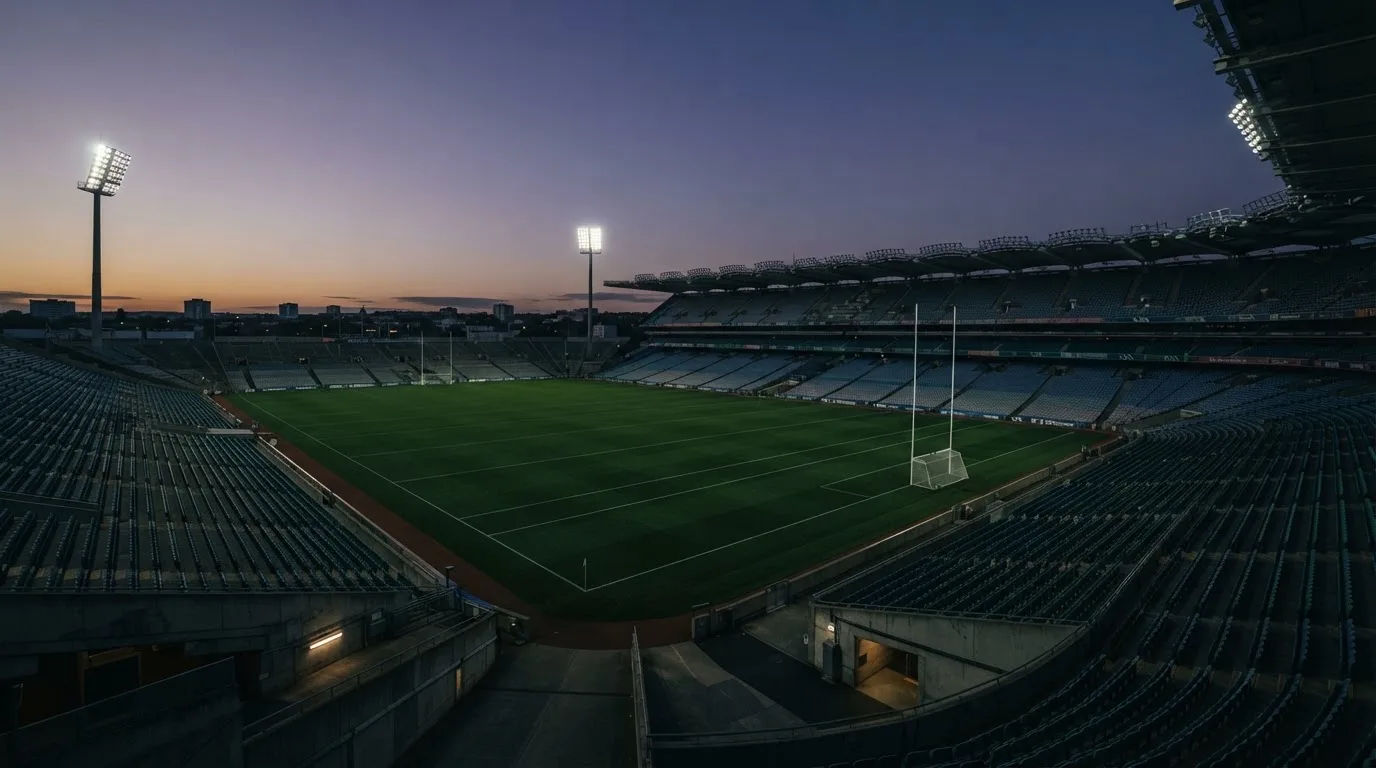
The senior inter-county game lasts seventy minutes: two halves of thirty-five. Most adult club matches run for sixty minutes: two halves of thirty. Each team may name up to fifteen substitutes, of whom six may be used. The Championship calendar runs from late spring through July, with the All-Ireland final at Croke Park as the season’s end point. Outside that window, club fixtures keep the sport alive in the calendars of the bigger UK operators but rarely attract deep pre-match markets.
The fundamentals matter to a bettor because the betting menu is shaped by them. A sport with a low-scoring, drawn-friendly profile rewards 1X2 betting and modest handicap lines; the kind of half-time / full-time markets that work in association football are less reliable in Gaelic football because the scoring pattern does not match. A sport with a small fixture list and a short calendar concentrates the betting volume on a handful of weekends, which concentrates the bookmaker’s pricing effort on the same handful of fixtures — and leaves the rest of the calendar with thin markets and wide margins.
The GAA, the sporting body that governs Gaelic football and hurling, runs the sport under rules that make betting on it smaller in scale than betting on football, tennis or horse racing. There is no English Premier League equivalent in Gaelic football. There is no live televised league weekend every week of the season. There is, instead, a concentrated inter-county championship that most casual sports fans never see, plus a sprawling club championship that almost no one outside Ireland follows. The betting market on the sport reflects that. It is real, it is licensed, it is priced — and it is small.
How UK bookmakers are licensed to take bets on Gaelic football
The licensing regime for betting in Great Britain runs through the Gambling Commission (UKGC), the non-departmental public body that licenses commercial gambling under the Gambling Act 2005. Northern Ireland sits outside the 2005 Act and runs under its own older legislation; a bookmaker licensed by the Commission is licensed to take bets from customers in Great Britain (England, Scotland and Wales) — not from customers in Northern Ireland. Since the Gambling (Licensing and Advertising) Act 2014, an operator whose remote facilities are used in Great Britain needs a Gambling Commission licence wherever the operator itself is based; a Curaçao, Maltese or Gibraltar licence is not a substitute.
The relevant licence for an online sportsbook is a remote general betting standard (real events) licence, listed against the operator on the Commission’s public register. The register is searchable by business name, trading name, domain or account number. It is the whole test of whether a brand holds a GB licence. The licence categories relevant to sports betting are: remote general betting standard (real events), remote general betting standard (virtual events), remote general betting limited, remote pool betting, and remote betting intermediary (the licence for betting exchanges). A bookmaker offering Gaelic football markets is operating under one of these categories; none of them is specific to Gaelic football, because there is no statutory list of permitted sports or markets in the regime.
There is no state monopoly and no cap on the number of licences. The register has more entries than any article can name, and the Commission’s licensing decisions run in the hundreds. A brand’s presence on the register is a necessary condition for taking bets from customers in Great Britain; it is not, in itself, a recommendation. Each licence holder is responsible for its own product, its own marketing, its own customer due diligence and its own conduct under the Commission’s Licence Conditions and Codes of Practice (LCCP).
To check whether a brand holds a licence, search the Commission’s public register at its official address by the brand’s trading name, the licence-holder company’s name or the domain the brand uses. The register’s record will show the licence categories the holder is licensed for, the trading names the licence covers, the status of the licence (active, suspended, revoked) and the date of the next licence review. A licence number that does not appear on the register, or that appears against a different company, is not the licence that brand is operating under.
The bookmakers in this article’s shortlist are all licensed under the regime described above. None is the “only” licensed brand; each is one of many. The list is the editorial shortlist, not a regulatory ranking.
Player protection on licensed UK betting sites
The British licensed betting regime is built around a set of player-protection duties that an unlicensed offshore operator is not bound by. The four mechanisms a bettor should know about are GAMSTOP, financial vulnerability checks, deposit limits, and the routes to help when gambling stops being fun.
GAMSTOP is the national multi-operator online self-exclusion scheme, and a mandatory licence condition for online operators since 31 March 2020. A customer registering with GAMSTOP is excluded from every GB-licensed online operator for a chosen period — six months, one year, five years, or five years with auto-renewal. After the minimum period, the exclusion stays in place for a further seven years unless the customer asks GAMSTOP to remove it. GAMSTOP covers online sites and apps; the betting shops use a separate offline self-exclusion service. Every GB-licensed online operator takes part.
Financial vulnerability checks (LCCP condition 3.4.4, in force since 30 August 2024) apply to licensed remote betting when a customer’s deposits minus withdrawals exceed £150 in a rolling 30-day window (since 28 February 2025). The check is a public-record check — for example bankruptcy or county court judgments — not an income check and not a credit-reference check. The operator runs the check; the customer’s stake is paused while the check is running. A separate strand of “financial risk assessments” (the affordability checks of the press) has been announced by the Commission in a staged plan (Commission article of 7 July 2026) with no start date yet.
Deposit limits: every GB-licensed operator must offer a customer-set gross deposit limit on a fixed time frame. The first changes took effect on 31 October 2025; a second phase was postponed to 30 September 2026, and whether it is live is not established as a single cut-off date. There is no state-set deposit or loss ceiling: any cap is the customer’s choice.
Help routes: GamCare runs the National Gambling Helpline; GambleAware funds treatment and research; the NHS runs gambling clinics in several regions; Gamblers Anonymous runs peer-support meetings. The licensed operators in this article’s shortlist signpost these services from their safer-gambling pages — that signposting is a licence condition, not a marketing choice. Fitzwilliam Sports’ site, for instance, links directly to GambleAware, GAMSTOP and Gamblers Anonymous.
The credit-card ban (LCCP condition 6.1.2, in force since 14 April 2020) closes one route into gambling: no credit card may be used to fund a betting account at a GB-licensed operator, and a credit-card-funded e-wallet deposit is treated the same way. Debit cards and bank-based payments are not covered by the ban.
The combination is what makes the licensed market a different proposition from an unlicensed one. Identity verification before the first deposit (in force since 7 May 2019) means there is no anonymous play at a licensed site. The £150 vulnerability check at the second month of continuous play means the operator is checking the customer’s public financial record at a defined threshold. GAMSTOP means a customer who has asked to be excluded is excluded across the whole licensed market. None of these is the bettor’s choice — each is the operator’s duty. A bettor who wants anonymity, no checks, and unlimited deposits is, by definition, not looking for a GB-licensed operator.
Crypto and anonymity at Gaelic football betting sites
A bettor who wants to deposit in bitcoin or another cryptocurrency is, with one narrow exception, not looking at a GB-licensed operator. The Commission’s regime requires identity verification before a customer’s first deposit or bet, including with a free bet or bonus (in force since 7 May 2019): name, address and date of birth must be confirmed before the account can fund. There is no anonymous play at a licensed site, and a cryptocurrency deposit does not change that — the verification still has to happen before the deposit lands, and the operator’s KYC and anti-money-laundering obligations run on the deposit regardless of the rail it arrived on.
The “narrow exception” is this: a small number of operators in the wider online gambling market offer crypto rails (Bitcoin, Ethereum, stablecoins), and a smaller number of those offer sportsbooks that carry Gaelic football. None of those operators are on the Commission’s public register. A bettor using one is using an unlicensed site, which means: no GAMSTOP coverage, no Commission complaints route, no approved alternative dispute resolution, no British consumer redress if funds are withheld, no £150 financial-vulnerability check, no operator obligation to honour the 10x bonus cap that applies to licensed marketing, and no guarantee that the operator will pay out at all.
The framing the regulator itself uses — and the framing the Commission has signalled in successive enforcement actions — is that the unlicensed site offers none of the protections the licensed site is bound by. The licensed site does not offer anonymity; the unlicensed site offers no recourse. Neither is “the safe choice” by default. The choice is between verification and recourse (licensed) and pseudonymity and exposure (unlicensed).
The crypto-specific risk is the rail, not the currency. A bitcoin deposit that lands in a regulated e-money account and is paid out in sterling is not, in itself, problematic. A bitcoin deposit that bypasses every regulated rail in the chain is, in itself, the unregulated deposit the Commission’s regime exists to police. A bettor who wants crypto because the operator accepts it should ask whether the operator is licensed; a bettor who wants crypto because the deposit will be anonymous at the betting site will not find that at a GB-licensed operator, and should be aware that the offshore site offering it is offering no recourse when it does not pay out.
Bonuses, free bets and wagering requirements
The free bets in this article’s shortlist sit in a specific shape: a deposit-gated offer, an opt-in, a qualifying bet at or above a stated minimum, and a free-bet payout subject to a stated expiry. The pattern across the ten brands is uniform enough to be worth reading as one product rather than ten. BetUK’s offer: four £10 free bets after a £10+ deposit and a qualifying sports bet within seven days, with the free bets themselves valid for seven days, each carrying a stated minimum number of selections (two multiples of two or more, two football accumulators of four or more). BoyleSports’ offer: £20 in free bets after a £10 qualifying bet for UK customers. Octobet’s offer: 50% back as a free bet up to £50, plus a £10 casino bonus. Betboro’s offer: 100% matched free bet up to £25 on the first qualifying wager, debit-card deposit of £10+, first bet of £5–£25 on three or more selections each at 3/5 (1.60) or higher.
Two points belong in every reader’s head on this product. The first: the free bet’s stake is usually not returned with a win. A £10 free bet at a price of 3.00 returns £30 (£20 of profit, but the £10 stake comes from the free-bet credit and is not paid back). The advertised headline is the headline, not the return. The second: the qualifying bet that unlocks the free bet has its own minimum price (the price the operator requires for the bet to count). A free bet unlocked by a “qualifying bet at odds of at least 3/5 (1.60)” needs the qualifying bet to clear that floor — at a shorter price than 1.60, the qualifying bet does not count, and the free bet is not issued.
The wagering-requirement cap that has applied since 19 January 2026 is worth knowing in this context. Under the new rule, wagering requirements on bonuses are capped at 10x: a £10 bonus with a 50x requirement would have needed £500 of bets to clear, and that offer is no longer permitted. The cap concerns the bonus amount and the turnover the operator demands; it does not change the free-bet stake-not-returned convention described above. Whether the cap applies to free bets with no wagering condition, and any cap on the money value of a bonus, are not established as single answers; describe them from each operator’s own terms.
“Free bet” is a marketing word. The price the operator puts on the offer is the stake the bettor has to win, the conditions the bettor has to meet, and the time the bettor has to meet them in. Read the offer as a price, not as a gift.
The margin inside a Gaelic football price
The bookmaker’s margin — the share of every pound bet that the operator keeps, on average, over the long run — sits inside every price on every market. The way to see it is the overround: the percentage by which the implied probabilities of every outcome in a market add up to more than 100%. Take a two-way market priced at 1.90 / 1.90 (decimal) — 9/10 the each way and 9/10 the other way. The implied probability of each side is 1 ÷ 1.90 = 52.6%. Add them together and you get 105.3%. The extra 5.3 percentage points is the overround, expressed as the margin: in this example, about 5.3% of every pound staked, on average, across both outcomes, is what the bookmaker expects to keep.
A market priced at 1.90 / 1.90 is a tight book. A market priced at 1.80 / 1.80 implies 55.6% on each side, an overround of 11.1% and a margin closer to 11%. The difference between the two prices is what the operator has decided to take out of the book. On Gaelic football at smaller fixtures, the margin tends to sit wider than on Premier League football at the same operator, because the book is thinner and the prices are set with less competition behind them — a typical band for Gaelic football at mid-tier fixtures is roughly 6% to 12%, depending on the operator, the fixture and how close to the throw-in the price was set.
The margin is a statistical estimate: across many bets and many outcomes, it is what the operator expects to keep. It is not a guarantee on any single bet. A bettor who backs a 1.90 outcome and wins gets paid at 1.90 regardless of the margin; a bettor who backs a 1.90 outcome and loses gets nothing. The margin matters because it tells the bettor what the operator is, on average, charging for the privilege of placing the bet at all. A bettor who wants to beat the margin has to find prices the operator has mispriced, which on a thin market like Gaelic football is harder than on a deep one — there are fewer prices to compare, fewer operators quoting the same fixture, and less consensus on what the right number is.
The figure above — a margin of roughly 5.0% on a 1.90 / 1.90 book — is an illustrative example, not a quoted price. Real Gaelic football prices at real operators on real fixtures will sit wider than that, often materially so on smaller fixtures. The illustration is useful for one thing: it shows the arithmetic that turns a price into a margin, and it gives the reader a baseline against which to read the wider margins that Gaelic football’s thinner markets usually carry.
Ladbrokes
Ladbrokes is a familiar British bookmaker, licensed in Great Britain by LC International Limited (Gambling Commission account 54743). The Sports Betting App in the GB App Store is published by Entain Operations Limited and has been rated 4.66 across more than 100,000 ratings — a figure that tells a reader how widely the app is used rather than how good its Gaelic football prices are. Ladbrokes’ sportsbook coverage is broad: football, horse racing, tennis, golf and the rest of the British menu, with Gaelic football covered on the major Championship weekends. The brand sits in the tier of UK bookmakers whose Gaelic football book at the All-Ireland final is competitive, and whose book at a Roscommon vs Sligo Connacht quarter-final is shallower than the Premier League book the same brand runs.
The verdict: Ladbrokes for the bettor who wants a familiar, large-volume bookmaker whose Championship weekends carry the same depth as the rest of the sportsbook, and whose app is rated by enough customers that a settled bet, a withdrawal or a market dispute is unlikely to require any unusual step.
Paddy Power
Paddy Power is licensed in Great Britain by PPB Counterparty Services Limited (Gambling Commission account 39439). The Sports Betting app in the GB App Store is published by Paddy Power PLC and is described as covering football, horse racing, boxing, rugby, tennis, golf, darts, snooker and F1 — a list that frames how the brand sees its menu, with Gaelic football sitting inside the football category rather than as a sport in its own right. Paddy Power’s marketing voice is distinctive, but the underlying product is a mainstream UK sportsbook with a Championship-weekend menu for Gaelic football and a thinner book outside the inter-county season.
The verdict: Paddy Power for the bettor who values the brand’s name recognition and wants its Championship-weekend Gaelic football coverage, and who is comfortable taking the menu as it sits — Gaelic football is a sport the brand carries rather than a sport it builds around.
DAZN Bet
DAZN Bet is licensed in Great Britain by DZBT Limited (Gambling Commission account 48756). The deposit profile is one of the operator’s distinctive features: deposits from £5 by debit card, Apple Pay, Paysafecard, Trustly and Skrill, with PayPal carrying a higher £20 minimum and no processing fees on any of the rails. The lower minimum on the bank and e-wallet rails makes the brand usable for bettors whose stake size is small and whose account is funded in single-digit pounds rather than £20 notes. The deposit menu sits alongside a sportsbook that covers football and the rest of the mainstream UK menu, with Gaelic football on the Championship weekends.
The verdict: DAZN Bet for the bettor whose stake size is at the small end of the British betting scale and who wants a deposit menu that lets the account be funded in single-digit pounds — the deposit minimum is the bettor’s lever with this brand.
BetUK
BetUK is licensed in Great Britain by LeoVegas Gaming PLC (Gambling Commission account 39198). The welcome offer is structured: new customers depositing £10+ and placing a sports bet within seven days of registering receive four £10 free bets, of which two are football accumulators of four or more selections and two are multiples of two or more, valid for seven days, with opt-in required. The shape of the offer — a fixed four-bet package rather than a single free-bet credit — is worth reading carefully: the two accumulator free bets need four or more selections to settle as winners, and a four-selection acca is a harder bet to win than a single. The 10x wagering cap that took effect in January 2026 applies to bonuses; whether it bites on this offer depends on whether the offer carries a wagering condition, which is a per-operator question.
The verdict: BetUK for the bettor who reads the welcome offer as a price (qualifying bet, free-bet expiry, minimum number of selections per free bet) and finds the package a fair exchange for the £10 deposit.
Sporting Index
Sporting Index is licensed in Great Britain by Sporting Index Limited (Gambling Commission account 27343). The brand is distinctive in the licensed market for letting a customer switch between fixed odds and spread betting on the same fixture. Spread betting on a sport like Gaelic football is a different product from a 1X2 fixed-odds bet: a customer’s stake is a margin-per-point exposure on a chosen range of outcomes (for example, the total points in the game, or the winning margin), and the customer’s profit or loss is the size of the margin multiplied by how far the result sat inside or outside the chosen range. Spread betting losses can exceed the deposit, which is the regulator-flagged caveat on the product. Sporting Index also offers in-play betting, Bet Builder for football, auto cash-out and Multi-Markets — a feature set that signals a brand which has invested in the in-play and same-game-multi products across its wider sportsbook.
The verdict: Sporting Index for the bettor who actively wants the choice between fixed odds and spread betting on the same fixture and is comfortable with the spread-bet risk profile — the fixed-odds menu is available, but the brand’s edge is the switch.
BoyleSports
BoyleSports is licensed in Great Britain by Boylesports Enterprise (Gambling Commission account 39469). The sports welcome offer for UK players is £20 in free bets when a £10 bet is placed — a different shape from the £10-deposit, four-free-bets offer at BetUK, and a simpler one. Irish players on the same brand see a parallel offer: €30 in free bets for a €10 bet. The offer is deposit-gated and wagering conditions apply; the headline is the headline, not the return.
The verdict: BoyleSports for the bettor who reads the welcome offer as a single qualifying bet unlocking a single free-bet bundle and prefers that shape to the four-free-bet split the competitor offers.
Lottoland
Lottoland is licensed for British customers under account 38991, held by EU Lotto Limited. The brand is distinctive for the breadth of what its app combines: casino, lottery betting, sports betting and scratchcards under one licence. The sportsbook menu covers the mainstream UK sports, with Gaelic football on the Championship weekends. Lottoland is a hybrid product — a bettor on the brand is using an operator that pitches itself as more than a sportsbook. The Commission’s licence covers the sportsbook activity as a remote general betting standard (real events) licence; the lottery betting sits on the same operator’s licence portfolio rather than as a separate licence.
The verdict: Lottoland for the bettor who wants a single account across casino, lottery and sports and is comfortable with a brand whose sportsbook is one of several products rather than the centre of the brand.
Octobet
Octobet is a British-licensed operator, holding account 62545 via Octopus Game Limited. The sportsbook welcome offer is 50% back as a free bet up to £50, plus a £10 casino bonus for new customers — a sports-plus-casino welcome package rather than a sports-only one. The shape of the offer, with a casino bonus stapled to the free bet, is worth reading carefully: a bettor who only wants the sportsbook is paying attention to the 50%-back free bet and ignoring the £10 casino credit. A bettor who uses both products gets the full package.
The verdict: Octobet for the bettor who actually uses both the sportsbook and the casino, where the full welcome package lands; for the sportsbook-only bettor, the headline price is the 50% back, not the headline with the casino bonus attached.
Kwiff
Kwiff’s GB-facing site sits on the Commission’s public register under account 44448, with Eaton Gate Gaming Limited as the licence holder. The brand describes itself as a trademark operated by Spryme Ltd, with the app carrying a 17+ age rating in the GB App Store (the standard adult rating for gambling apps under Apple’s guidelines). The brand’s distinctive product is its “supercharged” odds — randomly boosted prices on selected markets, framed as a feature rather than a margin. The boost is real on the markets where it lands; the markets where it does not land are the brand’s standard-margin prices. A bettor who values the boost mechanic gets a feature the rest of the licensed market does not offer; a bettor who values a stable price on every market should read the brand as offering a tiered product rather than a single price.
The verdict: Kwiff for the bettor who actually wants the boosted-odds feature and reads the brand as offering a feature-led product rather than a single-margin book.
Betboro
Betboro’s GB-facing site sits on the Commission’s public register under account 44181, with Webmedia Development N.V. as the licence holder. The sports welcome offer is a 100% matched free bet up to £25 on the first qualifying wager: a debit-card deposit of at least £10, a first bet of £5 to £25 on at least three selections each at 3/5 (1.60) or higher. The minimum-price floor on the qualifying bet (3/5, 1.60) and the minimum-three-selection requirement shape which first bets unlock the offer — a first bet on a single at evens does not unlock it; a first bet on a treble at longer prices does. The shape is more restrictive than a single-bet welcome and more permissive than a high-roller welcome: it sits in the middle of the licensed market’s welcome-offer spectrum.
The verdict: Betboro for the bettor whose first bet is already going to be a three-selection multiple at the kind of prices the offer accepts, where the qualifying-bet shape matches what the bettor was going to do anyway.
Frequently asked questions
How do you bet on Gaelic football?
A bettor picks a licensed UK bookmaker that carries Gaelic football, opens an account (with identity verification before the first deposit), deposits by debit card or a bank-based rail (credit cards are banned for gambling in Great Britain), and selects a Championship fixture from the sportsbook menu. The standard bet is a 1X2 match result — home win, draw, away win — at a price displayed in both decimal and fractional form. Bigger fixtures (the All-Ireland final, the provincial semi-finals) carry additional markets: handicap lines in points, totals on the combined score, and a winning-margin market.
How can it be checked that a bookmaker holds a Gambling Commission licence?
Search the Commission’s public register by the brand’s trading name, the licence-holder company’s name, or the brand’s domain. The register’s record shows the licence categories the holder is licensed for, the trading names the licence covers, the status of the licence (active, suspended, revoked) and the date of the next licence review. A brand whose name does not appear on the register, or whose licence is suspended or revoked, is not licensed to take bets from customers in Great Britain.
How is the return on a bet worked out from the stake and the odds?
The return on a winning bet is the stake multiplied by the decimal odds: a £10 stake at a decimal price of 2.50 returns £25 (£10 stake, £15 profit). At a fractional price of 3/1, the same £10 stake returns £40 (£10 stake, £30 profit) — the decimal equivalent of 3/1 is 4.00, and £10 × 4.00 = £40. A combination bet’s price is the multiplication of the prices on every leg: a treble at 2.00 / 3.00 / 4.00 carries a combined price of 24.00.
What is the bookmaker’s margin and how can it be seen in the odds?
The margin is the share of every pound bet that the operator keeps, on average, across every outcome in a market. It is visible in the overround: take the implied probabilities of every price in a market (1 ÷ decimal odds for each outcome) and add them up. If they total 105.3%, the margin is roughly 5.3%. A wider overround means a wider margin. The margin is a statistical estimate, not a guarantee on any single bet; a winning bet is paid at the price the operator quoted, regardless of the margin.
How do fractional odds such as 5/1 convert to decimal odds such as 6.00?
Divide the first number by the second and add one: 5/1 → 5 ÷ 1 + 1 = 6.00. The same calculation in the other direction: 11/4 → 11 ÷ 4 + 1 = 3.75. A fractional price of 1/1 (evens) converts to a decimal price of 2.00. A fractional price shorter than 1/1 (an odds-on price like 4/6) converts to a decimal price between 1.00 and 2.00 — 4/6 → 4 ÷ 6 + 1 = 1.67. The two notations describe the same price; decimal is the form every UK-licensed online bookmaker uses internally, fractional is the form the same operators display alongside.
Which tools for controlling play does a licensed bookmaker have to offer?
A licensed UK bookmaker has to offer GAMSTOP self-exclusion (six months, one year, five years, or five years with auto-renewal); a customer-set deposit limit; identity verification before the first deposit or bet; signposting to GamCare, GambleAware, the NHS gambling clinics and Gamblers Anonymous; and a financial-vulnerability check (a public-record check, not an income check) when deposits minus withdrawals exceed £150 in a rolling 30-day window. The credit-card ban means deposits by credit card, including credit-card-funded e-wallets, are not permitted. Timeouts, session reminders and product-specific block tools are operator-level features that vary by brand.
Rugby, cricket & Gaelic – Grey Hound
Content created by the «Grey Hound» team
