
Rugby Union Betting Odds in the UK — Markets, Margin and Where the Line Sits
 Available in US
The two numbers next to a rugby union match look like a verdict. They are not. They are a market, and the gap between them is where the bookmaker lives. This page walks through how rugby union odds are built in Great Britain, which markets a UK punter can actually wager on, what the margin in a typical two-way line really takes from the stake, and where each of ten licensed bookmakers fits a bettor who has decided that this is the sport they want to back.

Current as of 27 October 2026 — verified against the Gambling Commission’s public register and each operator’s own published terms.
How Rugby Union Odds Are Quoted in the UK
British bookmakers price rugby union in two formats side by side: fractional (5/1, 11/4, evens) and decimal (6.00, 3.75). Both say the same thing. A fractional price of 5/1 means a £1 stake returns £5 in profit plus the £1 back, so £6 in total. The decimal form of the same price is 6.00 — the number a betting slip multiplies the stake by to give the return. The conversion is mechanical: a/b in fractional form becomes a ÷ b + 1 in decimal form, so 11/4 becomes 11 ÷ 4 + 1 = 3.75, and evens (1/1) becomes 2.00.
For pre-match rugby union, fractional odds remain the everyday currency. A line of 4/5 (decimal 1.80) on the favourite and 6/5 (decimal 2.20) on the underdog is more typical of a league fixture than a Rugby World Cup knockout match, where prices are usually tighter. The bookmaker offers the same price on both formats because they describe the same market. The figure that matters for the punter is the decimal price, because that is what multiplies into the return when the bet wins.
Rugby union has three headline match-result markets. Match odds (1X2) lists home win, draw and away win at three prices; league and international fixtures settle on the score after eighty minutes plus stoppages, which in rugby union usually runs well past the eighty-minute mark because the clock does not stop for general play. Handicap lines apply a points spread that adjusts the perceived gap between the teams; a -7.5 handicap on the favourite means that side must win by eight points or more for the bet to land. Total points lines set a benchmark (often 41.5 or 47.5 in league rugby, lower in tight contests) and the punter backs over or under.
Beyond those, bookmakers offer try-scorer markets (first, last, anytime, with the captain often the favourite), half-time and full-time result markets, race-to-20-points markets, winning-margin bands, and outright markets on league winners and the Rugby World Cup. Bet Builder products combine several markets from a single match into one price; the legs multiply into a combined price, which is why a four-leg builder at 1.50/1.80/1.80/1.90 carries the kind of price a single match-result bet cannot reach. Each bookmaker decides which markets it prices and how deep it goes.
Tournaments, Fixtures and the Shape of the Calendar
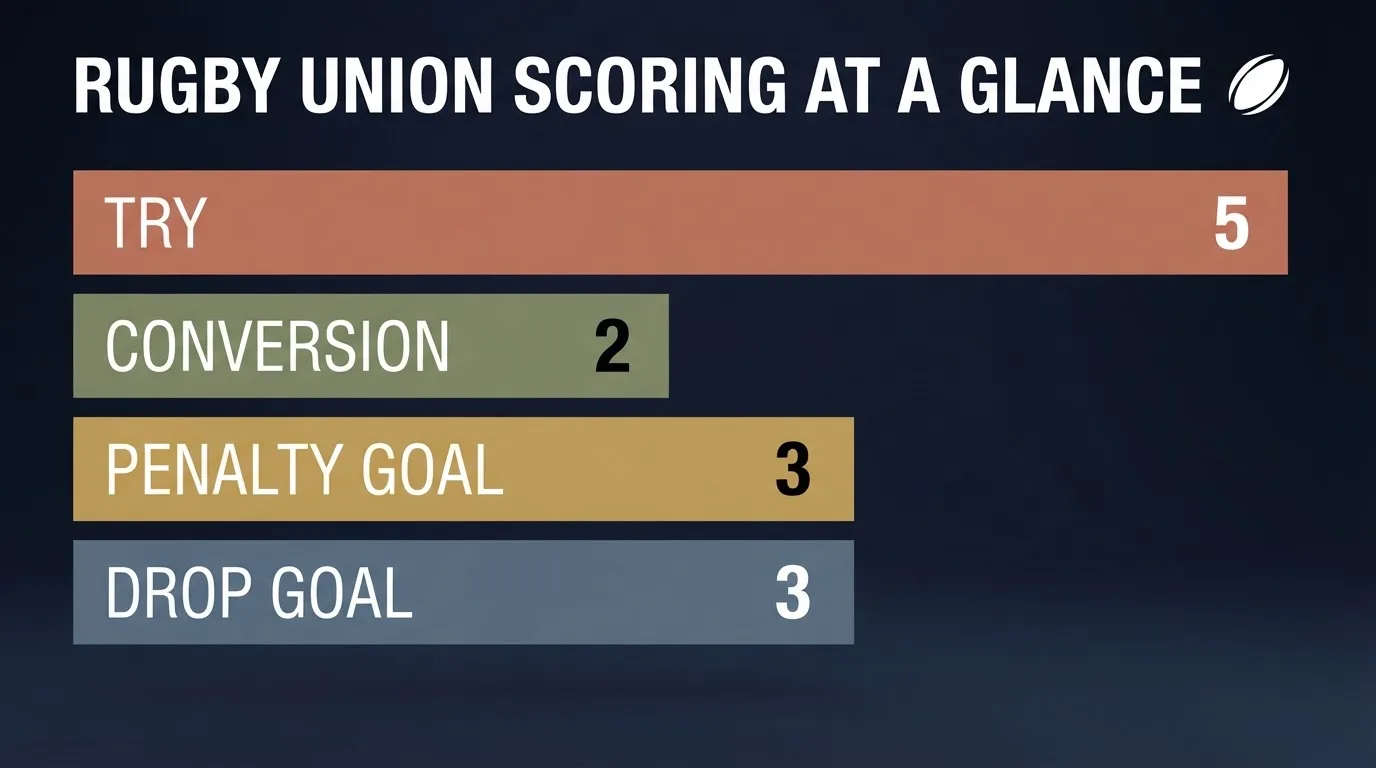
World Rugby has governed the sport since 1886, and the calendar below that runs through a layered set of competitions. A team fields fifteen players, the match is two forty-minute halves, and stoppages are not counted, so most games run longer than eighty minutes. A try is worth five points, a conversion two, a penalty three and a drop goal three, which is why a try-scoring market pays more than a penalty in any settled scoring line.
The international game is anchored by the Rugby World Cup. The first tournament was held in 1987 in Australia and New Zealand, with New Zealand winning the inaugural title. South Africa are the current holders after beating New Zealand in the 2023 final; the 2027 Rugby World Cup is hosted by Australia from 1 October to 13 November 2027, with twenty-four teams in six pools of four and fifty-two matches. Between World Cups, the Six Nations runs through February and March each year for England, France, Ireland, Italy, Scotland and Wales; the Rugby Championship covers the Southern Hemisphere sides in roughly the same window; and end-of-year internationals fill November.
The club game below that varies by country. England runs the Premiership Rugby season from September through June with a play-off series; France runs the Top 14 through to a June final; Ireland, Scotland, Wales, Italy and South Africa run their own domestic leagues, with the United Rugby Championship (URC) covering clubs from Ireland, Italy, Scotland, South Africa and Wales across the season and the Champions Cup running a European club competition alongside it. New Zealand’s Super Rugby runs in the southern winter.
Each competition settles on different conditions: a Premiership regular-season match settles on full-time plus stoppages, a URC match the same way, and a Rugby World Cup knockout match goes to extra time and golden point if the scores are level at full-time. The settlement rule matters for in-play and handicap bets because a Rugby World Cup knockout that finishes 20-20 is not a draw at the betting window — it goes to extra time, and only one outcome prices.
Image placement
A rugby union pitch is photographed at the spot where kick-off happens. The file the script will place here is described as *A ball on the centre spot of a grass pitch in morning light*.
The Margin Inside Every Price
The single most useful number a punter can read from a price list is the one that is not printed. The bookmaker’s margin — also called the overround — is the percentage of every pound staked that the bookmaker keeps on average across a market. It is built into the prices themselves, and it is the reason a market with three outcomes at “true” prices adds up to more than 100% when those prices are turned into implied probabilities.
Take an illustrative two-way market at decimal odds 1.90 / 1.90 — a price used here as an example, not a quoted price from any fixture. The implied probability of each outcome is 1 ÷ 1.90 = 0.5263, or 52.63%. Two outcomes at that probability add up to 105.26%, and the 5.26% above 100% is the margin. The payout share is 1 ÷ 1.0526 = 95.00%, so on every £100 staked across this market the bookmaker pays back £95.00 in winnings on average and keeps £5.00 as gross profit. That is what the margin of the line actually costs the punter over many bets.
The same market at 1.85 / 1.85 is a tighter line with a heavier margin: implied probability 54.05% on each side, total 108.11%, payout share 92.50%, margin 7.50%. A match-result market on a tight rugby union league fixture will often be priced tighter than 1.90 / 1.90, with a margin of 7% to 9% on the favourite’s side and a similar band on the draw side of the 1X2. Outright and tournament-winner markets are wider still — 12% to 20% on long-shot fields is common — because the bookmaker is pricing uncertainty against itself.
The gap between the price on the betting slip and the “true” probability of the outcome is the punter’s edge after the margin. On a market with a 5.26% margin, the bookmaker needs to be wrong about outcomes at a rate greater than 5.26% before the punter is ahead of the line in the long run. That is the test any tipping service or model has to clear, and it is why picking winners is harder than reading a price list.
What Kinds of Rugby Bets Are Available
Rugby union covers a wider menu than most sports books show on the surface. The headline markets — match odds, handicap, total points — are universal across UK bookmakers, but the second tier varies. Race-to-X points markets are common in bigger fixtures: race to 10, race to 20, race to 30, settled on which team crosses the threshold first. Try-scorer markets let the punter back the first try-scorer, last try-scorer, or anytime try-scorer, with the captain typically the favourite and an outside wing less so; an anytime try-scorer bet on a prop forward pays a longer price because props score less often but the payouts are larger when they do.
Half-time / full-time markets combine the result at the break with the result at the end of normal time. Winning margin markets price the size of the victory in bands: 1-7 points, 8-14, 15+, sometimes tighter bands in international fixtures where margins are tighter. Method-of-first-try markets price whether the first try is scored by a forward, a back, or from a set piece, though these are bookmaker-specific.
The bet builder product is the fastest-growing category. Most major UK bookmakers offer a same-game multi that combines markets from a single match — match result, total points, try scorer, handicap — into a single price. The legs multiply into one combined price, and the bet is void if any leg is void. The catch is that the margin on each leg is preserved (or enlarged) in the combined price, so a four-leg builder at 1.40/1.60/1.80/2.00 is not “free” combinational value; it carries the margin of each leg baked into the single price the punter is offered.
Outright markets cover the long horizon: league winners (Premiership, Top 14, URC), tournament winners (Rugby World Cup, Six Nations, Rugby Championship), seasonal specials (top try-scorer, player of the year), and end-of-year internationals priced weeks in advance. Outright markets have higher margins because the bookmaker is pricing a field, not a single event, and the price on a long-shot carries the most margin of all.
Where UK Rugby Union Betting Stands Legally
Rugby gambling in Great Britain is licensed by the Gambling Commission (UKGC), a non-departmental public body sponsored by the Department for Culture, Media and Sport, under the Gambling Act 2005. The Act covers England, Scotland and Wales; Northern Ireland is outside the Act and runs its own older law, so any reference here is to Great Britain. Since the Gambling (Licensing and Advertising) Act 2014, any operator whose remote facilities are used in Great Britain needs a Commission licence wherever the operator itself is based — sections 33 and 36 of the 2005 Act as amended. A Curaçao, Maltese or Gibraltar licence is not a substitute.
There is no statutory list of permitted sports or markets. The Commission licenses an operator for a category — remote general betting standard (real events) is the standard category for sports betting, alongside virtual events, pool betting, and the betting intermediary category that covers exchanges — and the operator decides which markets it prices under its own licence conditions and the Licence Conditions and Codes of Practice (LCCP).
The Commission’s public register is the whole test of who holds a licence. It is searchable by business name, trading name, domain or account number, and a brand’s appearance on the register is the only document a punter needs. A domain extension proves nothing — licensed UK operators use .com as well as .co.uk. No single brand in this comparison is “the only” licensed one; the register lists far more operators than any article can review, and several brands can run under one licensee (for example Paddy Power and Betfair). Identity verification happens before a customer can deposit or gamble, with name, address and date of birth verified since 7 May 2019 — that includes using a free bet or bonus, so a free bet is not an anonymous route in.
The minimum age is 18. Credit cards have been banned for gambling in Great Britain since 14 April 2020, including credit-card-funded payments through an e-wallet; debit cards and bank-based payments are not covered by that ban. Financial spread betting sits under the Financial Conduct Authority, not the Commission — Spreadex runs both, regulated by the FCA on spread betting and by the Commission on fixed odds.
Offshore operators, those without a Commission licence, do not need to be legal to be reachable, but they forfeit a defined set of British protections at the betting window: no GAMSTOP coverage, no Commission complaints route, no approved dispute-resolution service, no British consumer redress if funds are withheld, no 10x bonus cap, no £150 vulnerability check. The Act makes it an offence under section 33 to provide gambling facilities in Great Britain without the licence the Act requires — aimed at the operator, not the customer. Enforcement is disruption, not blanket blocking: cease-and-desist notices, search-engine referrals, registrar and payment-provider work, and court-order DNS blocking powers given or about to be given to the Commission. A punter comparing options should know that “licensed” and “unlicensed” describe two different protection regimes, not two different safety ratings.
Legal Status of Betting in the UK
A stadium at dusk carries the section break. The file the script will place here is described as *An empty football stadium with floodlight masts at dusk*.
Player Protection: Limits, Checks and Self-Exclusion
Three rules matter at the betting window.
GAMSTOP is the national multi-operator online self-exclusion scheme, mandatory for online operators since 31 March 2020. A customer signs up with periods of six months, one year, five years, or five years with auto-renewal. After the minimum period the exclusion stays in place for a further seven years unless the customer asks GAMSTOP to remove it. It covers online sites and apps; betting shops use a separate multi-operator self-exclusion service. Every GB-licensed online operator takes part.
Financial vulnerability checks apply under LCCP condition 3.4.4, in force since 30 August 2024, when a customer’s deposits minus withdrawals exceed £150 in a rolling 30 days (in force since 28 February 2025). The check is a public-record check — bankruptcy or county court judgments — not an income check, not a credit reference check. Financial risk assessments (the affordability checks of the press) have been announced in a staged plan, with no start date — write “announced, staged, no start date”, never “in force”.
Deposit limits are a gross deposit limit on a fixed time frame that operators must offer (RTS 12). The first changes have applied since 31 October 2025, a second phase was postponed to 30 September 2026, and whether the current promotion state is live is not established. There is no state-set deposit or loss ceiling for betting: limits are the customer’s choice. A punter looking to set their own ceiling does so on the operator’s responsible-gambling page.
Help is available outside the betting window: GamCare runs the National Gambling Helpline; GambleAware funds treatment and research; NHS gambling clinics offer face-to-face support; Gamblers Anonymous runs peer-led meetings. Fitzwilliam Sports is one of the operators on this page that links to GambleAware, GamStop and Gamblers Anonymous from its safer-gambling footer.
Image placement — Player Protection
A courtroom at the section break carries the legal frame. The file the script will place here is described as *An empty courtroom with wooden benches in morning light*.
Bonuses, Free Bets and What They Cost the Punter
Promotion rules for GB-licensed operators have moved since the start of 2026. Since 19 January 2026 wagering requirements on bonuses are capped at 10x, so a £10 bonus at 50x needed £500 of qualifying bets; under the cap no more than £100 of qualifying bets is required of the same £10. Mixed-product promotions — an offer that requires gambling on two or more product types (betting plus casino, betting plus bingo, betting plus lottery) — are banned. Whether the cap applies to free bets with no wagering condition, and any cap on the money value of a bonus, are not established.
A “free bet” is what most operators now lead with. The stake is not paid back with a winning free bet: a £10 free bet at decimal odds 3.00 returns £20 in profit, not £30. That is the standard, and it is the cost of the offer. A “bet £10, get £10” promotion is two £5 free bets in many cases, not £20 of betting credit. A “risk-free” first bet refunded as a free bet is not a money refund — it carries the same stake-not-returned condition, and a winning refund-as-free-bet is worth less than a money refund at the same nominal figure.
Most welcome offers in this market follow a pattern: a deposit of £10 or more, a first qualifying bet, a free-bet return capped at a stated figure (often £10, £15, £20, £25 or £30), and a settlement deadline (often seven days). A Hollywoodbets welcome is stake back as a free bet of up to £30 on the first qualifying losing accumulator (stake £10+, three or more legs, odds of 4/1 or greater, settled within seven days), one free bet per customer. A Betboro welcome is a 100% matched free bet of up to £25 on the first qualifying wager, with a debit-card deposit of at least £10 and a first bet of £5 to £25 with at least three selections each at 3/5 (1.60) or higher. A BetGoodwin welcome is “Bet £10, get £15 in free bets” with three £5 segments (a sports bet, an acca, and a Sub-Cover bet). A Bet Ahoy welcome is “Bet £10, get £10 in free bets” across two £5 segments.
The price condition matters: a free bet return on a winning 4/1 accumulator pays more than the same free bet on a winning 1/2 single, because decimal odds of 5.00 return five times the stake-free figure (the £10 free bet returns £40 in profit, not £10). That is why most welcome offers carry a minimum odds clause on the qualifying bet. The minimum price is the operator’s filter against an arbitrage-style conversion of the free bet into cash, and it is the single condition a punter should check before placing the qualifying bet.
The honest framing is that welcome offers are loss-leaders: they pay the operator in customer acquisition, and they pay the punter in something, but only when the qualifying bet is settled, only if the conditions match, and only on the operator’s own settlement calendar. The promotion rules the GB-licensed operators have operated under since 19 January 2026 cap the wagering requirement; they do not cap the marketing claim.
Live Betting and Cash Out on Rugby Union
In-play betting is offered by GB-licensed bookmakers, and the controls are the operator’s licence conditions and customer-protection rules. There is no statutory ban on in-play rugby union, no statutory cap on in-play stake limits, and no statutory rule that says a market must be suspended after a try. The LCCP requires social responsibility and fair treatment; in practice that means a market is suspended when a try is scored (because the next score is suddenly more likely), when a player is sent to the sin bin (because the next ten minutes are typically one-sided), and at half-time (because the second-half team list changes the picture).
Cash out lets the punter close a bet before the match ends, at a price the bookmaker sets in real time. Cash out is offered by Betfair alongside Bet Builder and free live streaming of UK and Irish horse racing and football; bet365 offers it through its app along with live streaming of events worldwide, Bet Track, Match Live and a Live Golf Tracker; Sporting Index offers auto cash-out on its spread-betting product. The cash-out price the operator offers is its own internal price, not the price of the next market on the same selection. On a market that has moved sharply against the punter’s position, the cash-out price is lower than the back price at the same moment, and that is the trade-off: the punter locks in something, but not the full price.
Live streaming is bundled into the larger apps. bet365‘s app carries live streaming of events worldwide; Betfair‘s app carries free live streaming of UK and Irish horse racing and football. Most UK bookmakers stream some events inside their app on the condition that the punter has a positive account balance or a qualifying bet on the event being streamed.
The risk of in-play rugby union is the same as the risk of in-play any sport: a market can move several percentage points in the seconds after a try, and the punter who reacts slowly pays for the speed of the bookmaker’s pricing model. The punter who enters the in-play market for a reason — a sin-bin, a forward substitution, a weather change — has a different edge than the punter who enters because the price looked short.
Predictions, Models and the Bookmaker’s Margin
There is no sure thing in rugby union. There is also no system that beats the bookmaker’s margin across a long run on its own; the punter either has an edge in pricing a particular fixture, or the margin eats it. The arithmetic of expected loss shows why: on a market with a 7% margin, a punter who turns over £1,000 in bets pays the bookmaker £70 on average, regardless of how the bets are split between favourites and underdogs. A tipping service that prices a 60/40 outcome at a 50% probability is paying for the punters’ wrong calls at a rate the margin compounds.
The way to read a price is to convert it to an implied probability and decide whether it is higher or lower than the punter’s own estimate. A line of 1.80 on a side implies 55.56% probability. If the punter thinks the side is closer to 60%, the price is short — the punter should back it. If the punter thinks it is closer to 50%, the price is long — the punter should not. The work of tipping is the work of pricing; everything else is commentary.
There are three honest reasons to follow rugby union betting tips. The first is when the tipster prices a market on information the bookmaker does not have — a starting XV, a captaincy change, a wet-weather call — and the punter wants that information without rebuilding it. The second is when the tipster focuses on a market the bookmaker covers less deeply — the lower leagues, the second-tier internationals, the women’s game — where the punter’s own information advantage is larger. The third is when the tipster’s track record is published transparently, with the margin of every market the tipster prices, so the punter can audit the closing line value of the tips and see whether the tipster clears the margin. Free rugby union betting tips exist across most sports forums, but a track record at the level a punter can audit is rare. The punter who relies on tips without auditing them is paying the tipster without finding out whether the tipster is paying them back.
The honest framing of strategy is that bankroll discipline matters more than tip quality. A punter who prices 5% edges, stakes 2% of bank per bet, and walks away from a price that is not there will outlast a punter who prices 10% edges, stakes 10% of bank per bet, and chases a bad price back. The reason is variance: a 5% edge at 2% stake has a small variance per bet, and the bankroll survives the losing runs; a 10% edge at 10% stake has a large variance per bet, and a 30% drawdown wipes the bankroll before the edge shows up in returns. Rugby union is a low-score sport with long losing runs even for the favourites, and the bankroll model should match that.
The Ten Licensed Bookmakers — What Each One Is For
Each operator below holds a Gambling Commission remote licence for general betting standard (real events). The same disclaimer applies across the comparison: a place in a ranking is not a licence, and several of the licences run more than one brand through the same licensee. Where a brand’s own terms are silent on a key subject, the table below says so rather than guess.
| Brand | Gambling Commission remote licence (account) | What the operator’s own terms say about rugby union |
|---|---|---|
| Tote | 054779-R-331321-008 (54779), held by TDCO Limited | Tote is the pool-betting arm of the UK racing industry; its main product is pool betting on horse racing, with sports betting extending the brand into other events |
| Hollywoodbets | 053028-R-330019-013 (53028), held by Hollywoodbets International UK Limited | South African bookmaker; UK sports welcome is a free bet of up to £30 on the first losing accumulator, settled within seven days |
| Sporting Index | 027343-R-308898-011 (27343), held by Sporting Index Limited | Spread-betting specialist; customers can switch between fixed odds and spread betting, with in-play, auto cash-out and Multi-Markets |
| QuinnBet | 061011-R-335683-004 (61011), held by QuinnBet (Gibraltar) Limited | Irish-facing bookmaker; Best Odds Guaranteed applies to UK and Irish horse racing from 10:00 daily, capped at £150 per customer per race |
| Betboro | 044181-R-324363-007 (44181), held by Webmedia Development N.V. | Sports welcome is a 100% matched free bet of up to £25 with a £10 minimum debit-card deposit and a qualifying bet of £5 to £25 at minimum odds 3/5 (1.60) per selection |
| BetGoodwin | 002927-R-327985-008 (2927), held by Goodwin Racing Limited | UK racing-led brand with a sports arm; sports welcome is “Bet £10, get £15 in free bets” split into three £5 segments |
| Fitzwilliam Sports | 048760-R-335434-009 (48760), held by SBKI Limited | Dublin bookmaker with capped membership; “High Stakes Welcome” subject to compliance criteria; safer-gambling footer covers GamCare, GamStop and Gamblers Anonymous |
| Betfair | 039439-R-319330-013 (39439), held by PPB Counterparty Services Limited | Betting exchange and Sportsbook under one licence; in-play, Bet Builder, free live streaming of UK and Irish racing and football, plus a 90 Minute Payout market |
| Bet Ahoy | 100094-R-341742-003 (100094), held by Bet Ahoy Ltd | Newer UK brand; sports welcome is “Bet £10, get £10 in free bets” split into two £5 segments |
| Kalooki Sportsbook | 057730-R-333396-005 (57730), held by Kalooki Sportsbook Limited | Operator is Kalooki Sports Book Ltd (company number 12938274); a GAMSTOP member |
Tote
Tote is the pool-betting arm of British racing. The brand carries the heritage of the original Tote, and the Commission’s licence for pool betting sits alongside the standard general betting licence. For a punter who wants pool betting on horse racing and a sports book for the rest, Tote offers both. Rugby union sits on the sports book rather than the pool product. The brand is unusual in being a pool operator at heart and a sports book on the side, which is the opposite of the typical UK bookmaker where pool betting is a corner of the racing product. Combining racing and rugby in one account is the brand’s primary utility.
Hollywoodbets
Hollywoodbets is a South African bookmaker with a UK licence, and its UK welcome offer is stake back as a free bet of up to £30 on the first qualifying losing accumulator (stake £10+, three or more legs, odds of 4/1 or greater, settled within seven days), one free bet per customer. The accumulator minimum is the key condition: a single or double does not qualify, and the 4/1 odds floor means the qualifying bet has to be a long-odds multi. For a punter who already bets accumulators, this welcome is a small rebate on the first losing one; for a punter who backs singles, the offer does not match how they bet.
Sporting Index
Sporting Index lets customers switch between fixed odds and spread betting, with in-play betting, Bet Builder for football, auto cash-out and Multi-Markets. Spreadex is the parallel example — financial spread betting under the FCA, fixed odds under the Commission — and the spread-betting half carries a different risk profile: spread-betting losses can exceed the deposit. Sporting Index sits in the spread-betting niche; the fixed-odds side is smaller than its specialist competitors. This brand is a top-tier choice for spread betting on rugby totals and supremacy.
QuinnBet
QuinnBet is an Irish-facing bookmaker. Its Best Odds Guaranteed applies to UK and Irish horse racing from 10:00am daily on singles, multiples and system bets, with a maximum benefit of £150 per customer per race. Best Odds Guaranteed is a long-standing British and Irish racing concession that pays the bigger of the morning price and the starting price on a winner; for horse racing it is the headline feature of QuinnBet’s racing product. Rugby union is the sports book rather than the racing product, so BOG does not apply. The trade-off is racing-leading, sports-following: a punter who bets both will find QuinnBet competitive on the racing half and ordinary on the sports half.
Betboro
Betboro’s sports welcome is a 100% matched free bet of up to £25 on the first qualifying wager, requiring a debit-card deposit of at least £10 and a first bet of £5 to £25 with at least three selections each at 3/5 (1.60) or higher. The minimum odds condition is the smallest in the comparison (1.60 decimal per leg), which makes the qualifying bet easier to construct; the matched-free-bet structure caps the value at £25 and the qualifying stake at £25. For a punter who backs small-stake accumulators, the Betboro welcome is one of the easier ones to clear; for a punter who backs singles, the three-selection minimum disqualifies the bet.
BetGoodwin
BetGoodwin’s sports welcome is “Bet £10, get £15 in free bets” split as a £5 sports bet, a £5 acca and a £5 Sub-Cover bet. The Sub-Cover product is the unusual segment: a free bet on a specific market the operator selects. Goodwin Racing is the racing parent, and the sports book is the secondary product. For a punter who bets racing primarily and rugby as a side, the brand fits; for a punter whose main interest is rugby, the racing-led product will not match their needs.
Fitzwilliam Sports
Fitzwilliam Sports describes itself as a Dublin bookmaker with capped membership and offers a “High Stakes Welcome” subject to compliance criteria. The capped-membership model is unusual among GB-licensed operators and signals a curated customer base; the welcome is by compliance invitation, not by open registration. The site offers instant deposits, fast withdrawals, timeouts and deposit limits, and links to GambleAware, GamStop and Gamblers Anonymous from its safer-gambling footer. For a punter who wants a Dublin bookmaker with a smaller customer base and a stake-led welcome, Fitzwilliam Sports is a distinct choice; for a punter who prefers a typical UK sports book, the capped-membership model may be a barrier.
Betfair
Betfair runs a betting exchange and a Sportsbook under the same licence (held by PPB Counterparty Services Limited, the same licensee as Paddy Power). The Sportsbook carries in-play betting, Bet Builder, free live streaming of UK and Irish horse racing and football inside the app, and a 90 Minute Payout market that refunds stakes on goals scored after the bet is placed. The exchange carries back and lay markets on most sports. Betfair provides a dual-product app that serves both exchange and sportsbook users effectively.
Bet Ahoy
Bet Ahoy’s sports welcome is “Bet £10, get £10 in free bets” split as a £5 sports bet and a £5 acca. The simpler structure — two segments rather than three — is the unusual feature; the matched value is the lowest in the comparison. This operator’s offer is the most accessible for those seeking a straightforward, lower-stakes entry.
Kalooki Sportsbook
Kalooki Sportsbook is operated by Kalooki Sports Book Ltd (company number 12938274), licensed by the Gambling Commission under account number 57730, and is a GAMSTOP member. The brand is one of the smaller operators on the register; the Commission’s public register confirms the licence, and the GAMSTOP membership is standard across the field. For a punter who wants a smaller, named-operator account, Kalooki fits; for a punter who wants the deep market coverage and streaming bundle of the larger brands, this is not the right option.
Choosing Between Them
A punter picking a bookmaker for rugby union should pick on three things: market depth, settlement reliability, and how the welcome offer fits how they already bet.
Market depth is the size of the menu and the price range within a single match. The bigger operators carry more match markets (race-to-X, winning-margin bands, player try-scorer markets); the smaller operators carry match odds, handicap and total points and stop there. A punter who bets match-result only will not notice the difference; a punter who bets player props will.
Settlement reliability is the speed at which a settled bet becomes withdrawable funds. The Commission does not publish settlement times, so this is a quality a punter finds out about only by experience. Industry-typical times are minutes to a few hours on most pre-match markets; in-play markets settle at the end of the event.
Welcome offer fit is the question of how the qualifying bet matches how the punter already bets. A welcome with an accumulator minimum does not suit a single-bet punter; a welcome with a minimum-odds floor of 4/1 does not suit a low-odds accumulator punter. The wagering cap of 10x since 19 January 2026 is the headline protection: any GB-licensed welcome with a wagering requirement above 10x on the bonus is now in breach of the rules, and any welcome that asks the punter to gamble on two product types (sports plus casino, for example) is banned.
Beyond those three, the practical question is whether the punter needs the racing or casino product. QuinnBet, BetGoodwin, Fitzwilliam Sports and Tote lean racing; the rest are sports-first. The punter who bets one sport only will pick on the menu of that sport; the punter who bets several will pick on the menu that crosses them all.
Image placement — Choosing Between Them
A second pitch photograph closes the operator section.
Putting a Price on a Match Result
The arithmetic of a single bet is mechanical: a stake of £10 at decimal odds 3.00 returns £30 — the original £10 back plus £20 in profit. The arithmetic of a combination bet is the legs multiplied: a treble at 1.80 / 2.50 / 3.00 carries a combined price of 1.80 × 2.50 × 3.00 = 13.50, and a £10 stake returns £135.
The arithmetic of a market is more useful. The illustrative two-way market at decimal odds 1.90 / 1.90 carries a payout share of 95.00% and an overround of 5.26%. Stated as a band, a tight two-way market in rugby union typically carries a margin of 5% to 7% — the price range a bookmaker offers at the time of writing, not the price any punter will get. A wider market such as a handicap (1.85 / 1.95, say) carries a margin in the 7% to 9% band. An outright market on a league winner carries 10% to 15%. A long-shot outright on the Rugby World Cup carries 15% to 20% on the field.
The wider the margin, the more the punter pays the bookmaker on every pound staked across the market. A punter turning over £1,000 on a 5% margin pays on the order of £50 to the bookmaker on average; the same turnover at a 15% margin pays on the order of £150. The punter who needs a 5% edge to beat the bookmaker at a 5% margin needs a 15% edge to beat the bookmaker at a 15% margin — and most punter edges sit below the margin of the market they bet on. The honest framing is that price is the first line of the bet, and margin is the first line the bookmaker draws.
Frequently Asked Questions
How does rugby union betting work in the UK?
A UK punter backs one of two or three outcomes on a rugby union match — home, draw, away; over or under on total points; a points handicap — at a price set by a licensed bookmaker. The bookmaker prices the market, the punter takes the price or leaves it, and the bet settles at the conclusion of normal time (or extra time and golden point in a Rugby World Cup knockout). Licensed operators verify the punter’s identity before the first deposit, the punter can set their own deposit limit, and the offer is subject to the operator’s own terms.
How do you bet on rugby union?
Pick a licensed bookmaker, complete the identity verification before the first deposit, choose a market (match odds, handicap, total points, try-scorer, outright), and place a bet at a stake the punter is comfortable losing. In-play betting works the same way after the match has started, with the bookmaker suspending and re-opening markets after key events such as tries, sin-binnings and half-time.
How can a punter check that a bookmaker holds a Gambling Commission licence?
The Commission’s public register is searchable by business name, trading name, domain or account number. A brand’s appearance on the register is the whole test of whether the brand holds a licence, and the register carries the licence categories, the licence holder and the licence status. Domains ending in .com are not licensed by their extension alone.
How is the return on a bet worked out from the stake and the odds?
The return on a winning single bet is the stake multiplied by the decimal odds; the profit is the return minus the stake. For a combination bet (a double, treble, accumulator or bet builder), the combined price is the product of the leg prices, and the return is the stake multiplied by the combined price. Free bets usually do not return the stake, so a £10 free bet at decimal odds 3.00 returns £20 in profit, not £30.
What is the bookmaker’s margin and how can it be seen in the odds?
The margin is the percentage of every pound staked that the bookmaker keeps on average across a market; it is built into the prices. To read it, convert each price to an implied probability (1 ÷ decimal odds), add the implied probabilities, and subtract 100%. The illustrative two-way market at 1.90 / 1.90 gives 1 ÷ 1.90 = 52.63% on each side, totalling 105.26%, so the margin is 5.26% and the payout share is 94.74%. A three-way match-odds market will typically run from 6% to 10% on each side.
How do fractional odds such as 5/1 convert to decimal odds such as 6.00?
The conversion is mechanical: divide the first number by the second and add 1. So 5/1 becomes 5 ÷ 1 + 1 = 6.00, 11/4 becomes 11 ÷ 4 + 1 = 3.75, and 4/6 becomes 4 ÷ 6 + 1 = 1.67. Decimal odds are the figure that multiplies the stake to give the return, including the stake.
Rugby, cricket & Gaelic – Grey Hound
Content created by the «Grey Hound» team
