
Over Under Betting in the UK A Punter's Guide to Totals Markets
 Available in US
The simplest way to think of an over/under bet is as a wager on a number. The bookmaker sets a line, you decide whether the actual outcome in the match will land above or below it, and the closer you are to right, the more you win. What makes the market harder than it looks, and where most of the value talk lives or dies, is the margin the bookmaker builds into both sides of the line. That margin is the silent tax on every wagered shop who enters the market. The page below explains how totals work across the sports British bookmakers actually price, how the licensed operators stack up against each other, and where the arithmetic of the margin puts a ceiling on any “claim” of the marketing.
Data current as of 27 October 2026, verified against the Gambling Commission’s public register and the operator terms named in each section.
Football Totals: Where Over/Under Gets Its Shape
Football is where the British punter meets the over/under market most often. The standard line is 2.5 goals, though bookmakers run 0.5, 1.5, 3.5, 4.5 and anything else they think will find two-way action. The half-goal variant kills the push: the combined score cannot land at 2.5, so every coupon settles one way. Whole-number lines, by contrast, return your money when the total exactly hits the line — a 1–1 draw on a 2-goal line is a push, stake refunded.

Football markets are settled on 90 minutes of play plus referee-added stoppage time, unless the market states otherwise. Extra time and penalty shootouts do not count. A 1–1 draw that becomes 2–1 after extra time is still under 2.5 on the match-result market; if the bookmaker prices extra time separately, the over-under there takes its own line.
The handicap cousin, often called Asian totals, uses lines such as 2.25 or 2.75 and splits your stake across two adjacent lines. A wager on over 2.25 at half stake wins in full if the combined score reaches 3 or more; it returns half the stake at exactly 2 goals. The bookmaker’s site lays these out before you confirm; reading them once takes longer than the bet itself.
Most licensed operators price match goals, team goals, both teams to score, corners, cards and shots on target. Lines move with team news, especially in the Premier League and Champions League, where limits shrink close to kick-off. Where a bookmaker restricts the size of the wager it will accept, the cap is the operator’s choice, not a legal ceiling — the Gambling Commission sets no stake cap on sports betting.
Cricket, Rugby and the Sports Where the Line Is Runs or Points
Cricket uses over/under for the total runs a side scores in an innings, the total in the match or, in shorter forms, the runs in a powerplay. Lines depend on the format: a Twenty20 line might sit around 160–180 runs, a one-day international around 350, and a Test innings around 320–380 depending on the pitch. Bookmakers price player performance lines too, and these are over/under by another name — runs scored by a named batsman, wickets for a named bowler.

Rugby union and rugby league use the same total-points frame. A union line at 47.5 covers a typical mid-table English Premiership fixture; league sits lower because defences are tighter. The bookmaker’s margin on rugby lines tends to be wider than on football because fewer punters price them, and the price tells the story: a 1.90 / 1.90 line on rugby points is harder to find than the same line on a Premier League match.
American football, basketball, baseball and ice hockey all carry totals heavily. The Super Bowl line is the example every primer reaches for: at Super Bowl XXXIX, most Las Vegas casinos set the over/under for the game score at 46.0, and the final combined score was 45, so under won. NBA basketball sits around 220 for a regular-season game, sometimes higher for a track-style match-up between two fast teams; the NFL sits between 42 and 52 depending on the two offences. Baseball uses runs scored, and the standard line at major league level is 8.5 with 9.5 as an alternative; the vig in MLB totals is famously higher than in football because the public bets the over and the bookmaker leans into that bias.
Boxing and UFC bouts use round totals — over/under on how many rounds the fight lasts, with most bouts settling around the 1.5 or 2.5 line. The range of over/under round bets reflects how thin the line range is on big fights: bookmakers offer three or four alternatives and the margin between rounds is small enough that one extra round changes everything. Tennis sets, total games, and the in-play “next game” market are the parallel shapes for a sport that has no goals.
How Over/Under Markets Settle and Pay Out
The mechanics of an over/under bet are short enough to fit in a sentence: pick a side, set a stake, the bookmaker takes the wager, the event finishes, the market settles according to the operator’s rules. What takes longer is understanding what happens at the boundary cases.
A push returns the stake without profit or loss. This matters most on whole-number lines. A line at 2 goals in a match that finishes 1–1 is a push, the stake comes back, no juice is taken. Half-goal lines remove the push entirely. A line at 2.25 splits the stake across 2 and 2.5, so half wins or loses outright and the other half pushes or settles on its own merits. The bookmaker’s terms page states the rule; reading it before staking real money costs nothing and saves confusion.
The combined score of both teams is the most common over/under statistic in any sport. It is the shape the market defaults to because it produces a binary outcome with a reasonable number of winning conditions on each side. Player totals, team totals, period totals and corner or card totals are variants of the same frame; they all ask “will this number be higher or lower than the line?”
In-play over/under is the same market with a clock running. Lines move every ball, every point, every minute of football; the bookmaker suspends pricing and reopens it at a new line when the game state changes a goal. Some operators offer cash out on in-play totals, and the value of cashing out depends entirely on the margin sitting inside the offered price — the closer to kick-off, the wider the margin tends to be, so a cash out taken late rarely matches the true line.
The Margin Inside Every Price: What It Costs
Every bookmaker’s price contains a margin. A line at 1.91 / 1.91 looks fair; it is not. The true probability of either side at evens is 50%, which would price both at 2.00 in decimal terms. The bookmaker pays 1.91 on each side, holding 9% of every matched pound on that market. That 9% is the overround, also called the margin or vig. On a three-way football market (home / draw / away) the margin is larger because the bookmaker holds on three outcomes rather than two; typical Premier League match odds run around 5–8% margin, and totals markets often run a point or two wider than match result.
The math is straightforward. Take a two-way market priced at 1.90 / 1.90 in decimal. The payout share is 1 ÷ (1 ÷ 1.90 + 1 ÷ 1.90), which works out to 1 ÷ (0.5263 + 0.5263), or 1 ÷ 1.0526. That is 95.0% returned to bettors across both outcomes, and 5.0% kept by the bookmaker. Move the line to 1.85 / 1.85 and the payout share falls to 1 ÷ (0.5405 + 0.5405), which is 1 ÷ 1.0811, or 92.5% returned, 7.5% kept. The bookmaker’s edge doubles with a 5-cent move in price, which is why small line shifts matter more than they look.
A bookmaker quoting 1.80 / 1.80 keeps 10% of every matched pound; at 2.00 / 2.00 the bookmaker keeps nothing and runs the market at cost, which is why a true evens line is almost never quoted. The wider the margin, the worse the long-run value for the punter, regardless of who wins the bet. A winning wager at 1.80 still returns less in expectation than a losing wager at 2.10 would on a fair market.
The implication for the punter is direct: a “best odds” claim is meaningful only against the same market on the same event at another bookmaker. Two bookmakers can both price the over at 1.91 and the under at 1.91, and one is still a worse bet than the other if the rest of their markets carry different margins; comparing prices line by line is the only honest way to compare bookmakers, and that comparison costs an hour with three open tabs. The closest two prices to even money (just over 2.00) carry the lowest margin and the best long-run value.
How a Winning Bet Pays: The Arithmetic of Stake and Odds
Decimal odds make the math mechanical. A £10 stake at 2.50 returns £25 total — the £10 stake plus £15 profit. A £10 stake at 1.50 returns £15 total — the £10 stake plus £5 profit. The return is always stake multiplied by odds; the profit is stake multiplied by (odds minus one). A £100 stake at 3.75 returns £375, profit £275. The bookmaker’s margin sits inside those odds and never reaches the arithmetic, which is why the calculation looks clean even when the value is poor.
Combination bets multiply the legs. Two legs at 1.80 and 2.20 combine to 3.96; a £10 stake returns £39.60 if both win, profit £29.60. Three legs at 1.50, 1.80 and 2.00 combine to 5.40; a £10 stake returns £54, profit £44. Each leg multiplies the risk too — all legs must win for the bet to pay. The combined margin is the sum of the per-leg margins, which is why a five-leg accumulator is much worse value than five single bets, even at the same per-leg prices. A bookmaker’s accumulator margin is wider than its single-bet margin for exactly this reason.
The British punter also sees fractional odds, written 5/1, 11/4, evens. The conversion is straightforward — fractional a/b becomes decimal a ÷ b + 1, so 5/1 is 6.00, 11/4 is 3.75, evens is 2.00. Odds-on (shorter than evens) means the profit is smaller than the stake: 4/6 is 1.67 decimal, a £10 stake returns £16.70, profit £6.70. The bookmaker’s margin is hidden the same way in fractional odds; the only difference is the notation.
A push on a multi-leg bet usually voids that leg and the bet continues on the others at reduced combined odds. A four-fold accumulator with one void leg becomes a three-fold at the remaining three prices. The bookmaker’s terms page states the rule; standard practice is to void the leg, but a few operators treat a void as a winner at SP (starting price), which benefits the punter on an early scratch.
What “Over/Under” Means in British Betting Vernacular
The British punter calls the over/under market “totals” or “the total” — same thing, shorter word. The line itself is the number; the side is over or under. “Backing the over” means taking the higher side; “laying the under” means betting against it, and on a betting exchange the lay is its own bet at its own price. The combined-score market is sometimes called “match goals” or “total goals” depending on the operator.
Other native terms matter once you read the bookmaker’s site. SP (starting price) is the industry benchmark price at the off, used when a bet is placed without a quoted price or when an ante-post bet settles. BOG (best odds guaranteed) means the bookmaker pays the higher of the price taken and SP if the SP is higher — a William Hill concession on UK and Irish horse racing from 8 AM on the day of the race, applied to single and multiple bets, with ante-post, tote and pari-mutuel bets excluded. A punter is a bettor; a bookie is a bookmaker; a stake is the money risked; a return is stake plus winnings; profit is return minus stake.
An each-way bet is two bets of equal stake — one on the win, one on the place — so a £10 each-way is £20 at risk. Place terms vary by race type and operator. A bet builder or same-game multi combines markets from one event into a single wager; bet365’s Bet Builder+ does this pre-match and in-play. Cash out settles a bet before the event finishes at a price the bookmaker sets; the closer to the end of the event, the smaller the cash-out value tends to be, because most of the uncertainty has resolved.
Accumulators are combinations: a double is two legs, a treble is three, an accumulator (“acca”) is four or more. Permutations are pre-built combinations: a Trixie is four bets on three selections, a Patent is seven bets on three, a Yankee is eleven bets on four, a Lucky 15 is fifteen bets on four, a Super Yankee or Canadian is twenty-six bets on five, a Heinz is fifty-seven bets on six, a Goliath is two hundred and forty-seven bets on eight. The total stake is the unit stake multiplied by the number of bets — a £1 Lucky 15 is £15 at risk.
Spread betting on sports is a separate market with a different regulator. Spreadex is regulated by the Financial Conduct Authority for spread betting and by the Gambling Commission for fixed-odds betting, and spread betting losses can exceed the deposit — a fact the operator states on its homepage. The spread market is not the over/under market: the spread is a range within which the result lands, and the punter wins or loses per unit of difference. A 100-point spread at £1 per point turns a five-point miss into a £500 loss.
The Ten Bookmakers: Who Offers What
The comparison below draws only from operators whose domains appear on the Gambling Commission’s public register against a remote general betting licence. Every operator here takes part in GAMSTOP; none is “the only” licensed bookmaker; the order below is the comparison order, not a quality ranking.
| Operator | Licence and holder | What the operator’s terms say |
|---|---|---|
| Fitzdares | Gambling Commission account 400 (Fitzdares Limited) | Cash out, accumulators, Lucky 15s, specials and antepost markets on horse racing, football, tennis, rugby, cricket, golf and American football, with in-play live odds |
| Fitzwilliam Sports | Gambling Commission account 48760 (SBKI Limited) | Prices based on Oddschecker’s average price per selection; iOS and Android apps |
| London Bet | Gambling Commission account 66162 (Thistle Bet Limited) | UK-licensed and regulated; iOS app carries a 17+ age rating |
| BetUK | Gambling Commission account 39198 (LeoVegas Gaming PLC) | Free bets exclude virtual sports, esports and non-UK/IE horse racing; minimum odds apply |
| Lottoland | Gambling Commission account 38991 (EU Lotto Limited) | Combines casino, lottery betting, sports betting and scratchcards; Gambling Commission licence for Great Britain |
| Betfred | Gambling Commission account 39544 (Petfre (Gibraltar) Limited) | Bet Builder, Sub Switch, Racing Post data, Extra Places, live casino and bingo |
| Tote | Gambling Commission account 54779 (TDCO Limited) | UK and Irish horse racing from 8 AM on race day, singles and multiples, with ante-post, tote and pari-mutuel bets excluded |
| bet365 | Gambling Commission account 55148 (Hillside (UK Sports) ENC) | Bet Builder+ combining markets from one event pre-match and in-play, Super Boosts, Winnings Boosts on Bet Builders and selected singles, daily Bet Boosts |
| Hollywoodbets | Gambling Commission account 53028 (Hollywoodbets International UK Limited) | First qualifying losing acca (stake £10+, 3+ legs, odds 4/1 or greater, settled within 7 days) refunded as free bet of up to £30; one per customer |
| Copybet | Gambling Commission account 53774 (Copybet UK Limited) | Best odds guaranteed all day every day on UK and Irish racing; first past the post paid on horse racing even if winner disqualified |
The table covers the operators listed above. Reading the licence numbers, they map to the Gambling Commission’s account numbers, not the full licence strings — the account number is what the register uses and what any reader can search by. The licence holders are corporate parents rather than always the same name as the consumer-facing brand; several brands in this comparison run under the same parent (LeoVegas Gaming PLC operates both BetUK and BetMGM UK, for example), and the table keeps the brand and the licence holder separate.
Fitzdares
Fitzdares prices horse racing, football, tennis, rugby, cricket, golf and American football. The operator offers cash out, accumulators, Lucky 15s, specials and antepost markets, and runs in-play live odds on the events it covers. It is run under Fitzdares Limited against Gambling Commission account 400 — a remote general betting standard (real events) licence — which means the brand sits on the Commission’s public register as a GB-licensed online bookmaker and takes part in GAMSTOP by virtue of that licence. The book’s appeal to the high-end racing punter is the antepost coverage and the Lucky 15 builder; the appeal to a casual football bettor is thinner because the football line range is narrower than at the bigger books. Fitzdares is a strong contender for those prioritising racing markets and the security of a long-standing Commission licence; alternatively, if a deep in-play football catalogue is the goal, other selections in this comparison might offer a more comprehensive range.
Fitzwilliam Sports
Fitzwilliam Sports is run by SBKI Limited against Gambling Commission account 48760. The site states it bases prices on Oddschecker’s average price for each selection, which is a specific approach: rather than running its own trading desk, it follows the consensus across Oddschecker’s listed operators. iOS and Android apps extend that coverage to mobile. The book suits a punter who values price-following behaviour — the line moves with the consensus rather than leading it — and who accepts that a follower’s liquidity in less popular markets can be thinner than a market-maker’s. The trade-off is real: chasing the consensus means Fitzwilliam is rarely the cheapest price on any single selection, and rarely the most expensive either. For a punter comparing prices across books and looking for one that holds close to the average, Fitzwilliam fits; for a price-taker who needs the line to move first, other alternatives in this guide are likely to prove more suitable.
London Bet
London Bet is published by Thistle Bet Limited against Gambling Commission account 66162, and states it is licensed and regulated in the UK. The iOS app carries a 17+ age rating, which is the standard rating the App Store applies to gambling apps in the UK. What is established is the licence, the operator’s location and the mobile presence. The brand suits a punter who wants a London-themed bookmaker with a clean Commission record and a mobile app, and who is willing to compare its prices on the events they bet on. For a punter looking for a deep feature set or a strong racing product, another book in this comparison offers more.
BetUK
BetUK runs under LeoVegas Gaming PLC against Gambling Commission account 39198 (the same parent operates BetMGM UK). The book’s terms state that free bets exclude virtual sports, esports and non-UK/IE horse racing, and minimum odds apply to qualifying bets. The restriction on virtual and esports markets is a normal feature of UK-licensed books that do not price those markets heavily; the exclusion of non-UK/IE horse racing is narrower than at the racing-led books. For a punter betting on British and Irish racing plus on mainstream sports, BetUK fits; for a punter wanting virtuals, esports or international racing pools, the terms state the lines that will not be available. LeoVegas Gaming PLC running multiple brands is a corporate fact, not a quality claim — both brands appear on the Commission’s register as licensed.
Lottoland
Lottoland is run by EU Lotto Limited against Gambling Commission account 38991. The brand is primarily a lottery betting operator — customers bet on the outcome of official lottery draws rather than buying a ticket — and the iOS app combines casino, lottery betting, sports betting and scratchcards. The book is licensed by the Gambling Commission for customers in Great Britain. For a punter who wants one app covering lottery draws, sports and casino, Lottoland fits; for a punter whose interest is purely sports totals, the lottery-betting core is a side issue. The mixed product offer is one the reader should know about, because the Commission’s January 2026 promotion rules ban mixed-product promotions — an offer that requires gambling on two or more product types — so the operator structures any cross-product offer carefully to remain within those rules.
Betfred
Betfred is run by Petfre (Gibraltar) Limited against Gambling Commission account 39544. The book is one of the larger UK high-street names and the app extends that footprint: Bet Builder, Sub Switch, Racing Post data, Extra Places, live casino and bingo. Sub Switch is a horse-racing feature that lets the punter swap the named selection in a multiple bet after one runner in the race is declared a non-runner; Extra Places adds place terms on selected races. For a punter who wants a full-service UK book with racing depth, football coverage and a casino, Betfred fits; for a punter who wants only the sportsbook or only the casino, the same app does both. The size of the brand is the trade-off — Betfred is large enough that its lines move sharply around major events, but the same size means the margin on Premier League football is tighter than at smaller books.
Tote
Tote is run by TDCO Limited against Gambling Commission account 54779. The brand is the pool-betting successor to the original Tote, the state-owned operator privatised in 2011. Pool betting is a different model: the stakes go into a pool, the pool takes a cut, and the remainder is split among winning tickets, so the dividend depends on how much was staked overall rather than on a margin the operator sets. Tote also offers fixed-odds markets under the same licence. The book suits a punter who wants pool betting alongside fixed-odds sports and who values the heritage of the Tote brand; the dividend model means the odds move with pool size, which is part of the appeal and part of the risk.
bet365
bet365 is run by Hillside (UK Sports) ENC against Gambling Commission account 55148. The app carries Bet Builder+ for combining markets from one event pre-match and in-play, Super Boosts, Winnings Boosts on Bet Builders and selected singles, and daily Bet Boosts. The feature set is wider than most books in this comparison: in-play depth, same-game multis, boosted prices on selected markets, and acca-style Winnings Boosts that add a percentage to the return on qualifying bets. The trade-off is the size of the brand — bet365 is the largest UK online bookmaker by many measures, and a book of that size tends to limit or restrict winning accounts faster than smaller books. Those seeking the deepest feature set and the tightest football margin will find bet365 compelling; conversely, bettors who prefer a smaller operator that limits less aggressively may find a more tailored service elsewhere in this guide.
Hollywoodbets
Hollywoodbets is run by Hollywoodbets International UK Limited against Gambling Commission account 53028. The brand’s sports welcome offer is structured as a stake-back: new players who deposit £10 or more by card get their stake back as a free bet of up to £30 on their first qualifying losing accumulator, defined as stake £10 or more, three or more legs, odds of 4/1 or greater, settled within 7 days; one free bet per customer. The free bet is refunded as a free bet, not as cash, which means a winning free bet pays profit only — the free-bet stake is not returned. Bettors building accumulators who accept that free-bet stakes are not returned with a win may find Hollywoodbets attractive; conversely, anyone preferring singles or immediate cash refunds on their bets might look towards alternative operators.
Copybet
Copybet is run by Copybet UK Limited against Gambling Commission account 53774. The brand offers best odds guaranteed all day every day on UK and Irish racing, and pays first past the post on horse racing even if the winner is later disqualified — a more generous BOG than the industry standard, which usually activates from 8 AM on race day. Copybet’s name references its social feature: customers can copy the bets of named tipsters on the platform. For a punter who wants the racing offer and is interested in following named tipsters, Copybet fits; for a punter who wants to bet only on singles without following anyone, the social feature is a side issue.
Mobile Betting on Totals: Apps and In-Play
The British punter’s over/under bets are increasingly placed on a phone. The same line that sat on a betting slip twenty years ago now sits in an app, and the in-play experience has compressed the time between line movement and staking from minutes to seconds. Bet365’s Bet Builder+ runs pre-match and in-play; Fitzdares offers in-play live odds on football, tennis, rugby, cricket, golf and American football; Fitzwilliam Sports ships iOS and Android apps; London Bet, BetUK, Lottoland, Betfred, Hollywoodbets and Copybet all carry App Store listings. The iOS apps in this comparison carry a 17+ age rating, which is the App Store’s standard for gambling content in the UK.
The app-versus-browser question is mostly settled: most punters use the app because the in-play speed is faster and the bet slip sits one tap from the home screen. The browser version exists for punters who do not want to install an app, and the desktop site is rarely used for in-play. A few operators are app-first and push the browser as a fallback. For totals markets specifically, the app is where in-play lines live; a punter who bets totals in-running will end up on the app regardless of preference.
Limits on in-play stakes are operator-set and can change with the score. A bookmaker that accepts £500 on a pre-match total may accept £50 in-play once one side is leading by two goals, because the risk on the operator’s book has changed. The Commission sets no statutory stake cap on sports betting, but the operator’s liability management is its own; a punter who bets in-running at high stakes should expect limits to move faster than pre-match.
Strategy for Totals: What the Punter Can and Cannot Do
The strategy literature on totals is honest about what a punter can control and what they cannot. Pre-match totals depend on team news, recent form, head-to-head scoring, expected goals, weather for outdoor sports, and the line the bookmaker has set. The punter can build a model that compares expected goals to the line, find edges where the line is higher or lower than the model says it should be, and bet the side with the edge.
In-play totals depend on the live state. A 0–0 game at half-time with a pre-match line of 2.5 has a different in-play line — the bookmaker has re-priced and the new line reflects the lower expected total. The punter’s edge, if any, is in spotting where the in-play line lags the live probability, and that edge closes quickly. Live odds under 3 is the in-play equivalent of a football match’s expected goals at a given minute.
Bankroll management matters more on totals than on match-result markets because the lines move faster. A punter who stakes a fixed percentage of the bankroll per bet controls the variance of the ups and downs. Flat staking (the same amount every bet) is a different approach and gives different variance. The strategy literature does not pick one over the other — both work, neither guarantees a profit, and the only thing that determines long-run results is whether the prices the punter takes are better than the true probability, which is the same edge as in any other market.
The marketing word the punter hears most often is “best odds” or “price boost”. A boosted price is a one-off uplift on a specific selection, usually an accumulator leg or a popular singles market. The boost is real in the sense that the price the punter sees is the price they get, but the boost is funded from the bookmaker’s margin budget — the bookmaker is willing to pay more on one market because it makes the price tighter on the other side of the book. A punter who chases only the boosted selections ends up taking the unboosted side of every other market, which is where the margin lives.
Legality and the Gambling Commission Frame
A bookmaker serving customers in Great Britain needs a Gambling Commission licence, regardless of where the operator is based. The relevant statutes are sections 33 and 36 of the Gambling Act 2005, as amended by the Gambling (Licensing and Advertising) Act 2014. The licence the operator needs for an online sportsbook is a remote general betting standard (real events) licence, which is the category every brand in the comparison above holds. Northern Ireland is outside the 2005 Act and has its own older law; a GB licence is not a Northern Ireland licence.
The Commission’s public register is the whole test of who holds a licence. The register can be searched by business name, trading name, domain or account number; the table above lists the account numbers for the ten brands so any reader can verify them on the register. There is no statutory list of permitted markets: an operator holds a licence for a category and offers markets under its own rules and the Licence Conditions and Codes of Practice (LCCP). In-play betting is offered under those rules, and no statutory prohibition was found; in-play is not “unrestricted” in a legal sense, but it is legal.
Identity verification happens before the first deposit. Since 7 May 2019, operators verify name, address and date of birth before a customer can deposit or gamble, including with a free bet or bonus. The minimum age is 18. A financial vulnerability check has been in force since 30 August 2024: when a customer’s deposits minus withdrawals exceed £150 in a rolling 30 days (the threshold is in force since 28 February 2025), the operator runs a public-record check (bankruptcy, county court judgments, similar). This is not an income check and not a credit reference check. Financial risk assessments — the “affordability checks” the press discusses — are announced in a staged plan, with no start date.
Bonuses are capped at 10x wagering since 19 January 2026. A £10 bonus at 50x wagering needs £500 of qualifying turnover; under the cap no operator can require more than £100 of turnover to clear a £10 bonus. Mixed-product promotions — offers that require gambling on two or more product types (betting plus casino, betting plus bingo, betting plus lottery) — are banned under the same rules. The cap applies to bonuses with a wagering condition; whether it applies to free bets with no wagering condition, and any cap on the money value of a bonus, are not established. The offer structure matters: a free bet refunded as a free bet rather than cash is a different shape from a cash bonus with a wagering requirement.
The player pays no tax on betting winnings in Great Britain. General Betting Duty is the operator’s tax on gross profits, currently 15%; from 1 April 2027 a new remote betting rate of 25% applies within it, while remote bets on UK horse racing, bets on self-service betting terminals in licensed premises, pool betting and in-person betting stay at 15%. Until 1 April 2027 the remote rate stays at 15%. Whether operators pass duty on through odds is not established.
Responsible Gambling Tools Every Licensed Operator Carries
Every GB-licensed online operator takes part in GAMSTOP, the national multi-operator self-exclusion scheme. Periods are six months, one year, five years, or five years with auto-renewal; after the minimum period, the exclusion stays in place for a further seven years unless the customer asks GAMSTOP to remove it. GAMSTOP covers online sites and apps; betting shops use a separate service.
Deposit limits are the customer’s choice. There is no state-set deposit ceiling, and operators must offer a gross deposit limit on a fixed time frame as a licence condition. The first changes applied since 31 October 2025; a second phase was postponed to 30 September 2026, and whether it is live is not established.
Help is available outside the operator. GamCare runs the National Gambling Helpline. GambleAware funds treatment and education. The NHS runs gambling clinics in several regions. Gamblers Anonymous runs peer-led groups. The Commission’s safer gambling pages link to all of these. A punter who feels their betting is no longer recreational can self-exclude through GAMSTOP, set a deposit limit on the operator’s site, or contact any of the help organisations above; the self-exclusion route is the strongest because it blocks all licensed operators at once. For a punter looking to manage their play, the right tool depends on the severity: a deposit limit for everyday control, a time-out for a break, a self-exclusion for a serious concern. The licence the operator holds is the reason these tools exist and the reason the Commission can require them.
Credit Cards and Payments at Licensed Operators
Credit cards are banned for gambling in Great Britain since 14 April 2020 (LCCP condition 6.1.2). The ban extends to credit-card-funded payments through an e-wallet — funding a PayPal or Skrill account with a credit card and then gambling is also banned. Debit cards and bank-based payments are not covered by the ban. The identity check before the first deposit means no anonymous play at a licensed site, and source-of-funds questions at higher spend are normal under the anti-money-laundering rules.
A British named-account rule, a state list of permitted payment methods and any rule for or against cryptocurrency deposits at licensed operators are not established. Operators typically list the payment methods they accept on the deposit page; a punter who wants PayPal, Apple Pay, or a specific bank transfer sees it there.
The speed of withdrawals varies by method. E-wallets are usually fastest; bank transfers can take longer because of the operator’s processing window and the bank’s processing window. The bookmaker’s help page states the time for each method. A punter who needs a fast withdrawal checks the withdrawal page before depositing.
Offshore Sites: What an Unlicensed Brand Loses
A GB licence is compulsory at the point of consumption. Providing gambling facilities in Great Britain without the licence the Act requires is an offence under section 33 of the Gambling Act 2005 — aimed at the operator, with a sentence on summary conviction of up to 51 weeks’ imprisonment, a fine up to level 5, or both (six months in Scotland). No offence aimed at a customer who bets on an unlicensed site was found; the loss is in protection, not prosecution.
A punter on an unlicensed site has no GAMSTOP coverage, no Commission complaints route, no approved dispute-resolution body, and no British consumer redress if the operator withholds funds. The 10x bonus cap does not apply. The £150 vulnerability check does not apply. The credit-card ban does not apply. The verification-before-dance rules do not apply. Whether the operator pays out at all is the operator’s own choice. The Commission’s enforcement is disruption rather than blocking: cease-and-desist notices, search-engine referrals, work with registrars, hosts and payment providers; the Commission has been given or is about to receive court-order DNS blocking powers, but never write that ISP blocking is in operation.
The honest framing is two-sided. A licensed site means checks, limits, GAMSTOP, the bonus cap, and verification before the first bet — the protections cost time and personal data. An unlicensed site means none of those protections and possible loss of funds. Neither is “the safe choice” by default; the choice depends on the punter’s priorities. For a punter who values the British protections, a licensed site is the only option; for a punter who values speed or anonymity and accepts the loss of protections, the unlicensed route exists and the law targets the operator rather than the customer.
How the Odds Format Affects What You See
The British bookmaker lists odds in fractional form by default — 5/1, 11/4, evens — and in decimal form alongside. A punter who grew up with fractions reads them naturally; a punter who did not reads decimals. The conversion is one operation either way: fractional a/b becomes decimal a ÷ b + 1, so 5/1 is 6.00, 11/4 is 3.75, evens is 2.00. The fraction tells the same information as the decimal; the format is convention, not value.
Decimal makes the payout calculation mechanical: return = stake × odds. A £10 stake at 2.50 returns £25, profit £15. A £10 stake at 1.50 returns £15, profit £5. The profit line is stake × (odds minus 1). On a combination, the odds multiply across legs and the calculation runs once. On an each-way bet, two calculations run: win at the win odds and place at the place odds, each on half the total stake.
Fractional odds are read by the profit per unit stake. 5/1 means £5 profit per £1 staked, so a £10 stake returns £60 (£50 profit plus £10 stake). 11/4 means £2.75 per £1, so £10 returns £37.50 (£27.50 profit plus £10 stake). Evens (1/1) means £1 profit per £1, so £10 returns £20. The arithmetic is the same; the notation differs. Some bookmakers let the punter pick the default format in the account settings; once set, it sticks across the site and the app.
The odds the bookmaker displays contain the margin; the format does not change that. A 5/1 line that should be 6/1 (decimal 7.00) carries the same margin as the equivalent decimal 5.50; the difference between the displayed price and the fair price is the overround. A punter comparing prices between two bookmakers on the same event should compare the implied probability (1 ÷ decimal odds), not the displayed numbers — implied probability strips out the format and the overround shows up directly.
Choosing Between the Bookmakers: A Reader’s Path
The table earlier maps the ten licensed bookmakers to their licence and the headline feature each one publishes. Choosing between them is a different exercise, and the choice depends on what the punter bets on, how often, and at what stake.
A racing-led punter looks at BOG coverage (Tote offers it on UK and Irish racing from 8 AM, William Hill offers it from 8 AM on the day of the race, Copybet offers it all day), each-way place terms, and the depth of the racing markets. A football-led punter looks at in-play depth, bet-builder coverage (bet365’s Bet Builder+ runs pre-match and in-play, Betfred’s Bet Builder is a different shape), and the margin on Premier League totals (tighter at the larger books). A multi-sport punter looks at the breadth of sports and the in-play speed. A casual punter who bets once a fortnight on the football looks at the welcome offer’s structure (Hollywoodbets refunds the first losing accumulator as a free bet, others run different shapes) and the mobile app’s clarity.
The licence is the floor, not the ceiling. Every brand in the comparison holds a Gambling Commission licence and takes part in GAMSTOP; that is the minimum, not the differentiator. The differentiator is what the operator does on top: feature set, market depth, margin on the events the punter bets on, and the limits the operator sets on the punter’s stakes. The Commission does not enforce a quality threshold; it enforces a conduct threshold. A licensed bookmaker can still restrict a winning customer, can still offer tighter margins than its competitor, and can still change its terms with notice.
The trade-off the punter makes is between feature set and customer treatment. bet365 has the deepest feature set in the comparison; it is also the book most likely to limit a winning customer aggressively. Betfred has the high-street heritage and a wide feature set; its limits are friendlier than bet365’s. The smaller books (Fitzdares, Fitzwilliam Sports, London Bet, Tote) treat winning customers more gently because their books are smaller and their risk teams have less data. None of this is in the licence or the terms; it is in the lived experience of betting at the brand over months.
For a punter who bets small (£10–£20 a week), the welcome offer and the in-play depth matter more than the limits, because the punter is unlikely to be limited at that stake. For a punter who bets large (£500+ a week), the limits matter more than the welcome offer, because the punter will be limited at that stake eventually, and the book that limits more gently is worth more in the long run. The choice is the punter’s; the comparison above names what each book does so the choice is informed.
Reading the Margin in Practice
The margin in a price is invisible to a casual reader; the price looks fair, and the punter does not run the implied-probability arithmetic on every selection. A punter who runs the arithmetic on three Premier League totals lines will find margins between 4% and 8% depending on the bookmaker and the market; a punter who runs the arithmetic on a niche sport — esports totals, for example — will find margins above 10%. The wider the margin, the worse the long-run value. The margin is the bookmaker’s edge on every bet, regardless of who wins.
A bookmaker that runs a 5% margin on Premier League totals is keeping 5p from every £1 matched across the market; on a £100 stake at evens, £5 stays with the bookmaker across the book. A bookmaker that runs an 8% margin is keeping 8p from every £1; on the same £100 stake, £8 stays. The difference compounds: a punter who bets £100 a week for a year at a 5% margin bets £5,200 of stakes and gives the bookmaker £260 of edge; at 8%, the same staking gives £416 of edge. The difference between two bookmakers that look similar in their headline offers is often the margin they run on the markets the punter bets on.
The way to read the margin is to take a price on each side of a market, convert to decimal, add the inverse-probabilities, and subtract from 1. A 1.91 / 1.91 line gives (0.524 + 0.524) – 1 = 0.048 or 4.8% margin. A 1.85 / 1.85 line gives (0.541 + 0.541) – 1 = 0.081 or 8.1% margin. A 1.80 / 1.80 line gives 10.0% margin. A 2.00 / 2.00 line gives 0% margin, which a real bookmaker almost never offers because no system can run at cost.
For the punter who bets totals, the practical exercise is to compare three prices on the same selection across three bookmakers and take the lowest implied probability (highest decimal odds) on the side the punter wants to back. The exercise takes a few minutes per event and saves the difference between the worst and best price over a season. The bookmaker with the lowest margin on Premier League totals is not always the same bookmaker with the deepest features or the friendliest limits; the trade-off is in the comparison, and the punter picks.
The Image Anchors
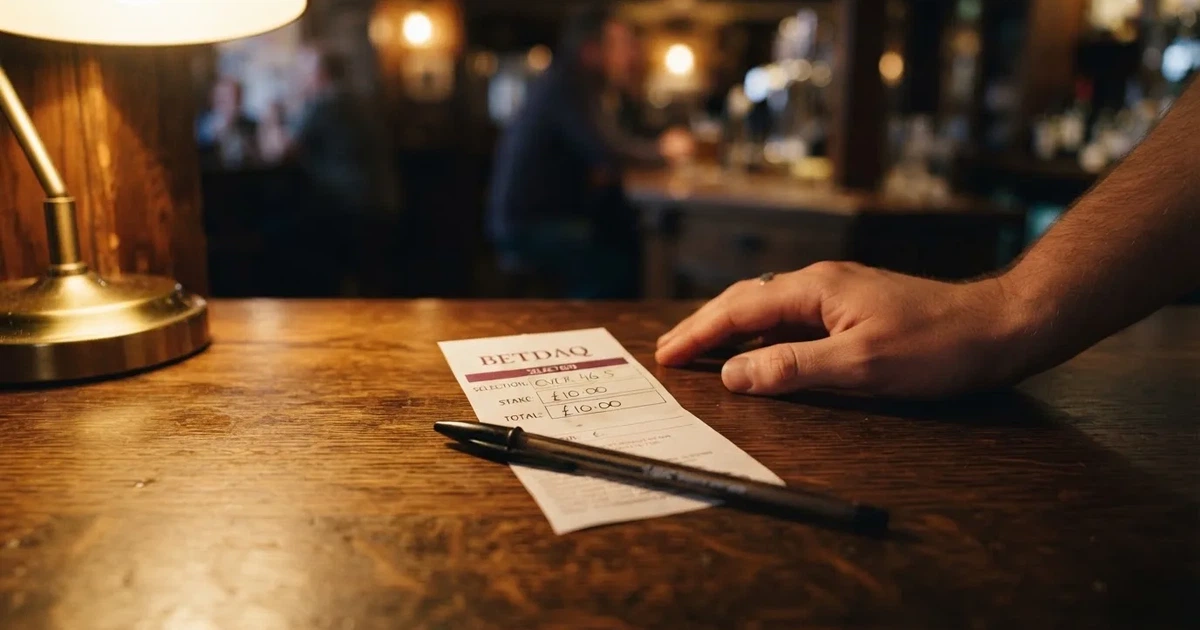
A blank paper betting slip beside a pen on a wooden counter. The slip is the symbol of the betting shop before the app, and the over/under line was once written on these slips by hand: a bookmaker’s pen, a customer’s pen, the line on the paper. Most Las Vegas casinos set the over/under for the game score at 46.0 for Super Bowl XXXIX; the combined score was 45, so the under won, and the slips that backed the under paid out.
An empty football stadium with floodlight masts at dusk. The floodlights are the visual cue for the in-play markets: a match under lights, the line moving with the score, the app refreshing as the clock ticks. In football betting, markets such as over/under are settled on 90 minutes of play including referee-added stoppage time, unless the market states otherwise; extra time and penalty shootouts are excluded. The stadium lights say the match is on, and the rules say what counts.
An empty courtroom with wooden benches in morning light. The courtroom is the venue for the Gambling Commission’s enforcement: cease-and-desist notices, court orders, the section 33 offence for unlicensed operators. Kalooki Sportsbook is operated by Kalooki Sports Book Ltd (company number 12938274), licensed by the Gambling Commission under account number 57730, and is a GAMSTOP member — the licence is the courtroom’s permission, the GAMSTOP membership is the operator’s compliance with the player-protection rules.
Frequently Asked Questions
How does a punter bet on tennis over/under?
Tennis over/under markets price total games in a match, total games in a set, or the outcome of a specific game. The most common shape is match total games at a line such as 21.5 or 22.5 — a three-set match averages around 20–24 games, so a line at 21.5 sits in the middle of the typical range. Settling is by completed games; a walkover or retirement before the match is properly underway voids the bet according to the operator’s tennis rules. In-play totals run game-by-game, and the line moves with every point.
What is an over and under bet?
An over/under bet is a wager on whether a specific statistic in an event will be higher (over) or lower (under) than a number the bookmaker sets. The most common statistic is the combined score of both teams in a match, and the bet is also called a total. If the final number exactly matches the line, the bet is a push and the stake is refunded; half-goal lines remove the push entirely because the combined score cannot land on 2.5.
What does “over/under” mean in betting?
“Over/under” describes the side of the line the punter is taking — over means higher than the line, under means lower. The bookmaker sets the line, the punter picks a side, the bet settles according to the operator’s rules. A bookmaker listing “Match Goals: Over 2.5 / Under 2.5” is offering both sides at its own prices; the punter backs the side they think will win. The combined score of both teams is the most common over/under statistic in any sport.
How can a punter check that a bookmaker holds a Gambling Commission licence?
The Gambling Commission’s public register can be searched by business name, trading name, domain or account number. The register lists every licensed operator with the categories of licence they hold and the dates the licence runs. A licence search takes a few minutes, and the register is the only test the Commission recognises. The account numbers in the comparison table above can be searched directly.
How is the return on a bet worked out from the stake and the odds?
In decimal odds, return = stake × odds, and profit = stake × (odds − 1). A £10 stake at 2.50 returns £25, profit £15. A £10 stake at 1.50 returns £15, profit £5. In fractional odds, the fraction is the profit per unit stake: 5/1 returns £5 profit per £1 staked. A combination bet multiplies the odds of the legs; two legs at 1.80 and 2.20 combine to 3.96, and a £10 stake returns £39.60.
What is the bookmaker’s margin and how can it be seen in the odds?
The margin is the slice of every matched pound the bookmaker keeps. For a two-way market priced at 1.90 / 1.90 in decimal, the payout share across both outcomes is 1 ÷ (1 ÷ 1.90 + 1 ÷ 1.90) = 95.0%, and the margin is 5.0%. The arithmetic converts each price to an implied probability (1 ÷ odds), adds the probabilities, and subtracts from 1. A market where the implied probabilities add to more than 100% is carrying a margin; the gap is the bookmaker’s edge.
Bet types & in-play – Grey Hound
Content created by the «Grey Hound» team
