
How esports betting tips actually work, and why none of them are certain
 Available in US
A “tip” lands on a betting site as a single price. The price is the end of a chain that begins with a bookmaker’s model, the form of two teams, a draft phase, a map pool, a meta, the date of a patch and the weight of the public’s money. This page walks that chain, shelf by shelf, so the reader leaves able to tell a tip worth following from a tip worth ignoring — and able to know in advance that even the better one can lose. The data behind this article is current as of 27 October 2026 and was checked against the Gambling Commission’s public register, the single source that names which remote operators hold a Great Britain licence.
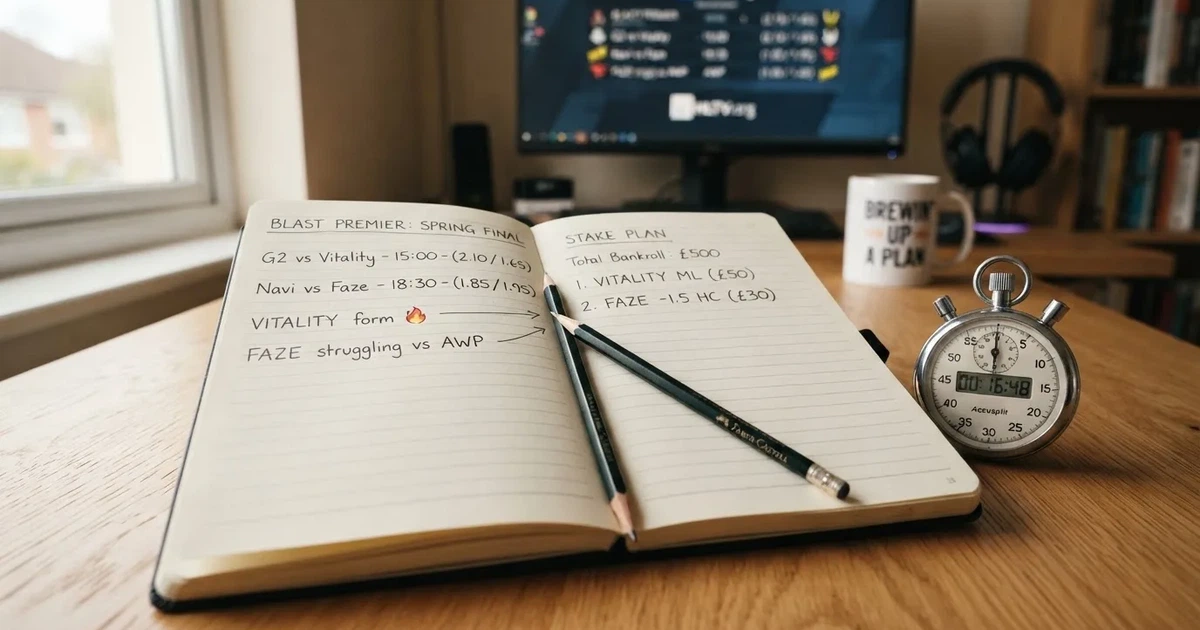
The first shelf is the one most “tips” articles skip past: where the bets are paid for in crypto, who that market is for, and what it costs the bettor who uses it. Once the price a reader pays for that choice is in the open, the rest of the page sits on firm ground.
Crypto and anonymity: what an esports bookmaker that takes bitcoin actually offers
A licensed Great Britain bookmaker does not run anonymous play. Name, address and date of birth are verified before the first deposit, and the operator runs the same file against public records and source-of-funds checks when stakes rise. The bitcoin and “no verification” framing that the SEO cluster around this subject trades on is therefore a description of the offshore, Curaçao-licensed end of the market — not the GB-licensed one. The two markets sit apart, and the bettor who crosses between them picks up a different set of protections on each side.
What “crypto betting” actually means in this corner of the market is a payments choice, not a regulatory one. Bitcoin, Ethereum and a handful of stablecoins are accepted by some operators at the cashier; the bet is still placed at the same kind of decimal price, settled in the same way and paid out to the same kind of wallet. The on-chain leg is a remittance. The licensed house, where one exists at all, sits on its own licence, runs its own KYC and uses crypto only as a funding rail. Where the only operator willing to take the bet is offshore, the bettor trades away British consumer protections: no GAMSTOP cover, no route to the Commission for complaints, no approved dispute-resolution body, and no British redress if funds are withheld. The same 10x bonus cap that a GB licence enforces, and the £150-rolling-30-days vulnerability check, do not bind. The license of the offshore house, not the coin, decides what the bettor loses.
For a bettor who already holds crypto, the practical effect of paying in bitcoin is settlement speed and a small saving on card fees. The wallet sits between the bank and the cashier, so the bank never sees the bookmaker’s name and the bookmaker never sees the card. The trade is not “anonymous”, because the on-chain ledger is a public record of the transfer, but it is private in the way a card payment is not. The price a reader pays for that privacy is the loss of the protection stack that comes with a GB licence. Where the reader is the kind of punter who wants GAMSTOP cover and a Commission route for a complaint, the trade is a poor one. Where the reader is the kind who already self-excludes through their own discipline and wants faster settlement, the trade is intelligible.
The shelves that follow deal with the licensed market; the crypto path is named here so the reader who goes down it knows what they have given up.
Bonuses and free bets: what an esports welcome offer is actually worth
The word “free” does a lot of work in this market and earns very little of it. A “free bet” is a credit, not a gift, and the stake is usually not returned with a winning bet. A “100% bonus” is a matched amount, locked behind a wagering multiple, on a clock, at a minimum price. A “risk-free” bet is a refund as a free bet, which is the same shape as a free bet with a second layer of rules on top. Each of these is a marketing word that the licensed house is allowed to use only because the LCCP does not forbid it — it forbids a different set of claims, and the marketing team has learned which words the rule book leaves alone.

The shape of the cost is in three numbers: the bonus amount, the wagering multiple and the minimum price. Take the published Coral welcome offer as a worked example, because the figures are public. The headline reads “Get £40 in free bets when you bet £20”: a £20 sports bet at minimum odds of 2.0 (1/1) earns £40 of free bet credit within seven days, and that credit expires seven days after issue. The £20 qualifying bet is paid back, win or lose, only as the free-bet credit and not in cash; the £40 of free bet credit is a stake, and the winnings of any free bet are paid in cash, but the free bet stake itself is not. The headline £40, in other words, can be worth a good deal less than £40, and the seven-day clock is part of the price. The wagering multiple on a deposit bonus, when one applies, has been capped at 10x by the LCCP since 19 January 2026, so a £10 bonus cannot require more than £100 of qualifying bets — a real cap, and one the licensed market has to live with.
For a bettor with a small budget, the smallest offer is often the best offer, because every extra pound of bonus base is one extra pound of qualifying stake at the minimum price. For a bettor who plans to bet anyway, the offer is a small uplift on a stake they were going to place. For a bettor who opens an account to chase a promotion, the offer is a way to spend more than they meant to, on bets they would not otherwise have made, on events they have not researched. The arithmetic behind that last sentence is the wagering multiple: a 10x cap on a £10 bonus means £100 of qualifying bets at the minimum price, and the margin on the market they are bet on is the bookmaker’s edge on those bets. At a 5% market margin, £100 of qualifying bets costs the bettor £5 on average before any bonus has been paid — and a £10 bonus that costs £5 of expected value to clear has, at best, doubled the bettor’s edge in their own favour. The same offer at a 7% margin costs £7, and the offer is roughly even money. Above that, the offer is a loss dressed as a gift.
The reader who wants the most out of an offer shops the wagering multiple first, the minimum price second and the deadline third. The reader who wants the least friction takes the smallest offer, with the shortest turnover, on a market they were going to bet on anyway.
Payments and payout speed: cashier mechanics at a licensed house
The cashier is the part of the site a reader uses least until it matters, and the part of the site the house spends the least time advertising. The licensed GB market settles through three rails in practice: debit card and bank transfer, e-wallets (PayPal, Skrill, Neteller, Trustly), and prepaid vouchers (Paysafecard). Credit cards have been banned for gambling in Great Britain since 14 April 2020, including credit-card-funded payments through an e-wallet; the ban is a Commission rule, not a marketing choice, and a reader who tries to fund with a credit card is stopped at the cashier rather than at the bet.
The speed of a withdrawal is set by the operator, not by the rail, because every rail has both an “instant” option and a “queue” option. A PayPal withdrawal that is approved by the operator in minutes still arrives only when the operator releases the funds; the e-wallet is the fast part of the route, and the house is the slow part. The general pattern is: e-wallets fastest (often same-day once approved), debit cards and bank transfer in one to three working days, and a first withdrawal slower than later ones because the verification check runs once, on the first request, against the same documents the sign-up KYC already collected. The reader who has been asked for source-of-funds paperwork mid-deposit is the reader who will be asked again at withdrawal, and the withdrawal that triggers the second check is the one that takes a week.
A “Paysafecard esports” path is a deposit path, not a withdrawal one, because the voucher has no account to receive a payout. A bettor who funds with Paysafecard will be asked, at withdrawal, for a bank account or an e-wallet. A bettor who funds with PayPal is usually paid back to the same PayPal, and PayPal’s own review queue sits in the middle of the timeline. A bettor who funds with a debit card and is paid back to the same card saves the e-wallet’s review step but pays a 1-3 day card-processing window.
The deeper point is that the cashier is a regulatory artefact, not a marketing one. Identity verification before the first deposit means that, by the time a withdrawal is requested, the house already holds the documents it needs, and the slow first withdrawal is the one the house is most cautious about, not the one with the worst plumbing. A bettor who has moved money in and out of the same licensed account for a year will rarely wait more than 24 hours; a bettor who makes their first deposit on a Friday night and asks for a withdrawal on Saturday morning is asking the house to run a full KYC on a weekend queue.
Mobile and app: how a betting app differs from a desktop site, and where it falls short
A licensed GB bookmaker runs two products: a website and a mobile app, with a few of them offering only one. The website is the full version, with every market, every stat, the bet builder, the cash-out slider, the deposit panel and the safer-gambling tools on one URL. The app is a cut-down version, optimised for a touchscreen, with the same markets, a faster bet-slip and notifications for price changes, settled bets and start times. The trade-off is depth: a website has more on it than the small screen can hold, and the app is the bettor’s choice when the bettor already knows which market they want.
The iOS and Android apps on the App Store and Google Play carry an age rating, mostly 17+ or 18+, and a GB-licensed app is the same licence as the website, governed by the same LCCP, run by the same operator. Kwiff’s app, for example, exposes the Supercharge feature — a randomly boosted price on a chosen bet, from 2/1 to 20/1 on a single or multi — alongside the same markets as the website. Betfred’s app layers in Bet Builder, Sub Switch (a substitution-aware version of a Same-Game Multi on football), Racing Post data for the racing products, Extra Places and a live casino tab. The function a bettor wants on a Saturday at 3pm is the function the app is built for, and the function a bettor wants at 11pm on a Tuesday — researching form for a Wednesday Dota 2 card — is the function the website is built for.
The two practical concerns with the app are: storage and updates, and notifications. A bookmaker’s app is updated often, and a bettor who has notifications off for a year will find a version that no longer matches the markets the website is showing. A bookmaker’s app is also a heavier install than most readers expect — between 80 MB and 250 MB for the iOS binary — and an older phone runs the live-streaming feature at the lower of the two resolutions by default. The reader who cares most about a fast bet slip picks the app; the reader who cares most about market depth picks the website; the reader who has a strict notification budget turns off price-change alerts and settles for the bet they meant to place.
For a bettor who does not want to install an app, the mobile website is a usable compromise, and the live-betting product on a small screen is good enough for in-play markets at the larger licensed houses. The bet builder, the cash-out slider and the safer-gambling tools all run on the mobile site; the only feature the app adds, beyond push notifications, is offline bet slip construction, which is not a meaningful gain.
Live betting and cash out: how in-play markets are priced, and what cash out really costs
In-play betting is the product the licensed GB market sells hardest, and the one a reader most often gets wrong. A live market is the same market as the pre-match one, repriced by a model that runs every few seconds on a feed of events: a goal, a kill, a round won, a map drawn. The model has a margin the same shape as the pre-match one, and the price moves, and the bettor who backs the side that has just gone a goal up is paying for a price that already reflects that goal. The pre-match favourite who falls a goal behind inside ten minutes is the favourite the model now thinks is a slight dog, and the price the bettor sees is the model’s new view, not a discount on the old one.
The cash-out feature is the bookmaker’s offer to settle the bet early, at a price the model is generating right now. The cash-out price is, on average, slightly worse than the same bet held to the end, because the cash-out price contains the same margin the model uses for the live market, plus a small premium for the house taking the other side. The premium is the cost of certainty. A bettor who cashes out a £10 bet at 2.00 (1/1) for £15 of cash-out value is taking £5 of profit instead of the £10 of profit the bet would pay at the end, and the £5 of foregone profit is the premium. For a bettor who wants certainty, the premium is the price. For a bettor who is hedging against a real budget risk, the premium is the cost of a stop-loss. For a bettor who treats the cash-out button as a default, the premium is a quiet, weekly tax on winnings.
A second live product is the bet builder, and on a Same-Game Multi the cash-out price is the product of the leg prices, less the margin the model has applied to each. The price looks generous because the same-game correlation is hard to model, and the price is generous because the model has mispriced the correlation. The licensed market has, on average, learned to price these; the bettor who builds a Same-Game Multi on a market with a 6% margin on singles is paying closer to 9-12% on the multi, and the cash-out value reflects the higher margin. The reader who wants to use the cash-out button well uses it as a stop-loss, not as a strategy, and only on a bet whose risk profile they have set themselves.
In-play esports is a thinner market than in-play football, and the prices move more slowly. A bookmaker with a thin in-play product on League of Legends will have a delay of several seconds between a kill and a price update, and the bettor with a feed running in another window can see the price move before the bookmaker’s site. The edge that creates is small and closes quickly as the licensed houses tighten their feeds. The reader who is curious about in-play esports is well served by starting at a bookmaker that takes the product seriously — a brand with a published in-play product for the specific game, not one that reskins a football in-play product for a Counter-Strike fixture.
Predictions and strategy: what a tip is, what it isn’t, and what a value bet really means
A tip is a prediction with a price. The prediction is the part the tipster writes — “Team A is the better side and will win” — and the price is the part the bookmaker writes. A tip is only worth following when the tipster’s predicted probability is higher than the price implies, because the price implies a probability too. A bookmaker’s price of 2.00 (1/1) is, once the margin is taken out, an implied probability of around 47-49% on each side of a two-way market. A tipster who picks the side at 2.00 with a 55% probability has an edge; a tipster who picks the side at 2.00 with a 50% probability has no edge; a tipster who picks the side at 1.50 with a 60% probability is paying the bookmaker the difference. The “value bet” the SEO cluster around this subject asks about is exactly that — a price whose implied probability, after the margin is taken out, is below the tipster’s estimate of the true probability. The bet is value because the bettor’s edge is positive. It is not value because the tipster is right.
A prediction is built out of inputs, and the inputs are the things a tip article ought to be honest about. Form is the most-cited input and the weakest: a team’s last five results on a particular patch, on a particular map pool, against a particular level of opposition, are the form that matters, and most tip articles do not separate the layers. Statistics — KDA, headshot rate, first-blood rate, opening-kill rate, win rate on a side of a map — are stronger but require the reader to read them on the right scale (a 60% first-blood rate over twenty maps is a different number from a 60% first-blood rate over two hundred). Line-ups and roster moves are the input the bookmaker’s model reacts to fastest, because a substitute is a new player whose prior numbers are not the substitute’s. Meta shifts — a patch that buffs a particular champion or weapon — are the input that breaks last month’s form entirely. The bookmaker’s price is, on a deep market, an efficient summary of all four; on a thin market, the price lags the inputs, and the tipster who watches the inputs can outrun the price.
No tip is certain, and the certainty the marketing around this subject implies is a marketing artefact. A bookmaker’s margin is, on average, 5-8% on a deep market (1X2, totals, match-winner on a major league), and higher on thinner markets and on specials. The margin means that, on average, the bettor loses 5-8% of every pound they bet. A tip is an attempt to push the bettor’s side of that average above 0, and the bettor who has a real edge — a 3-5% edge after the margin — is the bettor who can sustain a profit over thousands of bets. The bettor who has no edge is donating the margin to the house every bet. The single rule that governs the whole page is the one the licensed market is built to enforce: bankroll discipline, where a fixed unit (say, 1-2% of the bankroll per bet) is the stake on every selection regardless of how confident the bettor feels, and where the bettor stops when the bankroll drops by a pre-set amount. The tip that beats a bookmaker’s margin is a tip that fits inside a staking plan; the tip that breaks the staking plan is a tip that breaks the bankroll.
Bet types and odds: what a price is, what a margin is, and how a return is worked out
A decimal price is the unit that returns a unit stake plus the profit on that stake. A bet of £10 at 2.50 returns £25 (£10 of stake, £15 of profit); a bet of £10 at 1.50 returns £15 (£10 of stake, £5 of profit). A fractional price of 5/1 is the same as 7.00 in decimal — a £10 stake returns £70 (£10 of stake, £60 of profit) — and the British convention of writing 5/1 instead of 7.00 is older than the licensed online market, so the fractional form is what the British reader sees on a racing slip and the decimal form is what the same reader sees on a football or esports slip. The two forms are interchangeable, and the conversion is a/b → a ÷ b + 1.
The bookmaker’s margin is the difference between the true probability of all outcomes (1.00, or 100%) and the implied probability of all outcomes after the bookmaker’s prices are added up. On a two-way market priced 1.90 / 1.90, the implied probability is 1/1.90 + 1/1.90 = 1.0526, or 105.26%. The 5.26% is the overround, while the margin is 5.0%. The same market, priced 1.85 / 1.85, sums to 108.11%, with a margin of 7.5%. A market priced 1.95 / 1.95 sums to 102.56%, a margin of 2.5%. The 1.90 / 1.90 example sits in the middle of the band the licensed market typically prices a deep two-way market at; the 1.85 / 1.85 example is the rough end of what a deep market looks like at a thinner licensed house; the 1.95 / 1.95 example is the best a reader will see on a major fixture, and only on a heavily bet event.
The conclusion, in plain prose, is that a two-way market at 1.90 / 1.90 is a market where the bookmaker keeps about 5.0% margin. A two-way market at 1.85 / 1.85 is a market where the bookmaker keeps about 7.5% margin. A two-way market at 1.95 / 1.95 is a market where the bookmaker keeps about 2.5% margin. The band, in this corner of the market, runs from about 2.5% to about 8% on a deep market, and higher on specials and on thinner esports titles. The 1.90 / 1.90 figure is the page’s worked example and is not a quoted price from any specific event.
A return on a single bet is stake × decimal odds. A return on a combination bet (a double, a treble, an accumulator, an “acca”) is stake × the product of the leg prices, with the leg prices multiplied into a single price. A £10 double at 1.80 / 2.50 is a single bet at 4.50, returning £45 (£10 of stake, £35 of profit). A free bet whose stake is not returned has a value of free-bet amount × (decimal odds − 1) ÷ decimal odds, scaled by the payout share of the market the free bet is used on; a £10 free bet at 2.50, on a market with a 95% payout share, is worth £10 × 1.50 ÷ 2.50 × 0.95 = £5.70 on average. The £5.70 is the average, not the floor: the bet pays out at full winnings on a win, and zero on a loss, and the average sits in the middle.
The bet types the licensed market offers on esports are: match-winner (two-way or three-way depending on the title and format), map winner, map handicap, total maps (over/under), first blood / first kill, total kills (over/under), and the same-game / Same-Game Multi build. The bet builder product at a deep licensed house lets the bettor combine several of these for a single fixture, with the price the product of the leg prices, less the correlation margin the house has applied. The same-game multi is a richer product on a League of Legends or Counter-Strike fixture than on a fighting game or a single-elimination bracket.
Sports and tournaments: what an esports fixture actually looks like to a bookmaker
Esports is a form of competition using video games, usually organised multiplayer matches between professional players, individually or in teams. The popular titles at the time of writing are League of Legends, Dota 2, Counter-Strike, Valorant, Overwatch, Call of Duty, Fortnite, Rocket League and StarCraft; the major tournaments are the League of Legends World Championship, Dota 2’s The International, the Evolution Championship Series (EVO) for fighting games and Intel Extreme Masters. The International 2021 for Dota 2 carried a prize pool above US$40 million, the largest in esports history at that time, and the Esports World Cup 2026 ran from 6 July to 23 August 2026 in Paris with a US$75 million prize pool across 24 games. The 2025 edition of the same event carried a US$71.5 million prize pool, and Team Falcons won the Club Championship that year, defending its 2024 title. These are the fixtures the licensed bookmaker prices most deeply, and the fixtures where a tip is most likely to be value.
Outside that band, the licensed market thins fast. A Tier-2 League of Legends league, a national Counter-Strike qualifier, a Rocket League regional: each is on the licensed house’s site, but with fewer markets, longer delays between price updates and higher margins. The reader who bets only on the major tournaments is reading a market the bookmaker has spent the most effort on; the reader who bets on the regional leagues is reading a market the bookmaker has spent less effort on, and the bettor pays for that in higher margin. A tip on a Tier-2 league is a tip against a thinner model, and the bettor’s edge is harder to find.
The bookmaker’s treatment of esports under a GB licence is the same as the treatment of any other event. The operator holds a remote general betting standard (real events) licence category on the Commission’s public register, offers markets under its own rules and the LCCP, and the markets are settled on the operator’s published rules. A map-winner market on a Counter-Stike fixture is settled on the operator’s score feed; a kill-handicap market is settled on the same feed with a published margin; a futures market on the League of Legends World Championship is settled at the conclusion of the tournament. The reader who has a complaint about a settled bet has a Commission route to escalate it, and the reader who bets on an unlicensed house has no British route to do the same.
The market mix on a deep licensed house runs from match-winner and map-winner on the most-bet titles, to player props on a Tier-1 Counter-Strike fixture, to outright winner on the year-end majors. Outside the deep licensed market, the operator may have a thin in-play product and may not offer the same-game multi at all. The reader who wants depth bets on a Tier-1 League of Legends fixture; the reader who wants to bet on a regional qualifier checks the operator’s own list of covered events before staking.
The ten licensed UK bookmakers, compared
The table below is the comparison the reader came for. It is a list, not a recommendation: every brand listed is a holder of a Gambling Commission remote licence, and every brand takes part in GAMSTOP. The licence number and licence holder are taken from the Commission’s public register; the fourth column records what the operator’s own terms state on a key subject — the wagering and expiry conditions on a bonus, the safer-gambling tools in use, the in-play product on offer. A reader who wants the kind of detail a marketing page glosses over — the deadline, the minimum price, the maximum stake on a price boost — should read the operator’s own terms.
| Brand | Gambling Commission remote licence | Licence holder | What the operator’s own terms state |
|---|---|---|---|
| Betboro | 044181-R-324363-007 (account 44181) | Webmedia Development N.V. | In-play markets and cash-out on football, racing and tennis; boosted odds on selected singles from £10 stakes; responsible gambling tools including deposit limits, reality checks and self-exclusion. |
| BetGoodwin | 002927-R-327985-008 (account 2927) | Goodwin Racing Limited | Best Odds Guaranteed on all UK and Irish horse and greyhound racing, up to £1,000. |
| Kwiff | 044448-R-323408-017 (account 44448) | Eaton Gate Gaming Limited | Supercharge feature can instantly boost the odds on a bet, for example from 2/1 to 20/1, applicable to single or multi bets on any sport. |
| Fafabet | 057385-R-333191-006 (account 57385) | Taichi Tech Limited | Best Odds Guaranteed on UK and Irish horse racing win and each-way bets from 9am on race days, with the starting price paid if bigger than the original price. |
| NetBet | 039170-R-319343-032 (account 39170) | Netbet Enterprises Limited | Daily Boosts, Profit Boosts and free bet offers; Bet Builder with instant dynamic odds; sports stats for major leagues. |
| Bar One Racing | 056516-R-332750-007 (account 56516) | Bar-One Racing Limited | Irish independent bookmaker with shops across Ireland and horse racing sponsorships at Dundalk, Fairyhouse, Navan, The Curragh, Curraheen Park and Cork; trading as BAR 1 Betting. |
| Bet Ahoy | 100094-R-341742-003 (account 100094) | Bet Ahoy Ltd | 10% Acca Bonus up to £1,000; Sub-Cover for player substitutions; Best Odds Guaranteed on UK and Irish horse and greyhound racing up to £100; Double Result payout on UK and Irish racing. |
| Coral | 054743-R-330863-014 (account 54743) | LC International Limited | Sports welcome offer: Get £40 in free bets when you bet £20 — £20+ sports bet at minimum odds of 2.0, with £40 in free bets issued within 7 days and expiring 7 days after issue; for new GB customers who opt in. |
| QuinnBet | 061011-R-335683-004 (account 61011) | QuinnBet (Gibraltar) Limited | Free bets valid for 7 days from credit, usable on any market at odds of 1/2 (1.5) or greater with maximum odds of 50/1; straight accumulators allowed but Trixies, Patents and Yankees are not. |
| Betfred | 039544-R-319290-010 (account 39544) | Petfre (Gibraltar) Limited | App features Bet Builder, Sub Switch, Racing Post data, Extra Places, live casino and bingo. |
What the table does not show is the price the reader pays for each offer, and that price is the wagering multiple, the minimum price and the deadline on each bonus, and the margin on the market the bonus is cleared on. The reader who wants the most out of the table reads the marketing claim on the right, then opens the operator’s terms page and reads the conditions underneath. A “Best Odds Guaranteed” headline on a racing-only bookmaker is a useful feature for a racing punter and an empty one for an esports bettor; a “Supercharge” feature is the same shape, useful on a sport the bettor uses and irrelevant on one they do not.
The next shelf turns to the legal frame that the licensed market sits inside, and the bits of that frame that govern how a tip is written, where a bonus may be paid out, and what a bettor gives up by stepping outside the licensed market.
The licensed UK market: the Gambling Commission, the LCCP, and what a GB licence means
The Gambling Commission is the regulator of the commercial gambling market in Great Britain, sponsored by the Department for Culture, Media and Sport. The Commission licenses operators under the Gambling Act 2005, which covers England, Scotland and Wales; Northern Ireland sits outside the Act and has its own older law, so the licence the Commission grants is a Great Britain licence, and a GB-licensed operator is not, by the licence alone, licensed in Northern Ireland. The Commission’s public register is the whole test of who holds a licence: search by business name, trading name, domain or account number, and the entry shows the licence category, the licence holder, the trading name and the address. A brand whose name does not appear on the register is not licensed, regardless of what its own site says.
Since the Gambling (Licensing and Advertising) Act 2014, an operator whose remote facilities are used in Great Britain needs a Commission licence wherever it is based. A Curaçao, Maltese or Gibraltar licence is not a substitute; a Curaçao-licensed house serving British customers is breaking section 33 of the Gambling Act 2005. The 2014 Act closed the “point of supply” loophole that had let overseas operators serve British customers on an overseas licence. The reader who bets on a Curaçao-licensed site is betting on an unlicensed site in the British regulatory sense, and the protections the GB licence brings do not apply.
The licence categories that govern this page are: remote general betting standard (real events) — the category every operator in the table above holds; remote general betting standard (virtual events) — a separate category for virtual fixtures; remote general betting limited — a smaller category for limited-stake products; remote pool betting — for pool products on horse and dog racing; and remote betting intermediary — the licence for a betting exchange. Esports are treated as real events under the LCCP, and a market on a Counter-Stike fixture or a League of Legends fixture is offered under a remote general betting standard (real events) licence. Virtual events — virtual horse racing, virtual football — are a separate licence category and are not the same product.
The player-protection rules the LCCP enforces are the ones a bettor notices. Identity verification before the first deposit (in force since 7 May 2019) means no anonymous play at a licensed site, and the verification includes a free bet or bonus — a reader cannot claim a “no deposit” offer without the same KYC. The financial vulnerability check (LCCP 3.4.4, in force since 30 August 2024) applies when a customer’s deposits minus withdrawals exceed £150 in a rolling 30 days; the check is a public-record check, not an income check, and a bettor who clears £150 in net deposits in a month is the bettor the check applies to. The financial risk assessment (“affordability checks”) has been announced in a staged plan, with no start date. The deposit limit rule (RTS 12) requires operators to offer a gross deposit limit on a fixed time frame; the first phase has applied since 31 October 2025, a second phase was postponed to 30 September 2026, and the live status of the second phase is not established. GAMSTOP is a mandatory licence condition for online operators since 31 March 2020, with self-exclusion periods of six months, one year, five years, or five years with auto-renewal; after the minimum period, the exclusion stays in place for a further seven years unless the customer asks GAMSTOP to remove it. Credit cards are banned for gambling in Great Britain since 14 April 2020, including credit-card-funded e-wallet deposits.
The bonus cap that the LCCP enforces is the wagering multiple cap of 10x, in force since 19 January 2026, and the ban on mixed-product promotions — an offer that requires gambling on two or more product types (betting and casino, betting and bingo, betting and lottery) in a single set of conditions. The 10x cap means a £10 bonus cannot require more than £100 of qualifying bets; the reader who sees a bonus with a higher multiple is, by definition, not looking at a licensed offer. The mixed-product ban means a reader who is offered “bet on football to get free spins” is looking at an unlicensed offer. The two rules together are the most important consumer protections on the bonus shelf.
The reader who bets on a GB-licensed site is the reader the Commission protects: KYC, GAMSTOP, vulnerability check, bonus cap, dispute-resolution routes, the British consumer-law framework, and the British redress route if funds are withheld. The reader who bets on an unlicensed site has none of those protections, and the loss of funds on a closed account is a loss the bettor has no British route to recover.
Offshore and the cost of the unlicensed route
The single largest cost of the unlicensed route is not the marketing message but the absence of the protection stack the LCCP enforces. No GAMSTOP cover, so a bettor who has self-excluded can still open an account; no Commission route for a complaint, so a bettor whose bet is wrongly settled has no British regulator to escalate to; no approved dispute-resolution body, so the bettor is bound by the operator’s own dispute process; no British consumer redress if funds are withheld, so a bettor whose account is closed with money in it is reliant on the operator’s cooperation.
The second cost is the bonus shape. The 10x wagering cap does not bind, the mixed-product ban does not bind, and the marketing word “free” does the work it is paid to do. A reader who sees a £5,000 welcome bonus on an unlicensed site is reading an offer that is not constrained by the LCCP, and the wagering multiple on that offer is whatever the operator wrote into the terms. The 50x, 60x, 80x multiple the SEO cluster around this subject trades on is the multiple the licensed market cannot offer.
The third cost is the enforcement risk on the operator side. The Commission has been given, or is about to receive, court-order DNS blocking powers; the Commission already uses cease-and-desist notices, search-engine referrals and work with registrars, hosts and payment providers. A reader who bets on an unlicensed site is betting on an operator whose domain may be unreachable next week, whose payment processing may be the next route the Commission disrupts, and whose brand may be the next cease-and-desist target. The bettor’s funds are tied to that risk, and the operator’s terms are the only terms that apply.
The licensed market is not “the safe choice” by default — it is the choice that is verified, and verified is what the Commission’s public register is for. The unlicensed market is the choice that gives up the verification. A reader who has read the licensed shelf and still wants the unlicensed one is making the trade with the eyes open; a reader who has not read the shelf is making the trade blind.
Responsible gambling: the tools, the help, and the cost of the bettor who overplays
The licensed market’s safer-gambling tools are: deposit limits (daily, weekly or monthly, set by the customer), reality checks (a pop-up on a chosen interval), product restrictions (the customer excludes themselves from a product, such as casino, while keeping another), time-out (a short break of 24 hours to six weeks), and self-exclusion (six months, one year, five years or five years with auto-renewal through GAMSTOP). The first three are the customer’s choice, set inside the account, and the customer’s choice is the LCCP’s design: a limit is a line the customer drew themselves, and the operator is bound to enforce it. A licensed operator that does not offer a deposit limit is breaking the LCCP.
The help outside the account is: GamCare, which runs the National Gambling Helpline, GambleAware (now part of the same family of services), the NHS gambling clinics, and Gamblers Anonymous. The first three are free, confidential, and reachable by phone, online chat or in person. The clinics are clinical — a bettor who is in debt, depressed, or risking the rent is the bettor the clinic is for. The helpline is the front door. The licensed operator’s safer-gambling page links out to all four, and the licensed operator’s customer service can refer a customer directly to the helpline on request.
The line a bettor should hold is the one they set themselves, and the line a bettor should not break is the one they set. The cost of breaking the line is paid in the bettor’s own time, and the cost of setting the line lower than the bettor wanted is paid in the time the bettor would have spent chasing a loss. A bankroll of £100, a unit of £2, a stop at a 20% drawdown, and a 30-day break on every loss above the stop: those are the four numbers the LCCP’s design is built around, and the bettor who sets them has, by the end of a year, spent less than the bettor who set none. The licensed market’s design is that the bettor’s own limits are the regulator’s main instrument, and the regulator’s role is to enforce the limits the bettor set.
The help line for a British bettor who is reading this shelf and recognising their own behaviour is the National Gambling Helpline on 0808 8020 133, free from any phone, 24 hours a day. The line a bettor’s family can call is the same one. The first call is the one that costs the most, and the first call is the one that changes the most.
Coral
Coral runs a sports welcome offer of “Get £40 in free bets when you bet £20”, and the headline is the part a reader notices and the conditions underneath are the part a reader needs. The qualifying bet is a £20 sports bet at minimum odds of 2.0 (1/1), the £40 of free bet credit is issued within seven days, and the free bets expire seven days after issue. The qualifying bet is paid back, win or lose, only as the free-bet credit and not in cash; the free bet itself is a stake and the winnings are paid in cash, but the stake is not. The 7-day window on the free bet is the part of the offer that costs the most in practice, because a bettor who does not have a market ready in that window forfeits the credit.
Coral sits under LC International Limited on the Commission’s public register, with the licence categories the table above records. The same licence covers the sportsbook, the gaming products and the betting exchange that runs under the same corporate umbrella in some markets. The reader who bets on esports at Coral is betting on a deep bookmaker with a thin in-play esports product compared to a specialist house; the reader who bets on football, racing and tennis is the reader Coral’s product is built for.
The cost of the welcome offer, in expected-value terms, is the wagering the qualifying bet generates, the margin on the market the free bet is used on, and the seven-day clock. A bettor who has a market at minimum odds of 2.0 ready when the free bet is issued can clear the credit in one or two bets; a bettor who lets the clock run is the bettor who pays the most for the offer. The bettor for whom Coral is the right choice is the one with a settled betting routine and a market at the right price on a Tuesday evening; the bettor for whom Coral is the wrong choice is the one chasing a headline number with no plan for the credit.
Betfred
Betfred’s product is the deep one in the licensed market, and the app layers in Bet Builder, Sub Switch, Racing Post data, Extra Places, live casino and bingo on top of the sportsbook. The licence is held by Petfre (Gibraltar) Limited, with the categories the table records, and the brand has the long history the rest of the market compares itself to. The app is the way most Betfred customers place a bet, and the website is the way most of them research one.
The esports product at Betfred is a Tier-1 product on the major titles — match-winner, map-winner, total maps, first blood, total kills on a Counter-Strike fixture — and a thinner product on the regional leagues. The reader who bets on League of Legends, Dota 2 and Counter-Strike at a major tournament is the reader Betfred’s esports product is built for. The reader who wants a Same-Game Multi on a regional Rocket League qualifier is the reader who checks the operator’s coverage first.
The cost of the Betfred product is the price of a deep bookmaker, which is the price of a slightly higher margin on a thin market and the price of a small staking limit on a price-boosted singles. The reader who values depth over headline price is the reader Betfred is built for; the reader who values a 1.95 line on a Tier-2 fixture is the reader who shops the licensed market. The bookmaker’s Sub Switch feature, which adjusts a Same-Game Multi for a player substitution, is the kind of feature a deep bookmaker builds and a thin one does not, and the reader who bets on football substantively is the reader who notices.
BetGoodwin
BetGoodwin is a racing-focused bookmaker offering Best Odds Guaranteed on all UK and Irish horse and greyhound racing, up to £1,000. It is licensed to Goodwin Racing Limited. While the site covers some sports, its primary focus remains on racing; the esports bettor is better served by a specialist sportsbook.
The Best Odds Guaranteed feature, in plain prose, pays the bigger of the price taken at the time of the bet and the starting price, on UK and Irish horse racing, up to £1,000. The feature has been a racing-bookmaker staple for years, and the £1,000 cap is a typical cap. A bettor with a £1,000 win bet at the morning price who sees the runner drift on the track gets paid at the bigger starting price. The reader who wants BOG on a bigger stake is the reader who shops the racing bookmakers; the reader who wants BOG on any stake at all is the reader BetGoodwin already suits.
The esports shelf at BetGoodwin is a thin one. A bettor with a small esports interest and a primary racing interest is the bettor BetGoodwin can carry; anyone prioritising esports coverage should consider a specialist sportsbook. The cost of BetGoodwin is the cost of a focused product, which is the price of a thin esports shelf in exchange for a strong racing one.
Kwiff
Kwiff features Supercharge, a randomly boosted price on selected bets that can lift odds from 2/1 to 20/1. The licence holder is Eaton Gate Gaming Limited. This sportsbook offers a unique marketing-driven experience, though its esports depth may not match that of dedicated platforms.
Supercharge, in plain prose, is a stake-sized promotion: the bet is placed at the original price, and if the bet wins, the winnings are paid at the boosted price. The boost is on a single bet or a multi, on any sport, and the boost is announced in the bettor’s account when it lands. The cost of the boost is the price of a sportsbook with a marketing hook, which is the price of a margin on a thin market and the price of a feature the bettor may or may not see. The reader who bets a multi every Saturday is the reader Supercharge is built for; the reader who bets a single on a Tier-1 fixture is the reader who sees the feature less often.
The esports shelf at Kwiff is a moderate one. A bettor who has a multi bet on a Counter-Stike fixture and finds the Supercharge offer in their account is the bettor Kwiff can reward; a bettor who wants a deep market on a regional League of Legends qualifier is the bettor who picks a different bookmaker.
Fafabet
Fafabet provides Best Odds Guaranteed on UK and Irish horse racing win and each-way bets from 9am on race days, paying the higher starting price if it exceeds the original odds. It is licensed to Taichi Tech Limited. As a racing and sports bookmaker, its focus is primarily on the tracks, so esports enthusiasts might look elsewhere.
The 9am-on-race-days condition on the BOG feature is the kind of detail the racing product is built around. A bettor who bets the morning card at 10am and takes a price is the bettor the BOG feature protects; a bettor who bets the night before is the bettor the BOG feature does not cover. The cost of the BOG feature is the cost of a racing product with a published window, and the reader who bets the morning card is the reader the feature is built for.
The esports shelf at Fafabet is a thin one. A bettor with a small esports interest and a primary racing interest is the bettor Fafabet can carry; a bettor with a primary esports interest should look to a more dedicated operator.
NetBet
NetBet features daily profit boosts and free bets, plus a sophisticated Bet Builder with dynamic odds for major sports. The licence holder is Netbet Enterprises Limited. With its extensive statistical support for leagues, it caters well to those seeking deep sports integration.
The bet builder with instant dynamic odds is the kind of feature a deep bookmaker builds and a thin one does not. The dynamic-odds feature adjusts the price of the bet builder as the bettor adds legs, and the price is the product of the leg prices, with the correlation margin the model has applied. The reader who builds a Same-Game Multi on a Tier-1 fixture is the reader the feature is built for; the reader who wants a Same-Game Multi on a regional qualifier is the reader who checks the operator’s coverage first.
The esports shelf at NetBet is a moderate one, with a Tier-1 product on the major titles and a thinner product on the regional leagues. A bettor with a primary esports interest and a secondary interest in bet builders is the bettor NetBet can carry.
QuinnBet
QuinnBet offers free bets valid for seven days, usable on markets at odds of 1/2 (1.5) or greater, with a 50/1 maximum limit. Straight accumulators are allowed, but Trixies and Yankees are not. The operator is licensed to QuinnBet (Gibraltar) Limited, providing a sportsbook with a clear bonus structure.
The 7-day window on the free bet, the 1/2 minimum price, the 50/1 maximum and the exclusion of combination bets: these are the conditions the bonus is built around, and a reader who reads them finds the offer’s cost in three places. A bettor who has a market at 1/2 or greater ready in the 7-day window is the bettor the offer is built for; a bettor who lets the clock run is the bettor who pays the most for the offer.
The esports shelf at QuinnBet is a moderate one. A bettor with a primary esports interest and a clear bonus is the bettor QuinnBet can carry; a bettor with a primary esports interest and a Same-Game Multi habit is the bettor who picks a different bookmaker.
Betboro
Betboro offers in-play markets and cash-out options for football, racing, and tennis, alongside boosted odds on selected singles from £10. It is licensed to Webmedia Development N.V. The platform is broad, though dedicated esports fans may want to compare its market depth with specialist operators.
The £10 minimum stake on a boosted single is the kind of detail the boost product is built around. A bettor with a £10 stake on a settled market is the bettor the boost product is built for; a bettor with a smaller stake is the bettor who does not see the boost. The cost of the boost is the price of a sportsbook with a published minimum stake, and the reader who bets the £10 minimum is the reader the feature is built for.
The esports shelf at Betboro is a moderate one. A bettor with a primary interest in football, racing and tennis in-play is the bettor Betboro is built for; a bettor focused primarily on esports will find better depth elsewhere.
Bar One Racing and Bet Ahoy
Bar One Racing, trading as BAR 1 Betting, is an independent Irish bookmaker with extensive shop locations and horse racing sponsorships across Ireland. Licensed to Bar-One Racing Limited, it maintains a strong racing-focused portfolio. For those looking for extensive esports variety, other platforms may be more suitable.
Bet Ahoy offers a 10% Acca Bonus up to £1,000, Sub-Cover for player substitutions, Best Odds Guaranteed on UK and Irish horse and greyhound racing up to £100, and Double Result payout on UK and Irish racing. The licence is held by Bet Ahoy Ltd, the categories the table records, and the product is a sportsbook with a primary football and racing focus. The 10% Acca Bonus is the kind of feature a multi-bettor is the customer for, and the Sub-Cover feature is the kind of feature a Same-Game Multi bettor on football is the customer for. The £100 cap on the BOG feature is smaller than the £1,000 cap at BetGoodwin, and the bettor with a stake above £100 is the bettor who reads the cap.
The esports shelves at both are thin. A bettor with a primary racing and football interest is the bettor either bookmaker can carry; those seeking comprehensive esports markets should explore other options.
Reading the comparison: which bookmaker for which reader
A reader who wants a deep product on the major esports titles and a deep bet builder picks a deep bookmaker like Betfred, NetBet or Coral. A reader who wants a racing product and a small sportsbook picks a racing-led bookmaker like BetGoodwin, Fafabet or Bar One Racing. A reader who wants an in-play football, racing and tennis product picks a bookmaker with a published in-play offering like Betboro. A reader who wants a Same-Game Multi on a Tier-1 football fixture with a substitution-aware feature picks Betfred (Sub Switch) or Bet Ahoy (Sub-Cover). A reader who wants a marketing-hook boost product picks Kwiff (Supercharge) or NetBet (Daily Boosts and Profit Boosts). A reader who wants a clear bonus with a defined minimum price picks QuinnBet. A reader who wants an esports-only product and is willing to step outside the licensed market is making a different trade, and the shelves above tell the reader what that trade costs.
The reader who wants a single bookmaker for the whole year picks a deep licensed one. The reader who wants two bookmakers for the year picks a deep one and a racing one, and uses the racing one’s BOG feature on the racing bets and the deep one’s depth on the esports bets. The reader who wants three bookmakers picks a deep one, a racing one and a marketing-hook one, and uses the marketing-hook one on a multi every Saturday. The reader who wants more than three is the reader who has stopped comparing products and started comparing marketing, and the licensed market’s design is that the product is the comparison and the marketing is the wrapper.
The shelf that follows turns to the section the rest of the page sits on: the section that says, plainly, what a reader who reads this page should take away.
The core of the page: a guide, not a tip sheet
The reason this page does not carry a list of picks is the reason the licensed market has a LCCP. A tip is a prediction with a price, and the price is the part the bookmaker writes and the part the licensed market is built to price efficiently. A tip is only worth following when the tipster’s predicted probability is higher than the price implies, and the only honest way to publish a tip is to publish the price and the probability, side by side, on the fixture the tip is for. The page that publishes a list of picks without the price has published a prediction; the page that publishes a list of picks with the price and the probability has published a tip. The reader who has read this page knows the difference, and the reader who has read this page has the tools to make the difference on their own.
The guide the rest of the page is built around has three parts. The first is the inputs: form, statistics, line-ups and meta. The second is the price: the bookmaker’s view, with the margin taken out. The third is the staking: a fixed unit, a stop, a budget. The first part is the part the tipster writes. The second part is the part the bookmaker writes. The third part is the part the bettor writes. The bettor who does not write the third part is the bettor who loses to the margin, and the bettor who writes the third part is the bettor the licensed market is built to support.
The page that has been read is the page that has taught the reader to read the next page. The licensed market is the market the Commission regulates; the unlicensed market is the market the Commission does not; the crypto path is a payments choice inside the licensed market and a regulatory choice outside it; the bonus is a marketing word backed by a number the bettor can read; the live market is the same market repriced by a model; the bet types are the products a deep bookmaker prices; the major tournaments are the fixtures a deep bookmaker prices most efficiently. The reader who has the shelf in their head has the page in their pocket, and the page is the comparison the next bet is built on.
Frequently asked questions
How do you bet on esports?
Place a bet on an esports fixture through a licensed bookmaker’s website or app, choose a market — match-winner, map-winner, total maps, first blood — and confirm the stake. The bet is settled on the operator’s published rules against the official score feed of the fixture, and a winning bet returns stake × decimal odds. A bettor in Great Britain needs a Gambling Commission remote licence at the operator (the public register is the whole test), and the same KYC and source-of-funds rules apply as for any other sport. No special betting product is required; esports is treated like any other event under the LCCP.
What is esports betting?
Betting on a competitive video game, organised as a professional match between players or teams, on a licensed bookmaker’s market. The popular titles are League of Legends, Dota 2, Counter-Strike, Valorant, Overwatch, Call of Duty, Fortnite, Rocket League and StarCraft. The major tournaments are the League of Legends World Championship, Dota 2’s The International, the Evolution Championship Series (EVO) for fighting games and Intel Extreme Masters. The market is treated like any other event under a GB licence, and the bet is settled on the operator’s published rules.
Where can you bet on esports in the UK?
At a Gambling Commission-licensed remote bookmaker offering esports markets. The Commission’s public register is the only source that proves the licence, and a search by business name, trading name, domain or account number returns the licence category, licence holder and trading name. Every GB-licensed online operator takes part in GAMSTOP, and the safer-gambling tools the operator offers are the LCCP’s design. An unlicensed brand is not a substitute, and the protections the licence brings do not apply on the unlicensed side.
What is a value bet and why is no tip ever certain?
A value bet is a price whose implied probability, after the bookmaker’s margin is taken out, is below the tipster’s estimate of the true probability. The bet is value because the bettor’s edge is positive. No tip is certain because the price is a probability, the bettor’s estimate is a probability, and the difference is small. A bookmaker’s margin of 5% on a deep market means the average bettor loses 5 pence of every pound bet; an edge of 3-5% after the margin is the edge a real tipster sustains over thousands of bets. A single bet is a coin with a slight lean; a thousand bets is the lean made plain.
What is the bookmaker’s margin and how can it be seen in the odds?
The margin is the difference between the true probability of all outcomes (100%) and the implied probability after the bookmaker’s prices are added up. On a two-way market at decimal odds 1.90 / 1.90, the implied probability is 1/1.90 + 1/1.90 = 1.0526, or 105.26%, a margin of 5.0%. The same market at 1.85 / 1.85 sums to 108.11%, a margin of 7.5%. The market at 1.95 / 1.95 sums to 102.56%, a margin of 2.5%. The band, on a deep two-way market, runs from about 2.5% to about 8%; on thinner markets, higher. The price the reader pays, on average, is the margin.
How is the return on a bet worked out from the stake and the odds?
Return = stake × decimal odds. A £10 bet at 2.50 returns £25 (£10 stake + £15 profit); a £10 bet at 1.50 returns £15 (£10 stake + £5 profit). On a combination bet, the leg prices multiply into one price and the stake is multiplied by the combined price. A free bet whose stake is not returned has a value of free-bet amount × (decimal odds − 1) ÷ decimal odds × payout share, and the average is the middle of the bet’s range, not a guarantee. The arithmetic is the floor, not the ceiling, of the bettor’s expected return.
US & other team sports – Grey Hound
Content created by the «Grey Hound» team
