
Horse racing betting odds: how the price is built and where to find it
 Available in US
Odds on a horse are the price a bookmaker will pay for every pound staked, dressed up to look like a prediction. They aren’t. Once that distinction settles in, the rest of the page reads differently: margin stops being a number on a screen and becomes the slice taken from every pound you risk; each-way stops being “insurance” and becomes two bets bolted together; a free offer stops being a gift and becomes a stake you must wager before the winnings are yours. The market is straightforward once the language stops hiding what’s happening, and what’s happening is always arithmetic.
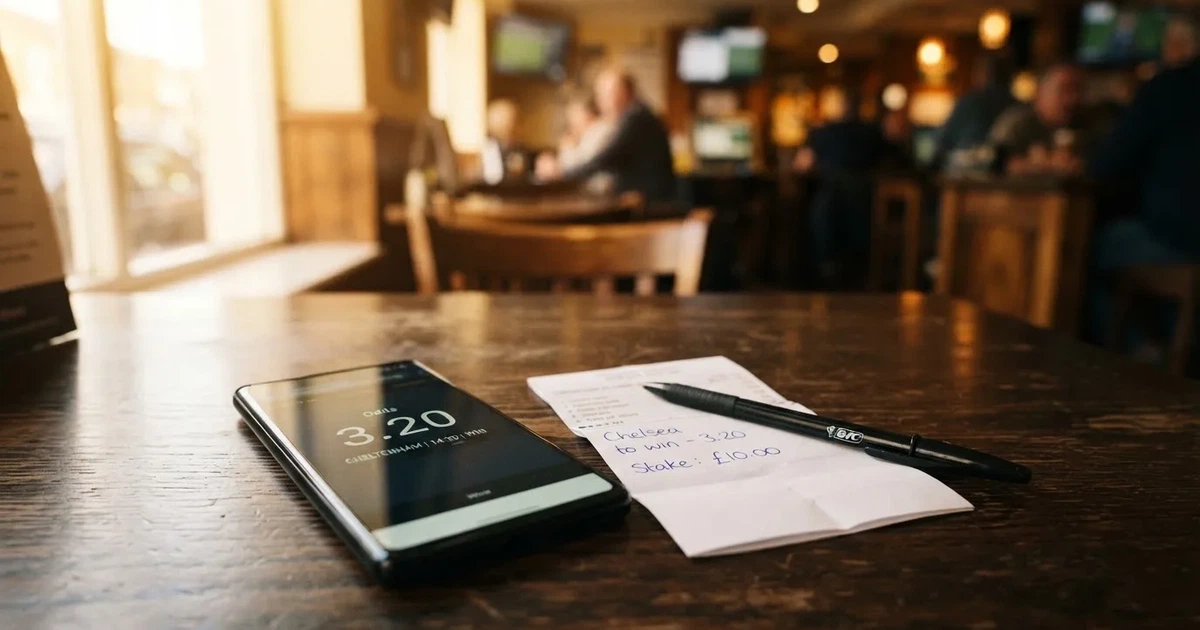
This page is current as of 27 October 2026, and the licence claims below were verified against the Gambling Commission’s public register.
Free bets and welcome offers on UK horse racing
The headline on every promotion page says “free”. Read the small print underneath and the picture changes. A UK welcome offer typically ties a free bet — a token whose stake is not paid back on a win, and whose winnings are yours — to a first qualifying wager. BetGoodwin, for example, pairs a first £10 stake with three £5 free bets (a sports bet, an acca and a Sub-Cover bet). Dabble’s structure mirrors that — £10 in, £10 in free bets — but adds a seven-day expiry on those free bets and a minimum-odds floor the qualifying bet must clear. VBet goes a different route: a £10 free bet if a verified customer’s first bet loses. Tote frames its product around the pool itself rather than a fixed-odds token.
The wagering cap changes how big that “free” amount can grow. From 19 January 2026, bonus wagering requirements at GB-licensed operators are capped at 10x — so a £10 bonus carries at most £100 of required betting, and an offer built around a 50x rollover is no longer allowed. There is no statutory cap on the money value of a free bet, but the expiry clock, the minimum price the qualifying bet must reach, and the markets the offer excludes (ante-post, tote, pari-mutuel) decide whether the offer is reachable inside a week.
Offers come in a few shapes, each with its own cost. A cash bonus is money added to the balance, usually with its own wagering attached. A free bet pays out only the profit; a £10 free bet at 5.00 returns £40, not £50. A first-bet refund, where present, is a free bet in disguise — the stake is refunded as a token if the first bet loses, not as cash. A price boost raises the published odds on one runner or market, often capped at a maximum stake. Acca insurance refunds the stake (usually as a free bet) if one leg of an accumulator lets it down. Cashback returns a slice of net losses over a period, sometimes in cash, more often as a free bet. Each one moves a different amount of money and asks a different amount in return.
The honest summary: the qualifying bet is where the bookmaker earns from the promotion, and the free token is what you receive in return. For a bettor who would have placed that first wager anyway, the offer lifts the expected value. For a bettor placing it solely to claim the token, the qualifying bet is the cost. There is no version of “free” that skips that arithmetic.
Apps and mobile betting for horse racing
A betting app is a thinner window onto the same bookmaker — same markets, same odds engine, same terms. What changes is how quickly prices update, how reliably a wager settles while you’re on the move, and whether the app handles a sport whose betting pattern is unusual: races settle in clusters, often several within an hour, and live in-play markets are short-lived compared with football.
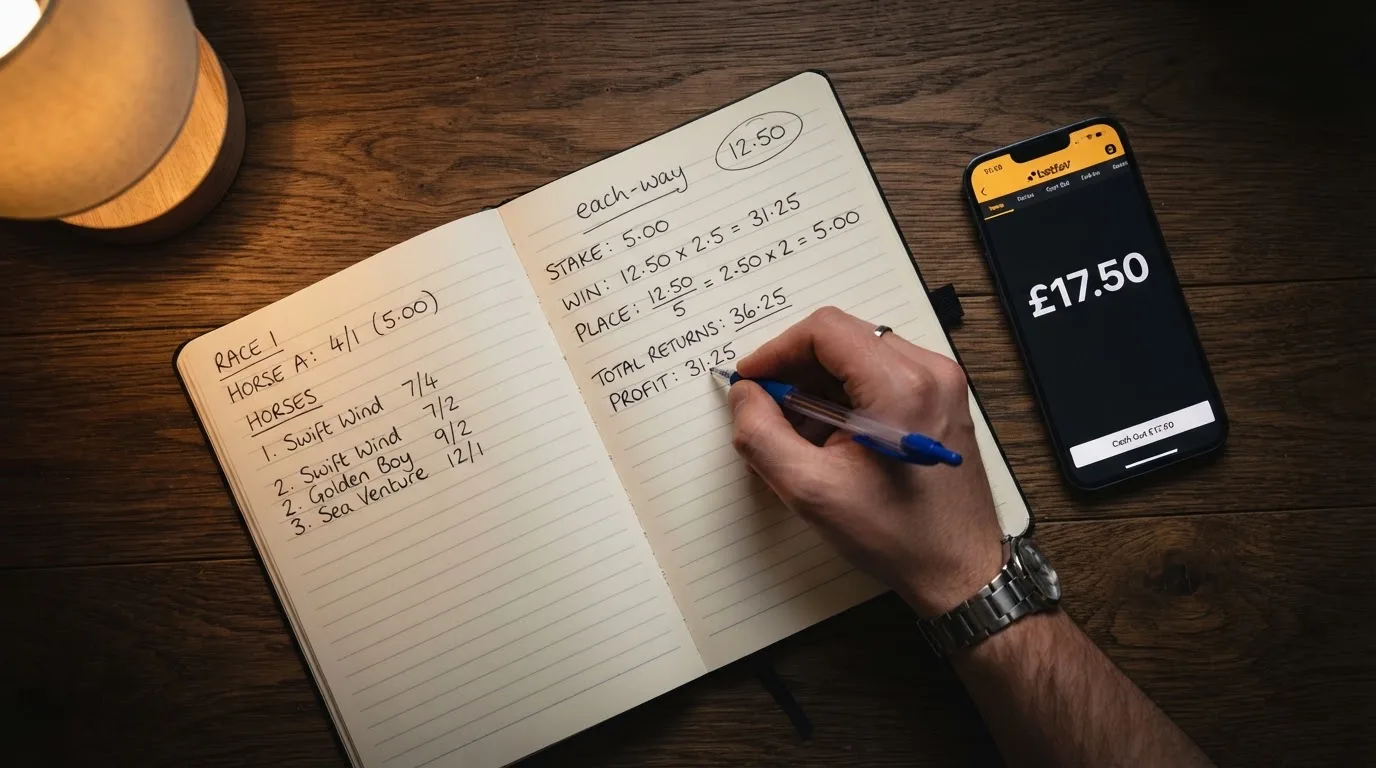
The leader on downloads in the UK is bet365, whose app is also the official global betting partner of the UEFA Champions League. Its horse-racing product surfaces Best Odds Guaranteed, Bet Builder+ (which combines markets from one event pre-match and in-play), Super Boosts, Winnings Boosts on Bet Builders and selected singles, and daily Bet Boosts. Sporting Index’s app adds spread betting to the same shelf, with the option to switch between fixed odds and spread markets, in-play betting, auto cash-out and Multi-Markets. Midnite’s horse-racing section sits inside a wider in-play board, an acca builder and price-boosted markets with stated maximum-stake limits.
The specialist end of the market is where apps tend to diverge most. Betfred’s app covers twenty-one sports plus over two thousand casino games and runs on the Done Brothers account. Lottoland UK’s app is a mixed cabinet — casino, lottery betting, sports and scratchcards — and is licensed by the Commission for customers in Great Britain. Geoff Banks’ app is published by GB Sports Advisors Ltd and focuses on ante-post and live in-play pricing. Kalooki Sportsbook runs its own dedicated app under Kalooki Sports Book Ltd (company number 12938274), Commission account 57730, and is a GAMSTOP member.
A bettor’s task in picking an app is narrower than the marketing suggests. Three things decide whether the app is the right one: whether it covers the meeting you want (an evening all-weather card at Kempton is not the same product as a Saturday ITV fixture), whether in-play and cash-out work on the markets you actually use, and how the operator handles a non-runner — a voided leg in an accumulator, a Rule 4 deduction on a winner. The rest is interface, and interface is a matter of taste.
In-play horse racing and cash out
Live horse racing betting is short, brutal and different from the in-play product on football. A race settles in under three minutes; prices move from a stable pre-race board into a sprint as the stalls open, then disappear the instant the result is called. GB-licensed bookmakers offer in-play on horse racing as standard; the controls live in each operator’s licence conditions and customer-protection duties, not in statute.
Cash out sits beside in-play and works differently. The bookmaker offers to buy your bet back at a price of its own, recalculated from the current market and the position you’ve taken. The price is always worse than the fair value the live board implies, because the bookmaker needs its own margin at the moment it quotes. For a horse that’s shortening into a favourite, the cash-out value tracks upward; for a horse drifting on the turn, it shrinks towards zero. Auto cash-out, offered by Sporting Index among others, lets you name a threshold and triggers the moment the live price reaches it.
The thing to know about in-play horse racing is its tempo. Most operators suspend the win market during the race; some keep a running price on selected runners up to a point in the race and pull it before the final furlong. The bookmaker’s own product page sets out which markets survive the start. Live streaming of races is a separate question entirely — At The Races and Racing TV hold the broadcast rights, and a bookmaker app surfaces them only by commercial agreement. Where live pictures aren’t offered, a radio commentary stream or a textual feed is the substitute.
The honest read: cash-out is a tool, and like every tool it costs money. It earns its fee when you’ve taken a position, the race has turned, and you’d rather lock in something than watch it evaporate. It costs when you cash out a horse that’s about to win, because the bookmaker’s repurchase price sits below the eventual payout.
Tips, predictions and the problem of “systems”
Searching for “today’s horse racing betting tips” turns up a torrent of content. Most of it is honest handicapping, written by people who watch the sport for a living; a fraction of it is written by people who sell subscriptions or affiliate links to bookmakers. Neither group can tell you which horse will win a specific race, because nobody can. That is the starting point for anyone thinking about tipsters, systems, or “best horse racing betting odds today” pages that promise a winning angle.
A staking plan is a different thing from a tip. Bankroll management — flat stakes, a fixed unit size, a stop-loss — sits inside the bettor’s control and it does cut variance. A staking system that asks you to chase losses by raising stakes after losers does the opposite: it shrinks a small losing streak into a bankroll-ending day. A “system” that claims to beat the book on a single race is a contradiction in terms, because the bookmaker’s margin is taken on every runner and the sum of implied probabilities across the field adds up to more than 100 per cent.
What the market does offer is information: sectional times, going reports, trainer-jockey combinations, draw bias at all-weather tracks, official ratings and Racing Post figures. None of those turn a non-winning horse into a winner. They make small differences between runners visible, and small differences compound over many bets. A bettor who treats tipsters as one input among several — alongside the form, the going, the market move — does better than one who treats them as the answer.
The practical version: pick a unit size that survives a bad week, never chase, and never let an offer’s headline change a stake plan that was already in place. The arithmetic above is the only edge a recreational bettor can build without inside information.
Bet types and how the price is built
A horse-racing bet starts as a single: a stake on one horse to win. From there the structures multiply, and each one carries its own arithmetic and its own tax on the bettor.
Single. One selection, one outcome. Decimal odds turn a £10 stake at 5.00 into a £50 return — £40 profit and the £10 stake back.
Each-way. Two bets of equal stake. The “win” half pays the full odds if the horse finishes first; the “place” half pays a fraction of those odds if the horse finishes in a set number of places. A £5 each-way bet costs £10. Place terms vary by race and operator. At a British meeting: handicaps with more than fifteen runners pay 1/4 odds for 4 places; twelve to fifteen runners 1/4 for 3 places; other races with more than seven runners 1/5 for 3 places; five to seven runners 1/4 for 2 places; fewer than five runners run win-only. A £10 each-way bet on a 10-1 horse at 1/4 place terms over three places costs £20 — £110 for the win half and £35 for the place half, £145 in total if the horse wins.
Accumulator. Multiple selections combined so all must win. The odds multiply: four runners at 3.00, 4.00, 5.00 and 6.00 produce a 360.00 combined price; a £10 stake returns £3,600. The bookmaker’s margin compounds with each leg, and a four-fold will keep a much larger slice of every pound than a single — the value of an acca is in its payout when one lands, not in its expected return. Acca insurance refunds the stake, usually as a free bet, if one leg fails.
Bet Builder. Combines markets from a single event — for example, a horse to win and the race to feature over a stated total number of favourites — into a single price. LiveScore Bet’s Bet Builder holds up to ten selections and covers match result, both teams to score, corners, total goals, player scoring and card markets; the horse-racing equivalent on operators that offer it covers win, place, forecast and finishing-position markets on the same race.
Spread betting. A stake on whether a variable — the SP of the favourite, the winning distance in a race, the number of finishers in a frame — finishes above or below a stated number. Spreadex is regulated by the FCA for spread betting and by the Gambling Commission for fixed-odds betting, and states that spread betting losses can exceed the deposit. Sporting Index offers both fixed-odds and spread markets under one account.
Ante-post. A bet placed before the final declarations, when the field and the going aren’t yet settled. Prices are larger, non-runner terms are harsher, and an offer such as Best Odds Guaranteed does not apply. Each bookmaker publishes its own ante-post rules.
The price carries a tax the bettor doesn’t pay cash for. Take an illustrative two-way market at 1.90 / 1.90 (fractional 9/10) — not a quoted price but the kind of symmetric line a bookmaker posts on a match result. The payout share for that market is 1 ÷ (1/1.90 + 1/1.90), which works out to about 0.95 — meaning the bookmaker returns roughly 95p on the pound across the long run. The remaining 5p is the book’s margin: what the bookmaker keeps of every unit bet on this market. On a horse race with twelve runners priced at roughly 6/1 across the field, the margin is steeper still — well over 20 per cent on the win market on most days. Margins are higher on the place market, on forecasts, and on exotic bets, and lower on the win market on major meetings where sharp money has trimmed the line.
A horse at decimal odds of 5.00 implies a 20 per cent chance; at 10.00, ten per cent. The sum of those implied probabilities across the field always exceeds 100 per cent, and the excess is the bookmaker’s margin. Read that and a horse’s “form” stops being the question and the price starts being the question.
UK horse racing: fixtures, codes and the calendar
British racing divides into flat and jump. Flat racing is run between two points around a straight or oval track; jump racing — steeplechasing and hurdling — is called National Hunt racing in Great Britain and Ireland. Flat distances range from 440 yards (400 m) to more than four miles (6.4 km), with five to twelve furlongs the most common ground. National Hunt is built around obstacles, longer distances, and a winter-to-spring calendar.
Race types vary by weight treatment. In a handicap each horse carries a different weight based on its assessed ability, set by the British Horseracing Authority’s handicapper; the field closes towards the leader and the race is supposed to be a test of judgement. In a conditions race the weights are set by age, sex and allowance — younger horses and fillies get weight from older horses and from colts and geldings — and the form is tested without the levelling the handicap applies.
The British Flat’s three Classics are the 2000 Guineas, the Derby and the St Leger. Winning the three is the Triple Crown, last achieved by Nijinsky in 1970. The jumps equivalent is built around the Cheltenham Festival in March and the Grand National at Aintree in April, with the Champion Hurdle, the Cheltenham Gold Cup and the King George VI Chase at Kempton on Boxing Day among the sport’s calendar peaks.
Bookmaker coverage expands with the meeting. At an ITV Saturday fixture, Best Odds Guaranteed applies from early morning on the day, the win market carries a long tail of bookmakers, and place terms are at their most generous. At a midweek all-weather meeting at Newcastle or Wolverhampton, the field is shorter, the form less reliable, and the place book smaller — sometimes win-only. Those conditions change the value of an each-way bet and the wisdom of an accumulator.
Pari-mutuel (pool) betting is the older structure and still runs at British meetings through the Tote: bets are pooled, the take is deducted, the remainder is divided among winning tickets. SP — starting price — is the price the industry sets from the on-course bookmakers’ boards at the off, and forms the basis of bets struck without a fixed price.
How the ten compare on licence and account standing
Every brand reviewed below holds a Gambling Commission remote licence for general betting on real events; the table sets out the register entry and the holder of record, then notes what each operator’s own terms page says about the relevant subject. The Commission account numbers are how a reader checks a brand against the public register before opening an account.
| Brand | Commission remote licence (register line) | What the operator’s own terms state |
|---|---|---|
| Tote | Licence 054779-R-331321-008, holder TDCO Limited | Pool-betting product on UK and Irish racing; pari-mutuel pricing structure. |
| BetGoodwin | Licence 002927-R-327985-008, holder Goodwin Racing Limited | Welcome offer “Bet £10 & Get £15 in Free Bets” as three £5 tokens. |
| Geoff Banks | Licence 054095-R-330366-010, holder GB Sports Advisors Limited | Ante-post and live in-play prices on a GB Sports Advisors–published app. |
| VBet | Licence 044662-R-324273-022, holder SCGO Limited | Welcome offer: £10 free bet on a first bet of £10+ that loses. |
| Sporting Index | Licence 027343-R-308898-011, holder Sporting Index Limited | Fixed-odds and spread markets under one account; auto cash-out and Multi-Markets. |
| Kalooki Sportsbook | Licence 057730-R-333396-005, holder Kalooki Sportsbook Limited | GAMSTOP member; Kalooki Sports Book Ltd operates under account 57730. |
| LiveScore Bet | Licence 056859-R-332720-005, holder LiveScore Betting and Gaming (Gibraltar) Limited | Bet Builder allows up to 10 selections across specified markets. |
| Dabble | Licence 065677-R-340363-005, holder Dabble Sports UK Ltd | Welcome offer “Bet £10, Get £10 in Free Bets”; 7-day expiry; stake not returned. |
| 10bet | Licence 043173-R-322899-023, holder Blue Star Planet Limited | Cash out, Bet Builder and Live Streaming on football, tennis and horse racing. |
| Betfred | Licence 039544-R-319290-010, holder Petfre (Gibraltar) Limited | Sports, casino and games app covering 21 sports. |
The featured set does not exhaust the licensed market. The Commission’s public register lists hundreds of brands holding remote general betting licences for Great Britain; what’s reviewed here is the ten the comparison judged worth a closer look, and the rest deserve the same licence check before a reader opens an account with any of them.
Tote — the pool model in a fixed-odds market
Tote runs pool betting on UK and Irish racing under the TDCO Limited licence. Its pricing is set by stake distribution across the pool rather than a margin set by the book, so the take is the take and the dividend is the dividend. For a bettor who prefers a single national pool to a bookmaker’s overround, that distinction is the entire pitch; for a bettor shopping for Best Odds Guaranteed, Tote isn’t in that race at all. The product fits a player who values the structure over the headline price and who bets on major meetings where the pool is deep enough to return a dividend worth claiming.
BetGoodwin — a Goodwin Racing–scoped racing book
Goodwin Racing’s online operation fronts racing in a way the high-street shops did for decades. The welcome offer — £10 in, £15 in free bets split three ways — sets the tone: a small stake produces a small but multi-part bonus, with the Sub-Cover bet a token specifically tied to racing’s exotic markets. For a bettor building a racing-only book, the Goodwin brand is a focused rather than a sprawling choice, and the licence travels under the Goodwin Racing Limited holder.
Geoff Banks — ante-post depth on a GB Sports Advisors platform
Geoff Banks’ product is published by GB Sports Advisors Ltd, and the ante-post board is where the account earns its place. Ante-post prices carry longer windows and larger prices than the day-of board, with non-runner terms drawn tighter; the live in-play board closes the loop once declarations are in. For a bettor who plans ahead and pays attention to declarations and going changes, this is the angle. For a last-minute Saturday punter, less so.
VBet — a verified-customer welcome built around a refund
VBet’s £10 free bet on a first bet of £10+ that loses operates as a refund of the first stake: stake the £10, lose it, take a free bet back. The qualifier: the customer must be verified before the bet settles. Verification is a Commission licence condition in any case, but VBet’s offer is built to enforce it at the front door. For a bettor comparing this against a cash-matched welcome, the comparison is between an offer that pays only if the first bet loses and one that pays regardless. The headline maths depend on which side of that bet a reader’s reading from.
Sporting Index — fixed odds and spread betting, one account
Sporting Index holds a Commission licence for fixed-odds betting and operates spread markets in parallel, with auto cash-out and Multi-Markets across the product. The FCA’s regulation covers the financial spread side; the Gambling Commission’s covers fixed odds. For a bettor who already trades financial indices, the convergence of a betting account and a spread-betting account under one login is a different proposition from a single-mode bookmaker — and the disclosure that spread losses can exceed the deposit is the explicit warning that comes with it.
Kalooki Sportsbook — the smaller book with the operator behind it
Kalooki Sportsbook operates under Kalooki Sports Book Ltd (company number 12938274) and Commission account 57730, and is a GAMSTOP member. It sits in a slightly smaller niche than the established racing books: the brand is more recent, the company is a single-purpose operator rather than a multinational gaming group, and the marketing is conservative. For a bettor who values the operator’s narrower footprint and the licence clarity, the Kalooki account holds together; for a bettor looking for Best Odds Guaranteed on every meeting, the published product set may be thinner.
LiveScore Bet — Bet Builder depth and a score-led interface
LiveScore’s pitch is the live-data brand bolted to a sportsbook: live scores on the homepage, Bet Builder on the betting side, with up to ten selections across match result, both teams to score, corners, total goals, player scoring and card markets. The horse-racing section runs inside that wider product. The account is held by LiveScore Betting and Gaming (Gibraltar) Limited, and the licence travels under that holder. For a reader who lives in the live-score app already, the betting product is a short reach from the device they’re already holding.
Dabble — social-led betting with a standard welcome
Dabble’s product leans social — a chat-led interface and a marketplace for tipping — and its welcome offer is the usual £10-in, £10-in-free-bets structure, with a seven-day expiry on the free tokens and the stake not returned. The minimum-odds floor on the qualifying bet is the qualifier that decides whether the offer is reachable inside the week’s window. The account is held by Dabble Sports UK Ltd.
10bet — a multi-sport book with horse racing inside
10bet’s sportsbook covers football, tennis and horse racing with Cash out, Bet Builder and Live Streaming available across the product. The licence is held by Blue Star Planet Limited; the account is one product line of a wider sportsbook. For a bettor who wants horse racing in the same wallet as football and tennis in-play, the 10bet account covers the ground in one deposit.
Betfred — the high-street book that runs online
Betfred’s sports, casino and games app is published by Done Brothers (Cash Betting) Ltd and covers twenty-one sports plus over two thousand casino games; the online licence is held by Petfre (Gibraltar) Limited under the same brand family. The book has Best Odds Guaranteed on UK and Irish racing from 8 AM on race day, with terms published on its help centre. The Done Brothers–licensed high-street presence is the bigger weight behind the brand; for a bettor who wants the high-street bookie’s muscle available on the phone, that’s the angle.
The wider UK horse racing market in 2026
The British horse racing market is bookmaker-led, with hundreds of brands holding a Gambling Commission remote licence for general betting on real events. There is no state monopoly, no cap on the number of licences, and no statutory list of permitted events or markets — anything a licensed operator chooses to offer in its product, and that the Commission licences it for, is a market a GB customer can bet on. The Commission’s public register, searchable by business name, trading name, domain or account number, is the whole test of whether a brand holds a licence; a domain ending in .co.uk proves nothing, since licensed operators use .com as well.
The market divides into three loose tiers. The high-street legacy books — Betfred, William Hill, Ladbrokes, Coral — combine retail reach with online accounts. The online-first specialists — bet365, betfair, Paddy Power, Sky Bet — built their customer base online and use scale and product breadth (Bet Builder, Super Boosts, Best Odds Guaranteed, live streams) as their edge. The racing-focused independents — BetGoodwin, Geoff Banks, Fitzwilliam Sports — run narrower books with sharper racing coverage and smaller marketing footprints. A bettor’s first choice is which tier’s trade-off they prefer: depth and product richness, or focus and a smaller book.
Best Odds Guaranteed is the single most distinctive feature of the UK horse-racing market and the easiest to get wrong. William Hill, for instance, pays BOG on UK and Irish racing from 8 AM on the day of the race, on both single and multiple bets; the rule does not extend to ante-post, tote or pari-mutuel bets. BOG pays the higher of the price taken at bet placement and the starting price of the horse at the off — a one-way upgrade in the bettor’s favour that, on horses whose price shortens into the off, returns a notable uplift on the stake.
The product mix matters for a different reason. A bookmaker with Bet Builder+, acca insurance, in-play markets on every meeting and a Super Boost shelf is a product for a customer who wants the whole apparatus. A racing specialist with deep ante-post board and conservative welcome offers is a product for a customer who knows what they want and doesn’t need the rest. Neither is right for everyone; the choice is the page’s pitch.
Regulation, licence and the offshore question
Every operator reviewed here holds a Gambling Commission licence. A licence isn’t a marketing badge — it’s the basis on which GB consumers can complain to an approved dispute-resolution body, rely on GAMSTOP for self-exclusion, and claim the bonus-wagering cap (10x) applies. There is no deposit or payout guarantee, but the licence ensures supervision, an identity-verification regime that catches problem gambling earlier, and a local legal venue for disputes. A licence is also why the regulator gets a vote on the in-play rules, the bonus rules and the marketing rules.
The Gambling Commission licenses the whole commercial market under the Gambling Act 2005, which covers Great Britain (England, Scotland and Wales); Northern Ireland is outside the Act and is governed by older legislation. Since the Gambling (Licensing and Advertising) Act 2014, an operator whose remote facilities are used in Great Britain needs a Commission licence wherever it is based — a Curaçao, Maltese or Gibraltar licence is not a substitute. Sections 33 and 36 of the 2005 Act, as amended, are the statutory basis. Minimum age is 18; name, address and date of birth are verified before a customer can deposit or gamble, including with a free bet or bonus.
The practical test for a reader is short: take the operator’s name or domain to the Commission’s public register and look it up. Quote no count of licensed operators without its access date — the register is the test, not a number a third party publishes. Several brands sit under one licensee: Ladbrokes and Coral, Paddy Power and Betfair. Never present sister brands as independent operators.
Offshore brands exist outside the GB regime, and the debate around them is louder than the regulation. Honest framing: licensed = identity checks at the door, GAMSTOP coverage, the 10x bonus cap, the £150 financial vulnerability check (a public-record check, not an income check), an approved dispute-resolution route and British consumer redress if funds go astray. Unlicensed = none of those protections, with the real risk that the operator simply withholds funds. Neither is “the safe choice” by default — licensed protects a bettor’s money and standing under the law, but also requires verification at the first deposit.
Enforcement against unlicensed operators is disruption, not blocking. The Commission serves cease-and-desist notices, refers unlicensed sites to search engines, and works with registrars, hosts and payment providers. Court-order DNS blocking powers are being extended to the Commission; ISP-level blocking isn’t yet in operation in any general sense, and never write that it is.
The tax frame is straightforward and bears repeating. The player pays no tax on betting winnings in Great Britain. General Betting Duty is paid by the operator on its gross profits at 15 per cent under the current rate; from 1 April 2027 a 25 per cent rate applies within it for remote betting, while remote bets on UK horse racing stay at 15 per cent (HM Government policy paper of 26 November 2025). Spread betting carries separate rates (3 per cent financial, 10 per cent other). Whether operators pass duty on through the odds isn’t established — never write that the player is charged duty. The Commission’s statutory levy is a separate charge from duty.
Responsible gambling under the licence
A licensed bookmaker is required to offer its customers safer-gambling tools. GAMSTOP is the national multi-operator online self-exclusion scheme and is a mandatory licence condition for online operators since 31 March 2020; periods run six months, one year, five years, or five years with auto-renewal, and after the minimum period the exclusion stays in place for a further seven years unless the customer asks GAMSTOP to remove it. GAMSTOP covers online sites and apps; betting shops use a separate service.
Deposit limits are operators’ own, set by the customer’s choice and bounded by the Commission’s Remote Technical Standards. The first phase of changes applied on 31 October 2025; a second phase has been postponed to 30 September 2026 — whether it is live is not established. There is no state-set deposit or loss ceiling. The financial vulnerability check (LCCP condition 3.4.4, in force since 30 August 2024) triggers when a customer’s deposits minus withdrawals exceed £150 in a rolling 30 days (since 28 February 2025); it is a public-record check such as a bankruptcy register or county-court judgment, not an income check and not a credit-reference check. Affordability checks proper were the subject of an announcement (7 July 2026) without a start date — write them as announced, staged, with no start date, never in force.
The credit-card ban matters at the cashier. Credit cards are banned for gambling in Great Britain since 14 April 2020 (LCCP condition 6.1.2); a credit card funding an e-wallet that pays a gambling site is also covered. Debit cards and bank-based payments aren’t. Identity verification at first deposit means no anonymous play at a licensed site; at higher spend, source-of-funds questions are normal under the money-laundering rules. There is no British named-account rule, no state list of permitted payment methods, and no rule for or against cryptocurrency deposits at licensed operators — describe payments qualitatively, and only from each operator’s terms.
Help exists outside the operator. GamCare runs the National Gambling Helpline. GambleAware funds treatment and education. The NHS runs gambling clinics. Gamblers Anonymous runs local groups. Fitzwilliam Sports’ page, for instance, links to GambleAware, GamStop and Gamblers Anonymous from its safer-gambling page. Self-exclusion is the single most powerful lever a bettor has, and GAMSTOP makes a single application cover every licensed operator.
Crypto, e-wallets and the question of payment flexibility
Cryptocurrency is not a regulated payment method at GB-licensed bookmakers: a Commission rule for or against crypto deposits isn’t established, and the practical picture is set by each operator’s cashier. A bettor paying in a stablecoin or a token is paying through whatever the bookmaker’s payment provider accepts, and the verification at the door still applies — the cashier may route the deposit through an exchange that performs a KYC check before the funds reach the betting account.
Crypto’s pull for a bettor is not anonymity at a licensed site, because no licensed site lets a bettor stay anonymous. The pull is speed of settlement, reach where fiat rails are awkward, and the option of betting from a wallet rather than from a bank account. The cost is the volatility of any non-stablecoin position and the wider absence of GB consumer protection if an unlicensed brand is used. The trade-off is simple: the reason crypto is interesting to a bettor is the same reason it is uninteresting to a regulator, and the licensed market hasn’t yet built a regulated crypto-onramp.
E-wallets and instant bank transfers operate inside the regulated frame. Apple Pay, Google Pay, PayPal, Skrill and Neteller are accepted at most licensed bookmakers where their use is permitted; the cashier tells the bettor what is and isn’t available. A withdrawal usually returns to the deposit method by default — a banking norm, not a betting quirk.
The honest frame on payment flexibility at a licensed site: verification before the first deposit, debits and bank transfers freely, credit cards out, e-wallets where the operator supports them, crypto not treated as a special case. Anything else is the operator’s own house rule.
How the margin calculation reads
Take an illustrative two-way market at decimal odds of 1.90 / 1.90 (fractional 9/10). The payout share is 1 ÷ (1/1.90 + 1/1.90), which works out to 0.95 — meaning that across the long run the bookmaker returns 95p of every pound wagered on this market. The remaining 5p is the book’s margin: what the bookmaker keeps of every unit bet on this market, before operating costs. The margin on a horse race with twelve runners priced around 6/1 across the field is steeper — around 20 to 25 per cent on the win market on most days, higher on the place market and on exotics. In-play margins are tighter on liquid races, looser on smaller fields. This is the trade the bettor is making on every bet: a slice goes to the bookmaker before a result is called.
Stating it as a band matters because every race is its own market. The 5 per cent on the illustrative line is a starting position, not the number a bettor will face on a real race.
Frequently asked questions about horse racing betting odds
How do I bet on horse racing?
Pick a licensed bookmaker from the Commission’s public register, complete identity verification (name, address and date of birth) before the first deposit, fund the account with a debit card or bank transfer (credit cards are banned), pick a race, pick a horse, choose a stake, and confirm the bet. Each-way doubles the stake but pays a fraction of the win odds if the horse only places.
How do I work out a horse racing bet?
Take the stake and multiply it by the decimal odds: a £10 stake at decimal odds of 5.00 returns £50 total — £40 profit plus the £10 stake back. For an each-way bet, the work splits into a win half and a place half using the place-terms fraction the race sets; the place part pays the odds × the fraction (a quarter, a fifth) on the same stake.
How do horse racing odds work?
The odds are the price a bookmaker pays per pound staked, not a probability. Decimal odds of 5.00 imply a 20 per cent chance of winning; at 10.00, ten per cent. The implied probabilities across a field always sum to more than 100 per cent, and the excess is the bookmaker’s margin. The bookmaker earns its margin on every bet, win or lose.
How do I check a bookmaker holds a Gambling Commission licence?
Search the Commission’s public register by business name, trading name, domain or Commission account number. The register is the whole test. Licensed operators use .com and .co.uk, so the domain proves nothing on its own. Sister brands often run under one licensee — Ladbrokes and Coral, Paddy Power and Betfair. A brand appearing on the register is licensed; a brand not appearing is not licensed at the time of the search.
How is the return on a bet worked out from the stake and the odds?
Decimal odds multiply the stake: £10 at 5.00 returns £50. The profit is the return minus the stake. For a combination bet, the odds of the legs multiply into a single combined price: four legs at 3.00, 4.00, 5.00 and 6.00 produce 360.00, and £10 returns £3,600. The stake is paid back; the profit is everything above the stake.
What is the bookmaker’s margin, and how do I see it in the odds?
The margin is the slice of every pound wagered the bookmaker keeps, calculated as 1 minus the payout share (the reciprocal sum of the implied probabilities of all outcomes). For a symmetric two-way line at 1.90 / 1.90, the margin works out at around 5 per cent. For a horse race, the implied probabilities of every runner added together exceed 100 per cent, and the excess — typically 20 per cent or more on a typical race — is the margin.
Horse racing & greyhounds – Grey Hound
Content created by the «Grey Hound» team
