
American football betting odds in 2026: who prices what, and who it suits
 Available in US
Live odds on the NFL, the Super Bowl, college football and the Canadian Football League are easy to find at any UK-licensed bookmaker. Choosing between them is harder, because the price a screen shows is only one piece of a market shaped by margin, by what is and is not offered around it, and by what the bookmaker does in play once the whistle has gone. The page below lays out the choices a Great Britain punter actually faces when pricing up an American football bet in 2026: the live markets, the types of bet, the season, the comparison of the ten brands on the Gambling Commission’s public register, and the rules, the protections and the offers that sit around the price.

Data current as of 27 October 2026, checked against the Gambling Commission’s public register.
American football live betting and cash out
American football is a game of possessions, and a possession can flip a price in under a minute. Live betting, also called in-play, lets a punter strike a price after the snap rather than take one set on Monday morning. Every UK-licensed bookmaker on the list below runs an in-play product on NFL fixtures, and the bigger ones run it on college football and on the CFL as well.

The in-play offering is not just a live moneyline. The more interesting markets open after the opening drive: next score type (touchdown, field goal, safety, or no score), next drive result, whether the next score is a touchdown or a field goal, and team totals that adjust as the game moves. A short injury report before kick-off can move a pre-match line two or three points; an in-game injury to a quarterback can move it again before the next play. The bookmaker’s software re-prices continuously, and a price that is on the screen for half a second is normal at the busiest part of the clock.
Cash out sits on top of the live market. The bookmaker offers to settle the bet before the final whistle, at a price that reflects the current state of the game and the bookmaker’s own margin. The offer is the bookmaker’s, not the punter’s, and the price it quotes is the bookmaker’s view of what the bet is worth at that instant. Punters who want full control of the exit can place a lay bet on a betting exchange instead, where any other user can take the other side at a price they set. Exchanges run on a separate Gambling Commission licence (the betting intermediary licence) and apply a commission to net winnings rather than building a margin into the price.
In-play brings its own risks. The price can be suspended at any time, sometimes for a matter of seconds during a goal-line stand, sometimes for minutes while the bookmaker waits for clarity. Bets placed in that window are usually rejected; bets placed a heartbeat earlier are usually accepted at the price that was on the screen. Operators’ own terms cover the suspension policy, the voiding of bets placed on obviously wrong prices, and the settlement of bets on events that are abandoned mid-game.
Tips, predictions and the limits of strategy
A search for “American football betting tips” turns up tipsters, model-based predictions, and handicappers who publish picks every week of the NFL season. Some sell picks as a subscription; most give them away and monetise through affiliate links. None of them know the outcome of a game, and any system sold as a way to win is sold against that fact.
What a tipster can do is tell a punter what other punters and bookmakers already think. A line is a public price set by a bookmaker’s traders and a public prediction set by the betting market. The punter’s job is to compare the two and decide whether the line is too high, too low or about right. The tools are the same as in any other sport: read the injury report, know which team is on a short week, check the weather, watch for line movement, and remember that the bookmaker’s margin is built into every price.
The clearest-eyed piece of strategy is bankroll management: stake a fixed unit, never chase losses, and accept that the long-term return for a recreational punter is negative because the margin is. A punter who treats the activity as paid entertainment, with a budget for the season and a willingness to lose it, is in the right frame. A punter who believes a system can produce a positive return is not.
Predictions that name a winner, a “sure bet” or a “lock” should be read as opinion, not as forecast. Even an injury report and a model is opinion filtered through probability; the only certainty at kick-off is that one of the two teams will lose.
Bet types, odds and how a price is built
American football is a points sport: a touchdown is six, a field goal three, a safety two, an extra-point kick one, and a two-point conversion two. The handicap and the total run on points, the moneyline runs on who wins, and almost every other market is built from one of those three.
The moneyline is the simplest. Each side has a price; pick the winner, collect the price. When the two teams are evenly matched, both sides sit around 1.91 in decimal odds (10/11 in fractional, close to even money), and the bookmaker’s margin is the gap between what the two prices should be at a perfectly efficient market and what they actually are. When one side is a heavy favourite, the favourite’s price drops towards 1.10 or 1.05 and the underdog’s price climbs into the high single digits, and the gap widens. The bigger the gap, the heavier the favourite, and the more a punter has to stake to clear a small return.
The spread, also called the handicap, levels the teams. A line of New England −3.5 means New England has to win by four or more for a spread bet on them to pay. A total is a line on the combined score: over 47.5 pays if the two sides add up to 48 or more, under 47.5 pays if they add up to 47 or less. A line that lands exactly on the number is a push and the stake is returned, unless a tie is offered as a selection.
A bet builder, sometimes called a same-game multi, combines markets from one game into one price. A punter might combine a Patriots moneyline with Tom Brady over 1.5 passing touchdowns, or a Chiefs handicap with over 48.5 total points. The price is the multiplied price of the legs, and the margin the bookmaker charges is layered on top, so a bet builder is usually a heavier-margin bet than a single.
A combination bet, the accumulator, links two or more separate games. The price is the multiplied price of the legs and a winning accumulator pays one stake times the multiplied price. A four-fold at decimal odds of 1.80, 2.10, 1.91 and 1.95 pays 1.80 × 2.10 × 1.91 × 1.95 = about 14.04, so a £10 stake returns £140.40 if all four legs win. The accumulator’s appeal is the long price from a small stake; its cost is that one losing leg ends the bet, and the margin of each leg is multiplied into the price.
The odds themselves are written two ways in Great Britain. Fractional odds (5/1, 11/10, evens) state the profit against the stake: 5/1 pays £5 profit for every £1 staked, evens pays £1 profit for every £1 staked. Decimal odds state the total return: 6.00 pays £6 return for every £1 staked, of which £5 is profit. The conversion is decimal = fractional + 1, so 5/1 becomes 6.00, evens becomes 2.00, and 11/10 becomes 2.10. The pages below use decimal form because the calculation is shorter and because the bookmakers’ own sites default to it on UK accounts. Where a bookmaker’s own site still shows fractional, the conversion is straightforward: a price of 9/10 (nine to ten) is 1.90 in decimal.
How a margin sits inside a price is the next layer. A perfectly efficient two-way market with no margin would price each side so that the inverse prices add up to exactly 1.00: 2.00 on each side, with one divided by the other to add to one. A real market adds a margin, so the inverse prices add up to more than 1.00. The excess is the margin. Take the illustrative two-way market at decimal odds 1.90 / 1.90 that the calculation below uses as an example: 1/1.90 + 1/1.90 = 0.5263 + 0.5263 = 1.0526, and the margin is 1 − (1/1.0526) ≈ 5.0%. That is the bookmaker’s take on every unit staked on the market. The two-way line is symmetric so the margin lands equally on both sides; on an asymmetric line, where the favourite is shorter and the underdog longer, the bookmaker still pulls a margin from the whole market, but the gap between the displayed prices is wider. A punter who wants to know the margin of a specific game and a specific bookmaker has to do the arithmetic on that book’s price; the formula is the same.
The exchange runs on a different model. A betting exchange does not take a position; it matches back bets (a bet that something will happen) with lay bets (a bet that something will not). The price is the market’s, not the exchange’s, and the exchange charges a commission on net winnings rather than building a margin into the price. The result is a thinner margin on liquid markets like the NFL moneyline and a wider margin on thinly-traded markets like a Tuesday-night college game.
Fixtures, season and what to bet on
The professional game is the National Football League, 32 teams split 16 in the AFC and 16 in the NFC, 17 games over an 18-week regular season, and 14 teams in a single-elimination playoff bracket. The Super Bowl closes the season; Super Bowl LX was played on 8 February 2026 at Levi’s Stadium in Santa Clara, California, the Seattle Seahawks beat the New England Patriots 29-13, and Kenneth Walker III took the MVP. The next Super Bowl is the offseason’s anchor fixture, and the lines for it open within days of the previous one ending.
The college game is the NCAA’s Football Bowl Subdivision, 130-odd teams in conferences and a four-team playoff in January that feeds the national championship. College football is a deep market at the bigger UK-licensed bookmakers, with moneyline, spread and totals on the headline games and a thinner offering on the rest of the schedule. The Canadian Football League is a smaller market still, with the Grey Cup as the season-closer and a slightly different set of rules (a 110-yard field, three downs instead of four, a rouge on a missed field goal).
The UK and Irish punter has a calendar that follows the North American season. Preseason opens in August, the regular season runs September to early January, the playoffs take January, and the Super Bowl closes in early February. The offseason is May to August, when the headline betting activity is futures: Super Bowl winner, conference champion, division winner, season win totals, and the draft in April. Live markets are quietest in June and busiest from October through February.
What to bet on is a matter of taste. A recreational punter who follows one team can bet on that team’s season win total or on weekly spread bets. A more analytical punter watches injury reports, line movement and the closing line. A casual punter takes a futures punt on the Super Bowl in the autumn and forgets about it until February. The market supports all three.
The comparison: ten UK-licensed bookmakers
Ten bookmakers hold a Gambling Commission remote licence and price American football at a level the comparison below looks at. Each one is named, the licence is named as it appears on the Commission’s public register, and what the operator’s own terms say about the subject sits beside it. A place in this list is not a recommendation and not a ranking; it is a list of the brands the comparison is built on.
| Bookmaker | Gambling Commission remote licence and holder | What the operator’s own terms state on the subject |
|---|---|---|
| Star Sports | 9177; Star Racing Limited | A telephone-trading desk is open at 08000 521 321 for opening an account, placing a bet and asking queries, and email support is offered at [email protected]. |
| Bar One Racing | 56516; Bar-One Racing Limited | An Irish independent bookmaker, with shops across Ireland and a stable of sponsorships at Dundalk, Fairyhouse, Navan, The Curragh, Curraheen Park and Cork. |
| Fafabet | 57385; Taichi Tech Limited | Best Odds Guaranteed applies to UK and Irish horse racing win and each-way bets from 9am on race days, paying the starting price if it is higher than the price taken. |
| BetTom | 64959; Bet Tom Limited | A sports welcome of 50% back as a free bet up to £50 plus a matching 50% back up to £50 in free slot funds, full terms on the operator’s site. |
| Fitzwilliam Sports | 48760; SBKI Limited | A Dublin bookmaker with a capped membership, offering instant deposits, fast withdrawals, timeouts and deposit limits, and links to GambleAware, GamStop and Gamblers Anonymous. |
| Betfair | 39439; PPB Counterparty Services Limited | In-play betting, Bet Builder, free live streaming of UK and Irish racing and football in the app, and a 90 Minute Payout market. |
| Unibet | 45322; Platinum Gaming Limited | Sports welcome is “Get £40 in Free Bets when you bet £20” for new GB customers using a debit card or instant bank transfer, with free bets expiring within 7 days of issue. |
| Swifty Sports | 58957; Swifty Global (UK) Ltd | Best Odds Guaranteed, Cash Out, daily price boosts, live streaming, in-play betting, and a Bet Builder listed as coming soon. |
| bet365 | 55148; Hillside (UK Sports) ENC | The official global betting partner of the UEFA Champions League, the most-downloaded sports betting app in the UK, and the home of Bet Builder+, Super Boosts, Winnings Boosts and live streaming of events worldwide. |
| VBet | 44662; SCGO Limited | A sports welcome of a £10 free bet to a new, verified customer who stakes £10 or more on a first-ever bet that loses. |
The table reads from left to right: which brand, which licence the Commission’s register attaches to it, and what the operator’s own terms say about its offering. The licence holder’s name is the corporate name the Commission publishes; the brand name is what a punter sees on the site. Several licences are held by companies that run more than one brand under the same corporate roof, and the register is the place to confirm which.
Star Sports: the telephone bookmaker
Star Sports runs a model few others do. The website prices a market, the app prices a market, and a telephone desk at 08000 521 321 takes bets from customers who want to talk to a human trader about the line. The licence sits with Star Racing Limited; the Commission account is 9177. For a punter who wants a bookmaker that answers the phone and is willing to talk about a price, the proposition is unusual. For a punter who only needs a screen and a tap, the rest of the list below has the larger in-play products.
Bar One Racing: an Irish bookmaker with a UK front
Bar One Racing has rebranded as BAR 1 Betting, and the operation is an Irish independent bookmaker with shops across Ireland. The UK-facing site is the Bar One Racing address, the licence is held by Bar-One Racing Limited, and the Commission account is 56516. Sponsorship is concentrated in racing (Dundalk, Fairyhouse, Navan, The Curragh, Curraheen Park and Cork), and the site’s racing offering is the deepest part of its product. American football sits alongside a full sportsbook.
Fafabet: best odds guaranteed on the racing side
Fafabet’s headline product feature is Best Odds Guaranteed on UK and Irish horse racing win and each-way bets from 9am on race days. The licence sits with Taichi Tech Limited under Commission account 57385. A punter who splits their action between racing and American football and wants the BOG protection on the racing side gets a single account for both. A punter who only bets on American football gets a smaller, less American-football-specialised product than the bigger names lower in the list.
BetTom: a sports welcome with a casino tail
BetTom’s sports welcome offer is 50% back as a free bet of up to £50, with a matching 50% back up to £50 in free slot funds for casino play, with the operator’s own full terms applying. The licence is held by Bet Tom Limited under Commission account 64959. The offer is two-track: a sports half and a casino half, and a punter who only wants the sports half is paying attention to the operator’s terms on the casino side as well. The 10x wagering cap on bonuses from the Commission’s promotion rules is the wider frame; full terms are on the operator’s site.
Fitzwilliam Sports: a Dublin bookmaker with capped membership
Fitzwilliam Sports is a Dublin bookmaker with a capped membership, and the home page describes a “High Stakes Welcome” subject to compliance criteria. The licence sits with SBKI Limited under Commission account 48760. The product is closed-shop, with timeouts, deposit limits and links to GambleAware, GamStop and Gamblers Anonymous on the site. A punter who wants the high-stakes welcome has to apply rather than register, and the rest of the market is on a different scale.
Betfair: the betting exchange and the sportsbook
Betfair runs two products under one brand. The exchange, licensed as a betting intermediary, lets punters back and lay against each other, and the sportsbook, licensed as a remote general betting standard operator, takes bets on its own book. The licence sits with PPB Counterparty Services Limited under Commission account 39439. In-play, Bet Builder, free live streaming of UK and Irish racing and football in the app, and a 90 Minute Payout market are the headline features on the sportsbook side. The exchange is where a punter who wants full control of the exit puts a lay bet to cash out at a price they set.
Unibet: the long-running Scandinavian operator
Unibet states that it has operated since 1999, and the UK site is run by Platinum Gaming Limited, Gibraltar, under Commission account 45322. The sports welcome is “Get £40 in Free Bets when you bet £20” for new GB customers using a debit card or instant bank transfer, with free bets expiring within 7 days of issue. A punter who wants a long-established brand with a sports welcome and a full American football product is the target. The minimum price on the qualifying bet is 2.0 (1/1) in the operator’s own terms.
Swifty Sports: a newer book with the standard set of features
Swifty Sports offers Best Odds Guaranteed, Cash Out on markets including horse racing and football, daily price boosts, live streaming, in-play betting, and a Bet Builder listed as coming soon. The licence is held by Swifty Global (UK) Ltd under Commission account 58957. A punter who wants the standard feature set on a single platform and is willing to wait on the bet builder gets a coherent product. A punter who needs the bet builder on day one is better served lower in the list.
bet365: the largest sportsbook and the deepest product
bet365 is the official global betting partner of the UEFA Champions League, and the app is the most-downloaded sports betting app in the UK. The licence sits with Hillside (UK Sports) ENC under Commission account 55148. Bet Builder+ combines markets from one event into a single bet pre-match and in-play, Super Boosts, Winnings Boosts on Bet Builders and selected singles, and daily Bet Boosts sit on top of the in-play and live streaming of events worldwide. For a punter who wants the deepest in-play product, the most bet builders and the most boosted odds, bet365 is the closest thing to a default choice. The Commission’s promotion rules and the operator’s own terms apply.
VBet: a smaller book with a clean welcome
VBet’s sports welcome offer is a £10 free bet to a new, verified customer who stakes £10 or more on a first-ever bet that loses. The licence is held by SCGO Limited under Commission account 44662. A punter who wants a small, clean welcome on a UK-licensed site and is happy with a thinner in-play product than the bigger names gets a coherent product. The rest of the comparison is a question of how much the rest of the product matters.
The fundamentals of the game and the league
The game is played with eleven players per team on the field, and a professional or college game lasts sixty minutes in four fifteen-minute quarters. The clock stops for incompletions, for out-of-bounds plays, and at the two-minute warning of each half, which is why a televised game runs for about three hours. A team’s offence has four downs to move the ball ten yards; if it makes the ten yards the count resets, and if it does not the ball goes to the other side.
The scoring is the spine of the betting markets. A touchdown is six points, and the scoring team can add one point with an extra-point kick or two points with a two-point conversion. A field goal is three points, kicked when the offence is close enough to the end zone but not close enough to be sure of a touchdown. A safety is two points awarded to the defence, scored by tackling an opposing ball carrier in his own end zone. A two-point conversion can be run or passed, and the decision to go for one is a coaching call that shapes the live market.
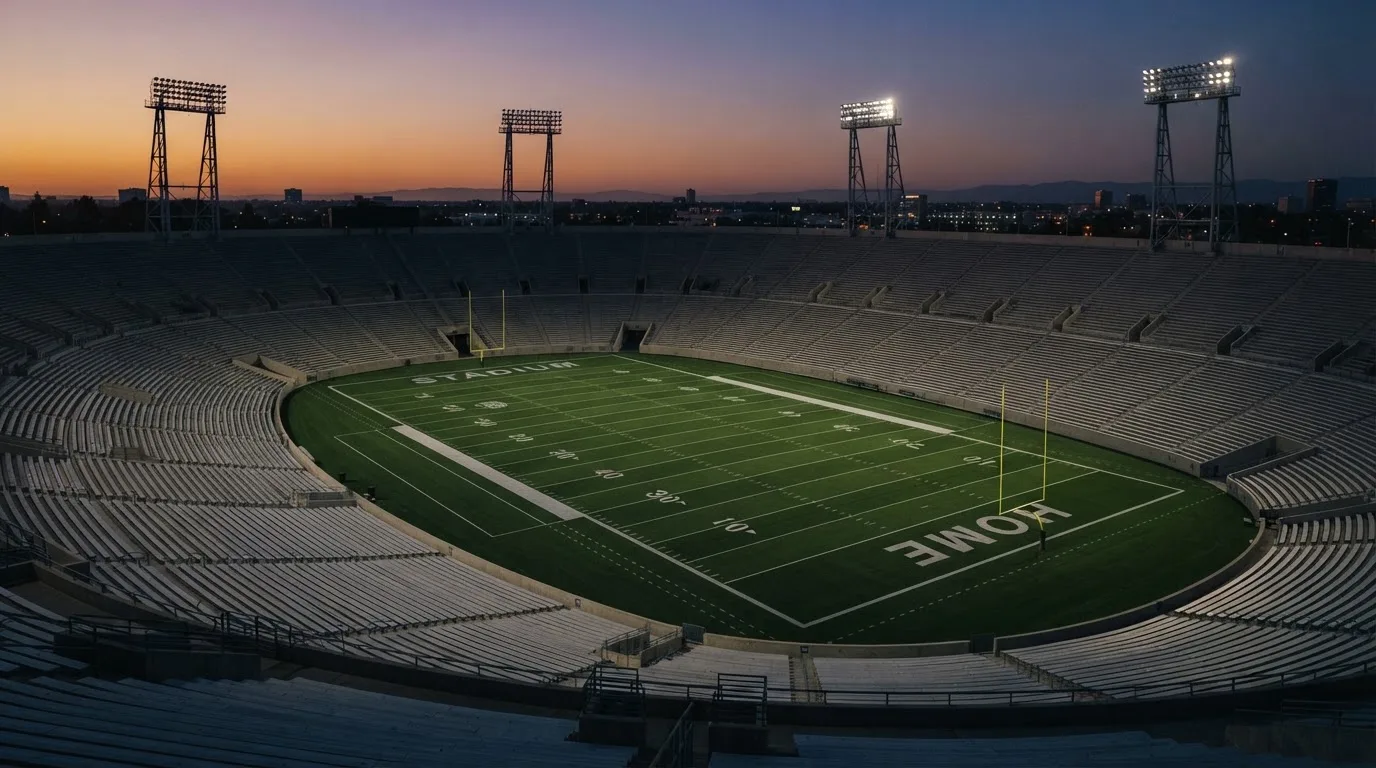
The league is the National Football League, 32 teams split 16 in the American Football Conference and 16 in the National Football Conference, 17 games across an 18-week regular season, and 14 teams in a single-elimination playoff bracket at the end of it. The Super Bowl closes the postseason. An empty stadium at dusk is a useful image for the page; the markets sit where the seats would.
How UK gambling law applies to American football betting
The Gambling Commission licenses the whole commercial market in Great Britain under the Gambling Act 2005, and a bookmaker whose remote facilities are used in Great Britain needs a Commission licence wherever it is based. The test of whether a brand holds a licence is the Commission’s public register, which can be searched by business name, trading name, domain or account number. The Commission is a non-departmental public body sponsored by the Department for Culture, Media and Sport, and a GB licence is the only route to a legal online bet in Great Britain.
A few other pieces of the frame matter to the comparison. A Curaçao, Maltese or Gibraltar licence is not a substitute. Northern Ireland is outside the Gambling Act 2005, and a “GB-licensed” bookmaker is licensed in Great Britain and not in Northern Ireland. The minimum age for a bet is 18, and the operator verifies name, address and date of birth before the first deposit and the first bet, so anonymous play at a UK-licensed site is not an option.
The licence categories on the register are the second layer. A remote general betting standard (real events) licence covers sports betting; a remote betting intermediary licence covers exchanges. A remote general betting standard (virtual events) licence covers computer-generated events and is a separate category. Financial spread betting is regulated by the Financial Conduct Authority, not the Commission, and the FCA-regulated side of a brand is a different regulator with a different rule book.
In-play is allowed at a UK-licensed bookmaker. The controls are the operator’s licence conditions and customer-protection duties, and the bookmaker sets its own rules on which markets it offers in play and how it handles bets placed on an obvious wrong price. There is no statutory cap on stakes in sports betting; the operator sets the maximum, and the maximum can vary by customer. There is no statutory list of permitted bets or markets, and the rule book on what a bookmaker may offer is the Licence Conditions and Codes of Practice and the operator’s own terms.
Player protection: limits, checks and help
The protection frame is layered. GAMSTOP is the national multi-operator online self-exclusion scheme, and a UK-licensed online operator has been a mandatory member since 31 March 2020. Self-exclusion can be set for six months, one year, five years, or five years with auto-renewal, and the exclusion stays in place for a further seven years after the minimum period unless the customer asks GAMSTOP to remove it. GAMSTOP covers online sites and apps; betting shops use a separate service.
A financial vulnerability check has been in force since 30 August 2024, and the threshold is a customer’s deposits minus withdrawals of more than £150 in a rolling 30 days (in force since 28 February 2025). The check is a public-record check, looking at things like bankruptcy or county court judgments, and is not an income check and not a credit reference check. Financial risk assessments, the “affordability checks” of the press, are announced in a staged plan, with no start date established at the time of writing.
Deposit limits are the operator’s, set by the customer on a fixed time frame, with the first changes under the new rules applied since 31 October 2025 and a second phase postponed to 30 September 2026. There is no state-set deposit or loss ceiling for betting. The help services are GamCare (the National Gambling Helpline), GambleAware, the NHS gambling clinics and Gamblers Anonymous.
Identity verification is the sharp end. Since 7 May 2019 the operator has to check name, address and date of birth before a customer can deposit or gamble, including with a free bet or a bonus. For higher spend, source-of-funds questions are normal under the anti-money-laundering rules. A punter who wants to bet at a UK-licensed site accepts the verification; a punter who wants anonymity is on a different bookmaker, with the loss of the protection that comes with it.
Crypto and anonymity at UK-licensed bookmakers
A bookmaker licensed by the Gambling Commission verifies the customer’s identity before the first deposit and the first bet. The verification is name, address and date of birth, with a check of public records at higher spend, and the operator’s own anti-money-laundering rules apply on top. A cryptocurrency deposit does not change any of that; the operator is still the one that verifies the customer, and the deposit is still in the operator’s account, not on a public ledger that the customer controls.
The Commission’s published position on cryptocurrency deposits at licensed operators is not a flat ban and not a flat endorsement, and the rule book is the operator’s own terms. A few of the brands on the comparison above take cryptocurrency deposits under their own conditions, and the rest do not. The punt is the same as it is for any other payment method at a UK-licensed site: the bookmaker holds the account, the bookmaker runs the rules, and the bookmaker pays out in pounds, not in coin.
Anonymity is the other half. A betting site licensed in Curaçao, in Malta, or in any other offshore jurisdiction can ask for less at the door, can take a cryptocurrency deposit, and can let a customer bet with a thinner paper trail. The cost is the protection: no GAMSTOP coverage, no Commission complaints route, no approved dispute-resolution body, no British consumer redress if funds are withheld, and the 10x bonus cap and the £150 vulnerability check do not apply. A bet placed on an unlicensed site is not a crime on the customer’s side in Great Britain; the loss of protection is the consequence.
Bonuses, free bets and the marketing frame
The promotion rules that matter in 2026 are the Commission’s. Wagering requirements on bonuses are capped at 10x, so a £10 bonus at 50x is no longer compliant and a £10 bonus at 10x is the new ceiling. Mixed-product promotions, an offer that requires gambling on two or more product types such as betting, casino, bingo and lottery, are banned, so “bet on football to get free spins” is no longer compliant. Whether the cap applies to free bets with no wagering condition, and any cap on the money value of a bonus, are not established; the operator’s own terms are the place to look.
The marketing frame is the ASA’s. The CAP Code (non-broadcast) and the BCAP Code (broadcast) cover advertising in Great Britain, with section 16 of the CAP Code requiring marketing to be socially responsible, not of strong appeal to under-18s, and with no one who is or seems to be under 25 featured gambling or playing a significant role (with an exception for marketing placed where a bet can be made directly). The rule is about who can appear in an advertisement, not about who can bet. The “whistle-to-whistle” ban, since 1 August 2019, stops betting advertisements on TV from five minutes before a live sporting event to five minutes after it, before the 9pm watershed, with horse and greyhound racing excluded.
A free bet is a free bet: a token the operator credits to a customer’s account, on which the stake is usually not returned with a win. A bet credit is the same kind of thing under a different name. A “risk-free” bet refunded as a free bet is a refund in token, not in money, and the token is then subject to its own rules. A price boost is a one-off enhancement on a specific market, settled at the boosted price if it wins. An accumulator insurance refunds a stake as a free bet or as cash if one leg of a multi lets the bet down. Each is its own kind of offer, and the cost of each is in the operator’s own terms.
The player pays no tax on betting winnings in Great Britain; this is general information, not tax advice, and a professional gambler should ask HMRC or an adviser. General Betting Duty is the operator’s tax on gross profits, currently 15%, with a new remote rate of 25% from 1 April 2027 on remote bets other than those on UK horse racing, self-service betting terminal bets, pool betting and in-person betting, and whether the operator passes duty on through odds is not established.
The cost of a price: the margin inside the odds
A bookmaker’s margin is the part of every pound staked on a market that the bookmaker keeps on average. It is built into the prices the bookmaker shows, and a punter who wants to know the margin of a market has to do the arithmetic on the prices the bookmaker is actually showing for that market on that day.
The illustrative two-way market is the cleanest example. Take decimal odds of 1.90 on each side, as an example and not as a quoted price. The payout share is 1 ÷ (1/1.90 + 1/1.90) = 1 ÷ 1.0526 ≈ 0.9500, and the margin is 1 − 0.9500 = 0.0500, or 5.0%. That is the bookmaker’s take on every unit staked on the market over a large number of bets at those prices, and the two-way line is symmetric so the margin lands equally on both sides. A line of 1.91 / 1.91 gives a margin of about 4.7%; a line of 1.85 / 1.85 gives a margin of about 8.1%; and the band from 4% to 8% is the band a well-priced NFL two-way market usually sits inside at a UK-licensed bookmaker.
An asymmetric line carries the same formula. The favourite at 1.20 and the underdog at 5.50 give a payout share of 1 ÷ (1/1.20 + 1/5.50) = 1 ÷ 1.1015 ≈ 0.9078, and a margin of 9.2%. The market is still two-way but the margin is higher than on a symmetric line at the same favourite/underdog gap, because the bookmaker’s traders are pricing more uncertainty on the favourite’s side. The same market at 1.20 / 5.00 gives a margin of about 11.5%, and the band widens further on a heavy favourite.
A three-way market, the NFL point spread with the home team giving points and the away team taking them, is the next layer. A line of home −3.5 at 1.91, away +3.5 at 1.91 gives the same 5.0% margin as the symmetric two-way line. A line of home −7.5 at 1.91, away +7.5 at 1.95 gives a payout share of 1 ÷ (1/1.91 + 1/1.95) = 1 ÷ 1.0361 ≈ 0.9652, and a margin of 3.5%, the lower margin a bookmaker charges on a market where the line is well-studied and the price competition is sharpest. The margin of one market is not the margin of another, and the margin of a spread is not the margin of a total; the arithmetic has to be done on the prices the bookmaker is actually showing.
The same bookmaker can carry different margins on different markets at the same time. A pre-match NFL moneyline is a thinner-margin market than a college football spread on a Tuesday night, which is a thinner-margin market than a Super Bowl prop bet on the colour of the Gatorade. A punter who wants the lowest margin sticks to the deepest markets at the busiest times of the week.
Choosing the bookmaker that fits
A punter who wants the deepest in-play product and the most bet builders is best served by bet365. A punter who wants a betting exchange alongside a sportsbook is best served by Betfair. A punter who wants a long-established Scandinavian operator with a sports welcome is best served by Unibet. A punter who wants to talk to a trader on the phone is best served by Star Sports. A punter who splits their action with horse racing and wants Best Odds Guaranteed is best served by Fafabet or, on the racing side, Swifty Sports. A punter who wants an Irish bookmaker with a UK front is best served by Bar One Racing. A punter who wants a sports welcome with a casino tail is best served by BetTom, with the operator’s own terms on the casino half read carefully. A punter who wants a high-stakes welcome at a Dublin bookmaker is best served by Fitzwilliam Sports, with the application to be made rather than the registration to be filled in. A punter who wants a small, clean welcome on a thinner in-play product is best served by VBet.
The choice is between a deep product at a big brand and a tighter proposition at a smaller one. The price is rarely the deciding factor on a single bet, because the margin of the big names and the small names on the headline NFL markets tends to land in the same band; the deciding factor is what the bookmaker does in play, what it offers around the headline market, and whether the verification and payment frame suits the punter.
What to check before placing a bet
The first check is the licence. The Commission’s public register, searchable by business name, trading name, domain or account number, is the whole test. A brand on the comparison above holds a remote general betting standard (real events) licence; the licence holder is named, the account number is on the register, and the operator is bound by the LCCP and the operator’s own terms. A brand not on the register is not licensed in Great Britain, and the comparison above does not list it.
The second check is the operator’s own terms. The market rules, the in-play rules, the cash-out rules, the voiding rules and the maximum-stake rules are on the operator’s site, and the price a punter sees on the screen is governed by them. A line of New England −3.5 means New England has to win by four or more for a spread bet on them to pay, and a line that lands on the number is a push and the stake is returned, unless a tie is offered as a selection. The settlement of bets on abandoned events, on events where the listed players do not start, and on events where the scoreboard changes after the bet is placed, is in the operator’s own rules.
The third check is the payment. A credit card is banned for gambling in Great Britain since 14 April 2020, including credit-card-funded payments through an e-wallet, and debit cards and bank-based payments are not covered. The verification before the first deposit means the first deposit takes a few minutes longer than it would at an unlicensed site, and the source-of-funds check at higher spend is normal. The payment methods a UK-licensed bookmaker accepts are on the operator’s own site.
The fourth check is the protection frame. GAMSTOP is the national self-exclusion scheme, and a UK-licensed online operator is a member. The help services are GamCare, GambleAware, the NHS gambling clinics and Gamblers Anonymous, and a punter who wants a timeout, a deposit limit or a self-exclusion can set it on the operator’s own site or through GAMSTOP.
Payment and tax in summary
A credit card is not a route to a UK-licensed bookmaker. A debit card or a bank transfer is, and the identity check at the door is the trade for the protection. The player pays no tax on betting winnings in Great Britain; the operator pays General Betting Duty on its gross profits. A spread bet on a financial instrument is regulated by the Financial Conduct Authority and taxed at a different rate, and the FCA-regulated side of a brand is a different regulator with a different rule book.
The season the page is written for
The NFL season opens in early September with the regular season, runs through early January, and is followed by the playoffs in January and the Super Bowl in early February. Super Bowl LX closed the 2025/26 season, and the next Super Bowl opens the 2026/27 futures market within days. The college football season opens in late August, runs through the conference championships in early December, and ends with the four-team playoff and the national championship in January. The CFL season opens in June and ends with the Grey Cup in November. The offseason is the time to bet futures: Super Bowl winner, conference champion, division winner, season win totals, the Heisman Trophy, and the NFL Draft in April.
Where this leaves a punter in 2026
The American football market in 2026 is deep at every UK-licensed bookmaker, the live product is mature, the in-play markets are the ones that move fastest, and the offers are constrained by the Commission’s promotion rules. The comparison above is a snapshot of the brands on the register, the licence each brand holds, and the feature each brand’s own terms attach to it. A punter who knows what they want from a bookmaker can pick from the list; a punter who wants the deepest product picks bet365 or Betfair, a punter who wants a phone-trading desk picks Star Sports, a punter who wants the racing-side BOG picks Fafabet or Swifty Sports, and a punter who wants a tighter proposition picks from the bottom of the list.
The price is rarely the deciding factor on a single bet. The margin of the headline NFL markets at the UK-licensed bookmakers sits inside a band that runs from about 4% to about 8%, the spread markets are slightly tighter and the prop markets are looser, and a punter who wants the lowest margin sticks to the deepest markets at the busiest times. The rest of the choice is about what the bookmaker does in play, what it offers around the headline market, and whether the verification and the payment frame suit the punter.
Frequently asked questions
How do you bet on American football?
A punter opens an account at a UK-licensed bookmaker, completes the identity check, deposits by debit card or bank transfer, and picks a market from the American football tab. The moneyline is who wins, the spread is a handicap and the total is the combined score. A bet builder combines markets from one game and a combination bet links two or more games. Bets settle when the operator’s rules say they settle, and a push on the spread or the total returns the stake.
What is American football betting?
American football betting is a market on the outcome of NFL, college football and CFL games, plus the futures market on season-long outcomes. A bookmaker sets a price on each side of a market, a punter takes the price by placing a stake, and the bet pays the stake times the price if the punter’s side wins. The bookmaker’s margin is built into the price, and the margin is the bookmaker’s take on every unit staked on a market over a large number of bets.
Where are the best American football betting odds found?
The headline NFL markets at the UK-licensed bookmakers run in a tight band, and the lowest margin on a specific market is found by doing the arithmetic on the prices the bookmakers are actually showing on that day. A pre-match NFL moneyline at the bigger names sits inside a margin of about 4% to 6%, a spread sits slightly tighter, and a prop market sits looser. The deepest in-play product is at the bigger names, and a punter who wants the lowest margin at a busy time of week sticks to the deepest markets at the biggest brands.
How can a punter check that a bookmaker holds a Gambling Commission licence?
The Commission’s public register, on the Commission’s own site, is searchable by business name, trading name, domain or account number. A brand on the register is licensed; a brand not on the register is not. The register is the whole test, and a licence is the route to GAMSTOP, the bonus cap, the vulnerability check, the Commission’s complaints route, and the British consumer redress if funds are withheld.
How is the return on a bet worked out from the stake and the odds?
The return is the stake multiplied by the decimal odds. A £10 stake at decimal odds of 2.50 returns £25, of which £15 is profit. A combination bet’s decimal odds are the multiplied odds of the legs, so a four-fold at decimal odds of 1.80, 2.10, 1.91 and 1.95 has combined odds of about 14.04, and a £10 stake returns about £140.40 if all four legs win. The fractional form is profit against stake: 5/1 pays £5 profit for every £1 staked, and the conversion to decimal is fractional + 1, so 5/1 becomes 6.00.
What is the bookmaker’s margin and how can it be seen in the odds?
The margin is the part of every pound staked on a market that the bookmaker keeps on average, and it is built into the prices the bookmaker shows. The payout share is 1 ÷ (1/odds on side one + 1/odds on side two), and the margin is 1 − the payout share. An illustrative two-way market at 1.90 on each side gives a payout share of about 0.9500 and a margin of about 5.0%. A real market at a real bookmaker on a real day has to be checked against the prices the bookmaker is actually showing.
US & other team sports – Grey Hound
Content created by the «Grey Hound» team
