
Formula 1 betting odds in 2026: prices, margin, and the UK rules that frame every bet
 Available in US
A Formula 1 weekend moves faster than a betting slip. Lights out, twenty-odd cars disappear into turn one, and the price on the race winner shifts before the safety car has pulled back in. Drivers’ championship, constructors’ championship, podium finish, fastest lap, head-to-head, qualifying, sprint — every market on the calendar pays out on a moment a split-second can change. The page below sets out which UK-licensed bookmakers price those markets, what a price actually pays back once the margin inside it has done its work, and where the rules that govern British play cut in around every bet a reader places this season.

Data current as of 27 October 2026, checked against the Gambling Commission’s public register.
What a price on a Formula 1 market means
A decimal price is what a winning stake of one unit returns, profit and original stake included. A bet of £10 at 3.50 brings back £35 — £25 of profit and the £10 stake returned. A price at 1.50, which a punter calls “1-to-2” or “half”, returns £15 from a £10 stake. The number looks simple; the work it hides is not. Every price on every market carries the bookmaker’s margin inside it — the slice of every pound staked the operator keeps on average, the rest going out as winnings. The margin is the one number on the page no offer talks about, and the one number a serious bettor learns first.

The market a punter sees most often is a two-way race: one driver or the other. Take an illustrative example. Suppose a sportsbook lists Driver A at 1.90 and Driver B at 1.90 in a head-to-head market. The total of the implied probabilities works out as 1/1.90 + 1/1.90, or roughly 0.526 + 0.526 = 1.053. That 1.053 is the bookmaker’s overround, and the margin on the market is 1 − 1/1.053, or about 5.0%. For every £100 staked across the two drivers in this market, the operator keeps about £5 on average once winnings have been paid out. A market priced at 1.80 versus 1.80 runs closer to 11%; the rule that tighter prices carry tighter margins, and longer prices carry fatter ones, is the structural law of the betting exchange board.
Decimal prices and fractional prices describe the same thing in two notations. Five-to-one in fractional form is 6.00 in decimal; 5/1 means a £1 stake returns £5 of profit and the £1 stake back, total £6, and the conversion is dividend ÷ divisor + 1. Eleven-to-four (11/4) is 3.75; six-to-four-on-a-favourite (6/4) is 2.50. Bookmakers tend to default to fractional on British horse racing pages and to decimal on sports pages with an in-play product; the two conventions describe the same number, and a punter who reads the one they prefer saves mental arithmetic at the moment the price changes.
A formula 1 betting market, in 2026, opens weeks before a Grand Prix and closes the moment the lights go out for the formation lap. Each operator prices its own board. Prices move on news — a wet-weather forecast, a grid penalty, a contract rumour — and the move is, more often than not, the market reacting to money more than to fact. A reader who sets out by understanding that the price carries a margin knows that even a perfectly judged bet costs them the slice their bookmaker is keeping, and that paying that slice down over a season is the slow gain a serious punter chases.
The 2026 calendar that frames every bet this page prices
The 2026 FIA Formula One World Championship is the 77th running of the series and the longest on the modern calendar. Twenty-three Grands Prix sit on the schedule, after the originally planned 24-race fixture list was trimmed when the Saudi Arabian Grand Prix was cancelled. The season opened at Albert Park in Melbourne on 8 March 2026 and is scheduled to close at the Yas Marina Circuit on 6 December 2026. Lando Norris carries the number one on the McLaren as the reigning Drivers’ Champion. Six rounds carry a sprint: China, Miami, Canada, Britain, the Netherlands and Singapore, which means a sprint market opens on each of those weekends alongside qualifying, the Grand Prix itself, fastest-lap, podium and the constructors’-title betting that runs from Bahrain to Abu Dhabi.
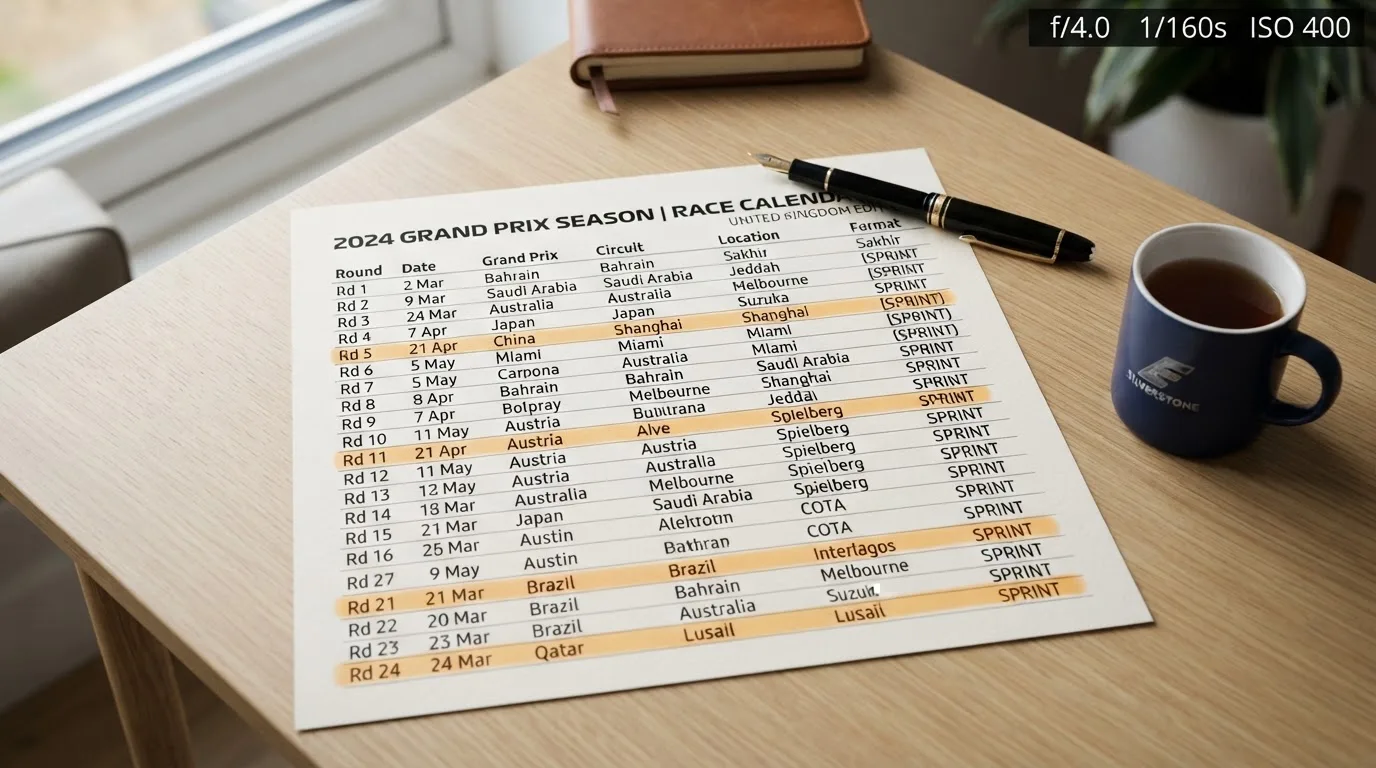
The technical regulations have changed enough to make this season a reset rather than a refinement. The MGU-H has been removed from the hybrid system; MGU-K output has risen from 160 bhp to 470 bhp; DRS, the drag-reduction system that opened a flap of rear wing to give a chasing car a tow down the straight, has been replaced with active aerodynamics, where the car itself decides when and how to deploy its own downforce. The cost cap, the budget each constructor is allowed to spend on the chassis and the racing operation that the FIA audits each year, has lifted from $135 million to $215 million, and that increase is the largest single line of spending freedom the constructors have been given in the cost-cap era. The grid that took the start in Melbourne is eleven teams strong, and the bookmakers’ markets run across them all.
What that means for a betting account is that 2026 markets open earlier, run more weekends, and close faster than in any season before. A reader who treats a season as 23 race weekends is treating a fifth of the year as betting market — every other week, from March to December, the calendar hands the punter two opportunities a day: qualifying and the race. The economics of the year stack up the same way: that 2026 calendar was the longest single-season programme the sport had ever set, and the betting volume priced into it is the largest annual chunk of motorsport handle on a British-licensed bookmaker’s books.
Why British bookmakers all price the calendar the same way
There is no statutory list of what a UK bookmaker may or may not offer on Formula 1. The Gambling Commission licenses a category, in this case remote general betting standard (real events), and the operator runs markets under the Licence Conditions and Codes of Practice. The categories a reader checks against the Commission’s public register are remote general betting standard (real events) for fixed-odds sports, remote general betting standard (virtual events) for computer-generated races, remote pool betting for Tote-style products, and remote betting intermediary for the exchanges. Formula 1 fixed-odds markets sit on the first of those categories.
What that does is set a floor. Every operator in the comparison below is licensed by the Commission against that category, every one of them is in scope for the Commission’s social responsibility code, every one of them offers GAMSTOP self-exclusion, every one of them is bound by the 10x wagering cap on bonuses that took effect on 19 January 2026. A reader who picks a licensed brand gets the same baseline regardless of who they bet with; the difference between the brands is the menu of markets, the format of the in-play product, the depth of the live data, the promotions during a race weekend, and the conditions attached to a free bet when one is on offer.
The shape this page does *not* take is “licensed is safe, unlicensed is unsafe”. The honest framing is that a licensed operator runs identity checks before the first deposit, runs GAMSTOP, runs a financial vulnerability check once a customer’s net deposits cross £150 in 30 days, and follows the social responsibility code in the LCCP; an unlicensed one runs none of those, and a customer with a dispute has no British complaints body to take it to. Neither framing is “the safe choice” by default; the reader weighs the protection on one side against the price on the other.
How to read the bookmaker comparison
The ten brands the table compares are not a ranking. They are ten operators who hold a Gambling Commission remote licence for general betting standard (real events). Several of them run as extensions of a larger licence holder; that is the Commission’s own structure and not a fact the comparison shrinks from. The licence number in each row is the one to look up against the Commission’s public register, which is searchable by business name, trading name, domain or account number; the comparison carries the licence type and operator name as the register reads them.
The second column carries what the operator’s own terms state on this page’s key — what the brand actually offers a Formula 1 bettor in 2026. The terms a reader sits with are the ones published on the operator’s site at the moment the bet is placed, and the table writes each row as the operator’s own terms do. Where the terms the operators publish differ — one pays Best Odds Guaranteed from 9 AM, another from 8 AM; one carries a 14-day window on free bets, another a 7-day one — the row carries the exact figure that operator publishes.
The licences run from account 8835 (Spreadex) up to account 64959 (BetTom), and the licence type reads the same all the way down. The variation is in the operator names and the trading structures attached to each licence. Midnite is run by Midnite Limited; bet365 is run by Hillside (UK Sports) ENC; William Hill is run by WHG (International) Limited. None of that variation changes what the licence authorises; it explains how the Commission has structured the market in this corner of it.
| Brand | Licence | What the operator’s own terms state |
|---|---|---|
| Midnite | Gambling Commission account 101839 (remote general betting standard, real events); licence held by Midnite Limited | In-play events, an acca builder, popular accas and price boosts with stated maximum-stake limits |
| Betboro | Gambling Commission account 44181 (remote general betting standard, real events); licence held by Webmedia Development N.V. | In-play markets and cash-out on football, racing and tennis, boosted odds on selected singles from £10 stakes, and safer-gambling tools (deposit limits, reality checks, self-exclusion) |
| Fafabet | Gambling Commission account 57385 (remote general betting standard, real events); licence held by Taichi Tech Limited | Best Odds Guaranteed on UK and Irish horse racing win and each-way bets from 9 AM on race days; if the starting price is bigger than the original, the bigger odds are paid |
| Octobet | Gambling Commission account 62545 (remote general betting standard, real events); licence held by Octopus Game Limited | Best Odds Guaranteed on UK and Irish horse racing, capped at £150 per customer per race |
| BetTom | Gambling Commission account 64959 (remote general betting standard, real events); licence held by Bet Tom Limited | Two-track welcome offer — 50% back as a free bet up to £50 in sports, with a matching 50% back up to £50 as free slot funds for casino, full terms on the operator’s site |
| bet365 | Gambling Commission account 55148 (remote general betting standard, real events); licence held by Hillside (UK Sports) ENC | In-play betting and live streaming of events worldwide, plus Bet Track, Match Live and a Live Golf Tracker for following bets in play |
| William Hill | Gambling Commission account 39225 (remote general betting standard, real events); licence held by WHG (International) Limited | Best Odds Guaranteed on UK and Irish horse racing from 8 AM on race day, on both single and multiple bets; does not apply to ante-post, tote or pari-mutuel bets |
| Spreadex | Gambling Commission account 8835 (remote general betting standard, real events); licence held by Spreadex Limited (FCA-regulated for spread betting) | New-customer offer of £60 in free bets for a £10 qualifying fixed-odds bet, qualifying bet to be placed within 28 days; spread betting on the same platform is regulated by the FCA and losses can exceed the deposit |
| LiveScore Bet | Gambling Commission account 56859 (remote general betting standard, real events); licence held by LiveScore Betting and Gaming (Gibraltar) Limited | Debit cards (Visa and Mastercard), Apple Pay, PayPal, Pay by Bank (Open Banking) and Revolut Pay across deposits and withdrawals |
| VBet | Gambling Commission account 44662 (remote general betting standard, real events); licence held by SCGO Limited | In-app Bet Builder, pre-match and in-play betting, live streaming and a live calendar with results and stats |
The table tells one story by what it does not say. None of the ten operators above is “the only” licensed brand — the Commission’s public register lists more than 100 remote licences for general betting standard, real events alone, and the comparison sits with the ten that research covers. The terms the operators publish on race-day markets are not the same as the terms they publish on bonuses, and a reader who plans to bet on every weekend needs the column above in addition to the welcome offer that brought them to the brand.
What is honest in the column above is what each operator’s own page says it offers a reader. What is not included is anything each operator published after the snapshot — a free-bet offer launched since, a Formula 1-specific promotion limited to a single weekend, an in-play product change between the snapshot and race day. The audit that produced these notes stopped at a fixed point in time, and the terms a reader sits with on race day are the ones live on the operator’s site at that moment. A licence number, on the other hand, does not move week to week; it is the anchor that survives any terms change.
The British legal frame a punter sits inside
The Gambling Commission is a non-departmental public body sponsored by the Department for Culture, Media and Sport. It licenses the whole commercial market under the Gambling Act 2005, which covers Great Britain — England, Scotland and Wales. Northern Ireland sits outside the 2005 Act and follows an older regime, and a brand licensed by the Commission is licensed for Great Britain, not the United Kingdom. Since the Gambling (Licensing and Advertising) Act 2014 an operator whose remote facilities are used in Great Britain needs a Commission licence wherever the operator is based; a Curaçao, Maltese or Gibraltar licence is no substitute. Spreadex, which is also regulated by the FCA for spread betting, is the entry in this comparison that crosses into the FCA’s domain, and the FCA’s regime applies to the spread-betting side of the product only.
The minimum age for any gambling product is 18. Identity is verified before the first deposit, name, address and date of birth, and the rule has held since 7 May 2019; a free bet or no-deposit offer is in scope and triggers the same check. What follows is no anonymous play. Source-of-funds questions at higher spend, including a public-record check through the financial vulnerability framework that took effect on 30 August 2024 and applies once a customer’s net deposits cross £150 over rolling 30 days, are normal at a licensed site, and a customer who refuses to provide them is in scope for the operator’s account-management duties under the social responsibility code. The check is a public-record one (bankruptcy, county court judgments), not an income one and not a credit-reference one.
What a reader can bet on is set by the operator’s licence category and the LCCP, not by statute. In-play markets are offered by GB bookmakers, and the controls are the operator’s licence conditions and customer-protection duties; a reader who treats in-play as unrestricted because it is openly offered has read past the licensing frame. Esports, virtual events, politics, TV shows and novelty markets are all offered; none has been the subject of a statutory prohibition. No statutory cap on stakes exists in sports betting; the operator sets its own maximum and may restrict individual customers, and the cap any reader is bound by is the one named on the betting slip.
GAMSTOP is the national multi-operator online self-exclusion scheme and a mandatory licence condition for every GB-licensed online operator since 31 March 2020. The minimum period is six months, then one year, then five years, then five years with auto-renewal, and at the end of the chosen period the exclusion remains for a further seven years unless the customer asks GAMSTOP to remove it. GAMSTOP covers online sites and apps; betting shops run a separate service. The advertised offers on a page a reader is reading right now have the GAMSTOP enrolment box behind them; the box and the offer are not separate features.
The advertised offer and what it costs to clear
A welcome offer trades a deposit and a stake for a free bet or a bonus, and the trade is rarely as simple as the headline number makes it sound. The wagering requirement is the figure the operator multiplies the bonus (or the deposit plus bonus) by to set the volume of betting the customer has to put through before the bonus becomes withdrawable, and the cap on that requirement is 10x under the LCCP rules that took effect on 19 January 2026. A £10 bonus at 50x needed £500 of bets to clear; under the cap no more than £100 of turnover is required to release a £10 bonus. A “100% bonus” up to £50 is a maximum of £500 of turnover under the cap; the same offer outside the GB regime could carry a 10x weight twice that.
Mixed-product promotions — an offer that requires gambling on two or more product types such as betting, casino, bingo and lottery, for example “bet on football to get free spins” — are banned under the same 19 January 2026 rules. A £50 sports free bet tied to a £20 casino play is no longer a legal offer on a GB-licensed operator’s page. The rule does not say mixed offers cannot be advertised; it says a GB operator cannot hand one to a customer on terms they have to clear to get the second half of it. Whether the cap applies to free bets with no wagering condition, and any cap on the money value of a bonus itself, are not established by the rules research holds.
A free bet whose stake is not paid back has a value of its own. Take a £10 free bet, used on an illustrative two-way market at 1.90 — 1.90 (margin of about 5% as the worked example above showed) — and stake it on the side that lands. The £10 stake is not returned; the £10 × (1.90 − 1) ÷ 1.90 = £4.74 is what the bet returns on a winning outcome. Apply that to the same market at the 5% margin, and the average value of the free bet over many uses works out at £10 × (1.90 − 1) ÷ 1.90 × (1 − 0.05), or about £4.50. The bookmaker edges in even where the punter doesn’t stake. The marketing word “free” hides the maths in plain sight; the maths is what the offer is worth on average, not what it wins.
A welcome offer the headline describes as a deposit match adds the question of bankroll. A reader who deposits and bonuses sees the bonus amount held against a turnover requirement, and every bet during the clearing period is wagered at minimum odds or above the operator names, often evens (2.00) or 4/6, and the maximum-stake per bet limit during clearing is in the operator’s terms. The bettor who treats a bonus as bankroll extension finds it is bankroll extension with a leash: bets below the minimum price, on the wrong market, or above the per-bet stake cap do not count.
A “best odds guaranteed” line on horse racing does not run on Formula 1 markets. BOG pays the bigger of the original price and the starting price when the SP is bigger, and it runs only on UK and Irish racing on a brand like Fafabet (from 9 AM on race day, win and each-way) or William Hill (from 8 AM, on single and multiple bets). The product is racing-only, and the punter who carries expectations from a horse-racing BOG page over to a Formula 1 betting page finds no equivalent in the season’s terms.
How a price actually moves through a race weekend
A Formula 1 betting market opens as soon as the previous race finishes and runs through free practice sessions, qualifying and the race itself. Each phase has its own price movement, and each phase carries its own edge for a punter who knows which side of the betting slip they want to be on. Practice sessions move the market on long-run pace and on the team’s preparation; qualifying fixes the grid and re-prices the race market from scratch; the race itself, where in-play betting unlocks on a licensed brand, moves the price on laps completed, pit stops, safety cars and the championship position.
A reader who watches the practice sessions has the most information of any bettor in the sport. Long-run pace on a fuel-corrected basis tells a sharp eye where the upgrade is working. A punter who reads practice data in real time has a window between Friday morning and Saturday afternoon in which the price has not caught up with the lap times; once qualifying is over, the market has caught up and the rest of the weekend trades on race-craft rather than pace. The opportunity is the practice phase; the cost is that the bet is on a market that closes if the driver is penalised, the team changes the car, or the weather moves.
A reader who bets on a race winner is betting on the outcome of twenty-odd cars finishing one race. Three-car podiums, fastest-lap markets, head-to-head matchups and the constructors’ championship each offer a smaller variance and a faster settling time. A driver retirement market, where a book takes a price on each driver to retire the car, is in scope on most operators, and a single retirement pays out before the race ends. A bet on a lap-one safety car pays out before the race ends. A bet on a record fastest lap is in scope at most operators. The smaller-variance markets are where a bettor with a small budget spends the year.
A live betting session is where the licensed operators earn the most of their formula 1 handle. Cash-out, the option to close a bet before the bet’s natural settlement, is offered by most of the operators in the comparison; bet365’s in-play offering carries Bet Track and Match Live; VBet’s app carries a live calendar alongside the in-play product; Midnite and Betboro list in-play and cash-out in the column above. The punt a reader makes against an in-play book is on a moving price, and the moving price is set by the same operator’s margin as the pre-race market — the book does not give up edge mid-race.
What every bookmaker in the comparison brings to a Formula 1 weekend
The ten brands are different products at different price points. What follows is what each of them brings to a Formula 1 bettor in 2026, in the order the comparison table above lays them out, finishing on a verdict that names which punter the brand actually suits.
Midnite
Midnite runs a clean in-play product with an acca builder and price boosts on named maximum-stake limits, and that combination — a builder for same-race combination bets and boosts for the headline markets — is what the operator has built its reputation on since launch. The platform lists in-play and popular accas alongside the boosts, and the maximum stake is one the customer sees on the slip rather than guessing. The brand sits well under the larger operators’ banner spend, which means a sharper price in places a major book is content to leave alone. For the punter who prioritises the acca-builder and price-boost combo, Midnite offers a focused book that trades the scale of a market leader for more direct utility.
Betboro
Betboro sits in the comparison as the platform that pairs in-play and cash-out on the major sports with a boosted-odds product on named singles from £10 stakes. The safer-gambling tools — deposit limits, reality checks, self-exclusion — are part of the operator’s terms, and the same applies to every other licensed operator in the comparison. The brand is a smaller one than the household names, and the result is that the welcome offer carries a less crowded field than a market leader’s. A punt on Betboro suits a bettor focused on weekend motorsport markets; just be sure to check the boost conditions before triggering that £10 stake.
Fafabet
Fafabet is the racing-led book in the comparison, paying Best Odds Guaranteed from 9 AM on race days on UK and Irish win and each-way bets; if the starting price is bigger than the original, the bigger odds are paid. The BOG product is racing-only — it is not a Formula 1 product — and a reader who carries it across to motorsport finds no equivalent. The brand is the right home for a punter whose year is half horse racing and half Formula 1, and the F1 product sits on a book whose racing pricing has carried the brand.
Octobet
Octobet is the other racing-led book in the comparison, with Best Odds Guaranteed on UK and Irish racing capped at £150 per customer per race. The cap is generous; a punter who lays a £150 win bet on a race where the SP drifts has the bigger price refunded in cash, minus the cap. The Formula 1 product is the smaller side of the brand, and a reader who joins for the racing and stays for the F1 takes the brand on its terms as a racing operator with a motorsport section.
BetTom
BetTom runs a two-track welcome offer — 50% back as a free bet up to £50 in sports, with a matching 50% back up to £50 as free slot funds for casino play. The offer splits the bankroll, and the full terms on the operator’s site are the document a reader sits with before claiming. The brand is a smaller licensed operator whose race-day product is the bettor’s draw; the rest is the welcome offer and a casino product most readers will leave alone. The brand’s sports-heavy race-day product draws the bettors; consider this a sports-first account where the mixed-product bonus is a side feature you can comfortably leave behind.
bet365
bet365 is the major-operator benchmark the comparison is built around, and the brand brings in-play betting and live streaming of events worldwide, plus Bet Track and Match Live. The Live Golf Tracker is the closest thing to a comparable product on a Formula 1 weekend — a visual product that follows the action for the bettor, not the same product as the F1 in-play offering. The price on a Formula 1 race winner at bet365 is the price most readers compare against when looking at the smaller operators, and the live streaming product is the one most operators cannot match. As the market leader, bet365 remains the standard for live streaming and in-play depth; it is the comprehensive choice for anyone chasing the widest constructors’ market available.
William Hill
William Hill sits at the major-operator end of the comparison with Best Odds Guaranteed on UK and Irish racing from 8 AM on race day, on both single and multiple bets, but not on ante-post, tote or pari-mutuel bets. The racing product is the brand’s calling card; the Formula 1 product is one of many sports on a long-established book. The brand carries the name recognition a reader may want on a first bet, and the F1 product trades on the same market depth as the racing book. The William Hill reader is the one who wants the racing-BOG product and is happy to use the same account for a Formula 1 weekend.
Spreadex
Spreadex is the only operator in the comparison whose product line crosses the FCA’s regulatory boundary. The fixed-odds book is on a Commission licence (account 8835); the spread-betting side of the platform is FCA-regulated, and the risk profile of spread betting — losses can exceed the deposit — is different from the fixed-odds risk the rest of the comparison describes. The new-customer offer is £60 in free bets for a £10 qualifying fixed-odds bet, and the qualifying bet is to be placed within 28 days. The Spreadex reader is the one who understands both sides of the platform, treats the spread-betting product as the riskier side, and uses the fixed-odds book on Formula 1 weekends.
LiveScore Bet
LiveScore Bet is the payments-led book in the comparison, accepting debit cards (Visa and Mastercard), Apple Pay, PayPal, Pay by Bank (Open Banking) and Revolut Pay across deposits and withdrawals. The payments set matters at the deposit step and the withdrawal step, and the brands that accept a reader’s preferred method are the brands the reader tries first. LiveScore Bet sits on a Gibraltar licence holder’s Commission account (56859), and the product mix is sports plus a smaller casino. The LiveScore Bet reader is the one whose payment method is Revolut or Open Banking and who wants the same brand to settle the withdrawal.
VBet
VBet is the mobile-led book in the comparison, with an in-app Bet Builder, pre-match and in-play betting, live streaming, and a live calendar with results and stats. The product mix is the kind a punter trying to settle a bet in three taps a session finds, and the live calendar is the closest thing to the formula 1 weekend’s own run sheet. VBet sits under SCGO Limited’s Commission licence. The VBet reader is the one who bets from a handset, wants the live calendar as the season’s home screen, and treats the Bet Builder as the way they construct a race-weekend combination.
What the page does not pay back
A reader who treats a price as a contract has misunderstood the contract. The price a bookmaker offers is the price at which the bookmaker is willing to take the bet; it is not the price at which the bet will pay out, because the bookmaker keeps the margin inside the price regardless of which side wins. A punter on the right side of every bet in a season pays the margin as a transaction cost on every winning bet; a punter on the wrong side of every bet pays the margin and loses the stake. The mathematics of the edge never inverts in the punter’s favour.
A free bet whose stake is not returned has a value, not a price. The £10 free bet at 1.90 is worth about £4.50 on average, not £19.00 and not £9.00. The bookmaker is not paying £10 to the punter on the bet; the bookmaker is paying the winnings only, and the punter has to clear the qualifying bet to claim the free bet in the first place. The marketing word “free” is the most expensive word on a welcome offer’s terms.
The headline price on a futures market — a drivers’-championship market in 2026, a constructors’-championship market in 2026 — is not a forecast. It is a market that re-prices through the year and that closes only when the trophy is handed over. A reader who bets a futures market on a championship with a long-shot price carries a position through twenty-three race weekends, and the position’s value moves with each race result and with every piece of news the bookmaker decides to react to. A futures bet is a long position; a reader who cannot carry it should not open it.
The bookmaker’s in-play product is a different product to the pre-race market. The margin is the same, the trading desk is the same, but the price is set by the in-play book that re-prices the market each lap and each sector. A reader who carries a pre-race bet into a race by setting a lay position on an exchange is making a different bet, on a different book, with a different margin. The Commission’s licensing covers both products under the same licence, and a punter who reads the column above as a guarantee that pre-race and in-play carry the same edge has read past the licensing frame and into the marketing.
What the British rules cost the reader
The 10x wagering cap on bonuses is the headline. A £10 bonus at 50x wagering required £500 of bets to release; the cap limits the same £10 bonus to £100 of turnover, and the operator’s “100% bonus” line stops being a top-line statement of generosity at the moment the multiplier drops. A bookmaker outside the cap could carry a 50x bonus where a GB-licensed operator cannot, and the difference is the protection the 19 January 2026 rules added.
The financial vulnerability check, in force from 30 August 2024, applies at a £150 net-deposit threshold across rolling 30 days. The check is a public-record one — bankruptcy, county court judgments — and is not an income check or a credit-reference check. It is a moment a bettor’s account is reviewed against publicly available records, and the operator’s response to a positive result is set by the LCCP. A bettor who has hit a county court judgment, who is in bankruptcy, or whose public record has shifted in the last 30 days, finds a check waiting at the threshold.
The financial risk assessment, the “affordability check” the press describes, was announced by the Commission on 7 July 2026 in a staged plan with no start date. The check is not in force, and a reader who treats it as live has read past the Commission’s article. A reader who treats the public-record vulnerability check as live, on the other hand, has read past the £150 net-deposit threshold and into the operator’s social responsibility duties.
The deposit limit (RTS 12) is a Commission-set technical standard that obliges operators to offer a gross deposit limit on a fixed time frame. The first changes applied from 31 October 2025, a second phase was postponed to 30 September 2026, and whether the second phase is live is not established. A reader who calls a deposit limit a Commission-set ceiling has the Commission’s standard right; a reader who calls it a state-set ceiling (the difference is technical, the effect is practical) has misread the rule. The deposit limit the punter sets is theirs; the framework the Commission requires is the operator’s.
The credit card ban, in force since 14 April 2020, closes credit-card-funded gambling on GB-licensed sites including the credit-card-funded e-wallet route; debit cards and bank-based payments are not in scope. A punter who tries to fund a betting account from a credit card pays at the deposit step, and the operator who processes the deposit in breach of the rule is in scope for the Commission’s enforcement. The ban does not apply to the spread-betting side of Spreadex’s platform, where the FCA’s regime carries its own funding rules; it applies to the fixed-odds side.
What betting winnings cost the punter
There is no UK tax on the punter’s betting winnings. The tax — General Betting Duty, currently 15% on the operator’s gross profits, with a new remote rate of 25% from 1 April 2027 — sits on the bookmaker’s side of the counter. Spread betting has its own rates (3% financial, 10% other). A professional gambler owes tax on the profession’s earnings and is in scope for HMRC’s rules; a recreational punter is not. Whether operators pass duty on through odds is not established, and a punter who pays duty by way of a worse price is paying it through the bookmaker, not to HMRC. There is no British punter who pays the duty on a winning bet to the Government.
The professional gambler exception is worth understanding. The HMRC rules on trading income tax a profession’s earnings; a punter whose gambling is a profession, not a hobby, has earnings to declare, and the test HMRC uses is the same as for any other trade. A punter who advertises the activity, who employs others, who carries it on a commercial scale, who treats it as the main source of income — those are the markers the test reads. A reader who is not a professional gambler is out of scope; a reader who is, is in scope, and the tax advice sits with an adviser, not with the bookmaker.
What the offshore frame costs the reader
A GB licence is compulsory at the point of consumption. A brand licensed by Curaçao or Malta is licensed in its home jurisdiction; a customer who uses the brand from a British address is using a brand that does not hold a Commission licence and is not bound by the LCCP. The Commission’s enforcement is disruption rather than blocking: cease-and-desist notices, search-engine referrals, registrar and payment-provider work, and the court-order DNS blocking powers the Commission has been given or is about to receive. None of that changes for the customer what the customer has already lost.
The customer’s loss is the British protection framework. No GAMSTOP coverage means a self-exclusion at one site does not register at another. No Commission complaints route means a complaint does not land with a regulator who can compel an answer. No approved dispute-resolution body means Alternative Dispute Resolution (ADR) is not in scope. No British consumer redress means an unpaid withdrawal is not enforceable under UK consumer law. The 10x bonus cap does not apply. The £150 vulnerability check does not apply. The operator’s terms, accepted at sign-up, are the contract that runs; the Commission’s social responsibility code does not.
A reader who values the price an offshore brand offers and the protection a GB-licensed brand offers has to weigh one against the other; the comparison cannot do the weighing for them. The honest framing is “a GB licence authorises the protection; an offshore licence does not. Neither is the safe choice by default.” The reader who skips the comparison runs into an account that does not carry the protection and does not refund the bookmaker’s tax.
What British safer-gambling tools do for a punter in 2026
GAMSTOP is the British multi-operator self-exclusion scheme and a mandatory licence condition for online operators since 31 March 2020. The exclusion period runs in four tiers — six months, one year, five years, five years with auto-renewal — and at the end of the chosen period the exclusion stays for a further seven years unless the customer asks GAMSTOP to remove it. GAMSTOP runs across online sites and apps; betting shops run a separate service. The exclusion covers every GB-licensed online betting account the customer has opened and every GB-licensed online casino and slots account.
The operator’s safer-gambling tools sit alongside GAMSTOP. Unibet’s published list of safer-gambling tools (a Member of the same comparison bracket) includes deposit limits, a Player Profile test, product restrictions, self-exclusion and live chat support, with links to BeGambleAware, GamCare, GAMSTOP, Gambling Therapy and the BGC. The tools a customer uses vary by operator; the duty to offer them, across the licence conditions and codes of practice, is universal. The framework is operator-and-customer together; the operator offers the tools, the customer decides which to use, and the regulator audits the offer.
The financial vulnerability check at £150 net deposits across rolling 30 days is the public-record review the operator runs at the threshold. The check is a public-record one — bankruptcy, county court judgments — not an income check and not a credit-reference check. A positive result, a record the operator sees, is the trigger for the operator’s social-responsibility duties under the LCCP; the operator’s response (an account review, a deposit limit the operator applies, an exclusion the operator flags) is set by the licence conditions, not by the customer’s preference.
GamCare runs the National Gambling Helpline, a free service the Commission funds through a separate grant, and a reader in need of support has a phone line, a live chat, and a web form to reach the service. The helpline carries the same operator-funding link as the safer-gambling tools; a punter who needs help calls the line rather than working the menu on the licensed operator’s site. The NHS operates gambling clinics in some regions, and Gamblers Anonymous runs group meetings across the country.
What a punter with a small budget actually does
A punter with a small budget spends the year on the smaller-variance markets and the operators whose terms suit the budget. A £10 stake on a race-winner market has a £10 stake and one outcome at the end; a £10 stake on a fastest-lap market has the same stake and one outcome at the end. The variance is similar; the difference is in the margin inside the price, which is larger on a smaller market and smaller on a more heavily-priced one. A punter who bets every race weekend is paying the margin on every bet; a punter who bets one in five weekends is paying it less often, on a larger stake, and on the prices that have caught up with the news.
A punter with a small budget who reads a welcome offer reads the qualified-bet requirement first. A “bet £5, get £25 in free bets” offer is the same headline as a “bet £10, get £60 in free bets” offer, and the smaller stake the qualified bet requires is the better offer for the punter with the smaller budget — the £5 stake is what’s risked, and the £25 in free bets is what’s claimed. The minimum odds on the qualified bet (often evens, 2.00) is the price ceiling on the bet that releases the free bet. A £5 at 1.50 does not qualify; a £5 at 2.00 does. The reader the offer suits is the one who reads the terms first and places the qualifying bet on the price that releases the offer.
A punter with a small budget who bets through a season carries a turnover limit the punter sets. The Commission’s framework requires the operator to offer a gross deposit limit on a fixed time frame; the punter sets the limit; the operator enforces it. A weekly limit of £50 is the kind of limit a punter with a small budget sets; the operator’s framework for setting a limit and the punter’s self-discipline in keeping it are two sides of one rule, and neither works without the other.
A punter with a small budget who carries a futures position across a season carries a market position the punter has priced into the bet. A futures bet is a long position; a punter who cannot carry a long position through twenty-three weekends should not open the position. The brand the punter opens the position with is the brand whose terms suit the budget, and the price the punter takes on the position is the price the operator publishes on the day the bet is placed. The punter’s overall edge on the season is the year-long sum of the per-bet edge, and the per-bet edge is the price minus the margin.
What the financial vulnerability check means in practice
A reader who has hit a county court judgment, who is in bankruptcy, or whose public record has shifted in the last 30 days finds a check waiting at the £150 net-deposit threshold. The check is the operator’s reading of the public record; the operator’s response is set by the licence conditions. The customer is not charged for the check; the customer is asked to provide additional documentation, in scope for the operator’s source-of-funds duty. The check does not ban a customer from gambling; the check flags a customer for the operator’s review.
A reader who has hit the threshold and has a clean public record finds the framework runs in the background and the customer’s account is unaffected. The framework is the operator’s audit trail; the customer is not in scope for an operator-initiated check unless the public record has shifted. The framework is not a credit-reference check and not an income check; the operator’s data sources are publicly available. The customer’s data is held by the operator under the operator’s data-protection duties.
The framework’s purpose is to flag customers the operator’s social-responsibility duties run against. The customer the framework flags is a customer whose circumstance has changed; the operator’s response to a changed circumstance is set by the LCCP, and the customer can withdraw at any point. The framework does not pause the customer’s gambling without the operator’s review; the framework prompts the operator to review.
The Framework’s effect on a punter in £150 net deposits is a touch point a punter who has deposited and withdrawn on a weekly cycle does not see. The framework’s effect on a punter who keeps deposits ahead of withdrawals is a touch point the punter sees every month the threshold crosses. The framework runs in the operator’s background regardless; the punter who is in scope notices only in the operator’s review, and the punter who is not does not notice at all.
What betting-exchanges and spread betting add to the picture
A betting exchange is a betting intermediary’s product, licensed under the betting intermediary category in the Commission’s framework. Back and lay is the exchange’s trade; a punter lays a horse (or a driver) the punter thinks will lose, and another punter backs the same selection the second punter thinks will win. The exchange takes a commission on net winnings; the margin inside the price is the punter-set margin in the market, not the bookmaker’s margin. A reader who uses an exchange prices the market themselves, and the price they set is the price they take the bet on.
Spread betting is a financial product where the punter bets on a margin — say the gap between two drivers’ finishing positions — rather than on an outcome. The stake is a per-point figure; the win or loss is the stake × the actual gap. A spread-bet on a 5-point gap at a £2 stake, settled at 7 points, returns £14 of profit; settled at 3 points, loses £4. Spreadex runs the spread-betting product alongside its fixed-odds book, and the FCA’s regime covers the spread-betting side rather than the Commission’s. The reader the spread-betting product suits is one who understands the per-point risk and can carry the per-position exposure; a £2 stake on a 30-point gap at the wrong end is a £60 loss, not a £2 loss.
The two products sit outside the GB fixed-odds comparison the table above holds, but they sit on the same British licence frameworks. A betting exchange is on a betting-intermediary licence, and a spread-bet on Spreadex is on an FCA-authorised activity. The Commission’s compliance regime runs against the betting-intermediary licence; the FCA’s regime runs against the spread-betting activity. A reader who uses both products on the same site or different sites has two regulatory frames to sit with.
What the 2026 calendar’s sprint weekends cost the comparison
Six rounds carry a sprint in 2026 — China, Miami, Canada, Britain, the Netherlands and Singapore. Each sprint weekend is a three-day schedule, with sprint qualifying and the sprint on Saturday and the main race on Sunday. A betting account that treats the sprint as a separate race, with its own qualifying, sprint race and main race, has more markets to bet on each weekend, and the in-play product runs over a longer window. A betting account that treats the sprint as a sub-market of the main race has fewer markets to price.
A reader who treats the sprint as a race treats the sprint result as a fast-running form book for the main race; a driver who wins the sprint on Saturday is not always the favourite for the Grand Prix on Sunday, and the market re-prices on Sunday morning. A reader who treats the sprint as a sub-market bets on sprint points (top-eight scoring) and on the points finishers’ positions; a reader who bets the main race on Sunday has the market to settle on race day. The two markets overlap, but they settle separately.
A reader on a small budget treats the sprint as one of the year’s six extra betting weekends and budgets for it. A reader on a futures position has the long position through every weekend regardless. The calendar’s six sprint rounds are the calendar’s biggest betting-volume windows, and the operators’ market depth and in-play product depth are at their largest across those six weekends.
Why the Commission’s public register is the test
The Commission’s public register is the whole test of whether a brand holds a GB licence. The register is searchable by business name, trading name, domain or account number; a reader who wants to verify a brand types the brand’s name or domain into the register and reads the entry. The entry carries the licence number, the licence category, the licence holder, and the trading names under the licence. The Commission’s public register does not verify a brand’s offer, the brand’s price, or the brand’s terms; the register verifies the licence, and the licence is the public protection the reader is entitled to.
The Commission’s register is updated continuously, and a licence the reader saw on the register a month ago may be suspended, revoked, or amended by the time the reader returns. The register’s access date is the snapshot the reader sits with; a “verified on 21 August 2026” line on the reader’s notes is the date the verification was true. A reader who treats the register’s contents as time-stable has misread the register’s standing, which is the date a licence snapshot is taken.
A reader who cannot find a brand on the register has a brand without a GB licence. The brand may be licensed somewhere else; the brand’s home jurisdiction, the licence it does hold, the regulator that licenses it, and the protection framework under which it operates are the questions the register’s absence answers. None of them is the Commission’s framework. A reader who treats a non-Commission-licensed brand as a Commission-licensed brand has read past the register’s standing.
Frequently asked questions
How does a Formula 1 bet actually work?
A punter selects a market — race winner, podium, fastest lap, head-to-head, qualifying, sprint — picks a price from the bookmaker’s board, and confirms the stake. The bookmaker takes the bet, holds the stake in the punter’s account, and settles the bet after the event resolves. A winning bet at 3.50 returns 3.5 × the stake; a losing bet returns nothing. Bets close at the moment the formation lap starts, and in-play markets open during the race on a moving price.
How is a Gambling Commission licence checked?
The Commission’s public register is searchable by business name, trading name, domain or account number. A reader who wants to verify a brand types the brand’s name into the register, reads the entry for a remote general betting standard (real events) licence, and confirms the licence holder name matches the brand’s published operating company. The register’s access date is the date the verification was true; a licence is not time-stable in the public record.
How is the return on a bet worked out from the stake and odds?
A winning decimal-odds bet returns the stake multiplied by the decimal price. A £10 stake at 3.50 returns £35, made up of £25 profit plus the £10 stake. A losing bet returns nothing; the stake is the cost of the bet. For a combination bet, the prices of each leg multiply into a single combined price, and the stake returns against the combined price rather than each leg’s price in turn.
What is the bookmaker’s margin and how does it show in the prices?
The margin is the slice of every pound staked the bookmaker keeps on average. On a two-way market priced 1.90 / 1.90, the implied probabilities sum to about 105%, and the margin is 1 − 1/1.05, or about 5%. Tighter prices (1.80 / 1.80) carry a fatter margin; longer-shot prices carry fatter margins within them. The margin is in every price, every market, every sport, on every bookmaker; it is the cost the punter pays the bookmaker for holding the bet.
How do fractional odds such as 5/1 convert to decimal odds such as 6.00?
Fractional odds are dividend ÷ divisor + 1. Five-to-one is 5 ÷ 1 + 1 = 6.00. Eleven-to-four is 11 ÷ 4 + 1 = 3.75. Six-to-four is 6 ÷ 4 + 1 = 2.50. Evens (1/1) is 1 ÷ 1 + 1 = 2.00. Decimal odds include the stake in the return; fractional odds describe profit only. Both notations describe the same underlying probability, and a punter reads the one they prefer.
Which safer-gambling tools does a licensed bookmaker offer?
Every GB-licensed online operator offers GAMSTOP self-exclusion — the minimum period is six months, with options up to five years plus auto-renewal — alongside deposit limits, time-out, reality checks and product restrictions. Operators link to BeGambleAware, GamCare, GAMSTOP, Gambling Therapy, and the BGC; GamCare runs the National Gambling Helpline. A punter who needs help calls the helpline or uses the live chat.
Combat & motorsport – Grey Hound
Content created by the «Grey Hound» team
