
How to bet on Gaelic football in 2026: value, strategy and reading the odds
 Available in US
The search for Gaelic football betting tips usually means a tipster’s pick. This page takes a different line. A tip is the end of a process — form read against fixtures, squad news weighed, the bookmaker’s margin stripped out to leave what the price is really saying — and the part where readers most often stumble is not the picking but the arithmetic that decides whether a price is worth taking at all. The licence point is the ground floor: a bookmaker taking bets from customers in Great Britain needs a Gambling Commission licence wherever it sits. The public register settles that question, and it is the only place that does.

Data current as of 27 October 2026, cross-checked against the Gambling Commission’s public register and each operator’s own published terms.
Live markets: where the price moves while the match moves
Live betting on Gaelic football is a small corner of a live-betting world built around football and tennis, and the structure of the in-play markets shows that. The big four bookmakers — and most of the ten reviewed below — carry the same skeleton: match odds that update after every score, the next-team-to-score market, total points over/under, and a half-time variant of the same. The scoreboard matters. A goal is worth three points and a point is worth one (with two-point scores added in 2025 for shots from outside the new 40-metre arc), so a single goal can swing a price that looked generous before swing prices complete. The punter’s job in-play is to read the gap between what just happened and what the market has had time to absorb.
Cash out closes that gap by hand. When a bookmaker offers cash out, it sets a real-time price on the bet already placed — a price that reflects the current score, time left and a margin of its own. The bet is settled at that price rather than at the final result. The trade-off is plain: a bettor who likes the position takes a smaller certain profit; a bettor who doesn’t likes the original stake back but a smaller one than the win would have paid. Either way the cash-out price is the bookmaker’s price, not the bettor’s, and the bookmaker’s price carries its own margin. That margin is the reason a bookmaker is happy to offer the button at all.
Live betting on Gaelic hurling sits beside it on the same page at most of the bookmakers reviewed below, and the markets follow the same logic. Hurling has the same scoring shape (goals worth three, points worth one) but the scoring rate is higher, which makes in-play markets on hurling faster and noisier than their football equivalents. A bettor who can read the rhythm of a hurling match will find more value in those markets than in the slower football versions.
What no bookmaker can sell is certainty. The in-play price moves on the score and on time, but it does not move on the next score before it happens. A bettor who thinks they have spotted the next score before the market has is reading the game, not the price, and that is a different skill. The skill is real. The certainty is not.
Building a tip into a forecast
A tip is a forecast that someone else has paid for, dressed up as a winner. Strip the dressing off and three things are left: the form picture, the squad news, and the price. None of them is a tip on its own. Put together they are a forecast, and the forecast becomes a tip only when the price is bigger than the probability it implies.
Form is where most readers start, and it is where they most often stop. The championship table, results from the last four or five fixtures, head-to-heads from the last three years, the venue and the weather — these are the ingredients of a form read, and reading them well is more art than science. A team that has won four in a row at home in winter is not four-in-a-row in summer, and a county that beat its rival by four last year without conceding a goal is not the same county that shipped three goals in the league meeting last month. Form is not a streak; it is a pattern that breaks.
Squad news is the second ingredient and the easiest to underrate. A team that wins with its first fifteen is not the same team without its full-back, its centre-field or its free-taker. GAA injury news travels through county boards and local press rather than through national outlets, so the reader doing the work has to know where to look. The bigger bookmakers put a “lineups” tab on the match page an hour before throw-in; smaller ones don’t. The punter who relies on a starting fifteen confirmed an hour early has an edge over the punter who bets blind.
Statistics are the third ingredient and the most slippery. Shots, scores, possession broken down by half, frees won and lost, kick-out success — every broadcaster and most of the bigger bookmakers publish some of this. The slippery part is that the stats that matter are not the stats that look most impressive. A team that wins the kick-out count but loses the shot count is not the team the stats suggest. A team that wins the frees count but loses the scoreboard is the team the stats flatter.
The price is the fourth ingredient and the one that turns a forecast into a bet. Two forecasts at the same probability can be worth taking at one price and not at another, and that is what a value bet is: a price that, once the bookmaker’s margin is taken out, is bigger than the probability the forecast implies. The bookmaker’s margin is the cut the bookmaker keeps of every pound bet on the market, and it is the same number whether the bet wins or loses. A 5% margin on a market means the market is paying back 95p in the long run for every £1 it takes; the rest is the bookmaker’s. Reading the margin out of the prices is the arithmetic of this page, and it is the part of the tip trade that cannot be skipped.
No tip is ever certain. A forecast built on form, squad news, statistics and a price can be a forecast; it cannot be a certainty. The match can be settled by a goal with the last kick, by a black card, by a wet ball, by a referee who sees something the cameras don’t. A tipster who sells certainty is selling something the game does not have. A reader who buys it is paying for an illusion.
Staking and bankroll discipline are where the certainty can’t be replaced by the certainty that isn’t there. A punter who bets 5% of the bankroll on one selection and 5% on the next is staking, not betting. The bankroll is the readies set aside for this purpose and not the rent money; the unit stake is a fraction of the bankroll, not a fixed amount; a losing streak of four in a row is not a reason to double the next stake to chase it. None of this is a tip, and all of it is the difference between a punter who lasts and a punter who doesn’t.
Bet types, odds and what they mean
Gaelic football odds are published in fractional form at most UK bookmakers — 5/2, evens, 6/4 — and in decimal form at the rest. The two are the same number in different clothes: fractional 5/2 says a £2 stake returns £7 (£5 profit plus £2 stake back); decimal 3.50 says a £1 stake returns £3.50 (£2.50 profit plus £1 stake back). The conversion is a ÷ b + 1, so 5/2 becomes 2.50 + 1 = 3.50, 11/4 becomes 2.75 + 1 = 3.75, evens becomes 1 + 1 = 2.00. A price at evens is the dividing line between a favourite and an outsider: shorter than evens and the selection is odds-on, longer than evens and it is odds-against.
The single is the simplest bet: one selection, one price, the stake returned with the profit if it wins. A double is two selections; both must win. A treble is three; all three must win. An accumulator — shortened to “acca” in every betting shop in the country — is four or more, and the prices multiply, so a four-fold acca at 2.00, 3.00, 2.50 and 4.00 carries a combined price of 60.00. The profit on a £10 stake is £590. The catch is that every leg has to win, and a four-fold acca is roughly four times as likely to lose as the worst leg in it. The bigger the acca, the bigger the price and the smaller the chance of any of them actually winning.
The bet builder is the acca’s modern cousin. A bookmaker offers a list of markets on one match — total points, first team to score, half-time result, player to score first — and the bettor picks two or three and asks for a combined price. The bet wins only if every selection wins. The advantage over a traditional acca is that the markets are correlated, so the price is fairer than it would be across two unrelated matches. The disadvantage is that the bookmaker knows the correlations and prices them in, so the price is fairer than it looks but not as fair as the bettor hopes.
Cash out, settled as the final result, has already been covered. The point worth restating is that the cash-out price is the bookmaker’s price and carries its own margin.
Each-way betting is a horse and greyhound racing term but the bookmaker applies it elsewhere too. An each-way bet is two bets of equal stake: one on the selection to win, one on the selection to place (usually in the first three, sometimes the first four). The place terms vary by sport, race and operator, so a £10 each-way bet is a £20 stake in two halves, and the place part pays a fraction of the win price. The full place terms sit on the bookmaker’s site.
Best Odds Guaranteed (BOG) is a concession the bigger bookmakers run on UK and Irish horse racing. William Hill pays it on UK and Irish racing from 8am on the day of the race, on both single and multiple bets; Fafabet runs the same from 9am; Bet Ahoy runs it on UK and Irish horse and greyhound racing. The mechanic is the same: if the starting price (SP) on the race is bigger than the price the punter took, the punter is settled at the bigger price. BOG does not apply to ante-post bets (placed before the final declarations), to tote or pari-mutuel pools, or to place-only bets.
Spread betting is a different beast and is governed by a different regulator. Spreadex runs both fixed-odds betting under a Gambling Commission licence and financial spread betting under Financial Conduct Authority (FCA) regulation. A spread bet is on whether the market — the total points in a match, the winning margin, the number of goals — will be higher or lower than a range set by the bookmaker. The win or loss is not capped at the stake; spread betting losses can exceed the deposit, and that line sits on Spreadex’s own homepage for a reason. The same warning sits on this page.
What a two-way market actually pays back
Decimal odds of 1.90 and 1.90 on a two-way market look like an even-money contest. They aren’t. The price carries the bookmaker’s margin, and the margin is taken out before the punter is paid.
The arithmetic runs as follows. A 1.90 / 1.90 two-way market implies probabilities of 1 ÷ 1.90 = 52.63% on each side, which sums to 105.26%. The 5.26% above 100% is the overround, also known as the margin — the cut the bookmaker keeps of every pound bet on this market. The payout share is 100% minus the margin, or 94.74% in this example: for every £1 taken on the market, the bookmaker pays back 94.74p in the long run and keeps 5.26p. A real market does not stay at exactly 1.90 / 1.90 — the prices move, the margin moves, and the shape of the move tells the punter what the bookmaker thinks is going to happen — but the principle is the same on every market the bookmaker offers.
As a band rather than a single result: a two-way Gaelic football match market in the UK review typically carries a margin in the region of 4% to 8%, which is the band readers should expect to see at the prices published on the day. Anything meaningfully tighter than 4% and the bookmaker is fighting for market share; anything meaningfully looser than 8% and the bookmaker is making a margin that the punter pays for. Either reading is a reading of the bookmaker, not of the match.
Gaelic games, fixtures and the championship calendar
Gaelic football is one of two sports under the Gaelic Athletic Association (GAA); the other is hurling. The two are played by the same fifteen-player teams on rectangular grass pitches 130 to 145 metres long and 80 to 90 metres wide, with up to fifteen substitutes of whom six may be used. The scoring system is identical: a goal (the ball under the crossbar into the net) is worth three points, a point (the ball over the crossbar) is worth one. The 2025 rule changes added a two-point score for shots from outside the new 40-metre arc, which has lengthened scoresheets and shifted the in-play markets.
Senior inter-county Gaelic football matches last seventy minutes, two halves of thirty-five minutes. Most other adult matches last sixty minutes, two halves of thirty. The championship clock is the longest, and the in-play markets on it run to seventy minutes plus the stoppages the referee adds.
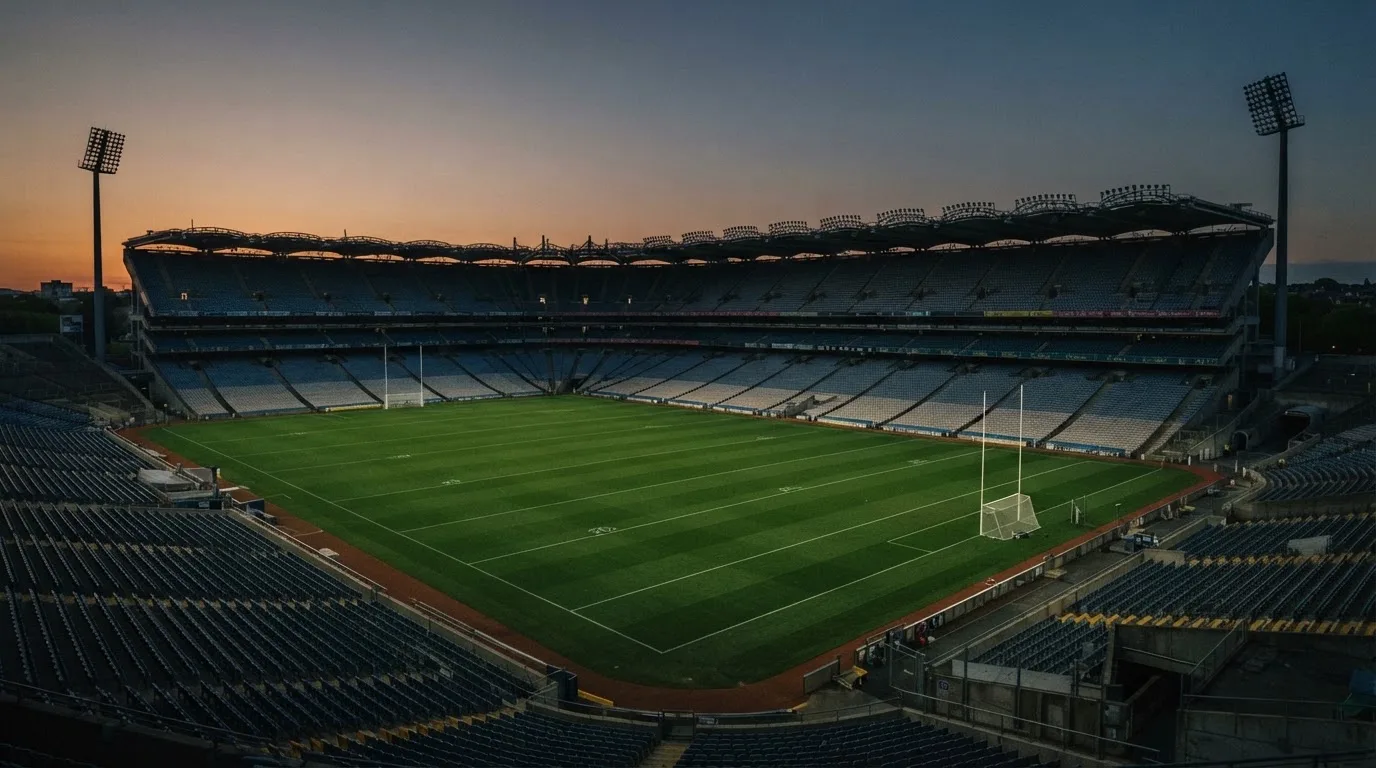
The inter-county championship is the showpiece. The All-Ireland Senior Football Championship runs from the provincial championships in May and June to the All-Ireland final in July, played at Croke Park in Dublin. The 2026 final was played on 26 July 2026 at Croke Park, with Mayo beating Kerry 1-20 to 1-17 for their fourth title. Kerry hold the record for the most All-Ireland Senior Football Championship titles with thirty-nine, and a meeting with Kerry is what every other county circles in the calendar. The Joe McDonagh Cup, the Christy Ring Cup and the Tailteann Cup run below the senior championship; the club championship runs from the county championships in autumn through the All-Ireland club final in January.
The Allianz League runs from January to April. It is the league season and the place where newer players break into the team before the championship, and the bookmakers cover it on the same markets as the championship but at thinner liquidity. Punters looking for a mispriced outsider in early season will find them in the league rather than the championship, where the bigger bookmakers have had weeks to trim the prices.
Hurling runs on a parallel calendar and is the second of the two Gaelic games. The scoring rate is higher, the matches run faster, and the bookmakers’ margins on hurling are typically a touch tighter than on football because the betting volume is higher. The All-Ireland Senior Hurling Championship final is also at Croke Park, in the same month, and the betting markets on it are the deepest single-game Gaelic games markets in the calendar.
Ten bookmakers taking bets on Gaelic football
The ten bookmakers below hold a Gambling Commission remote licence and are listed on the Commission’s public register against a licensee holding a remote betting licence for Great Britain. This is not a ranking and not a recommendation; it is a shortlist of ten brands a reader comparing options might look at, with what the operator’s own published terms say about the licence and the key subject of the page. Several of them run under one licensee — BetUK under LeoVegas Gaming PLC, for example — and that fact is worth knowing because it is the licence holder’s standing that the Commission registers, not the brand’s.
A reader choosing between them is not choosing between a licensed and an unlicensed operator. They are choosing between ten licensed operators on the kind of bettor they are. The match for a casual weekend punter is not the match for a serious markets trader. The bookmakers differ, and the differences are what the next ten sections are about.
| Brand | Gambling Commission licence | Operator’s published terms |
|---|---|---|
| Tote | 054779-R-331321-008 (TDCO Limited, account 54779) | Best Odds Guaranteed on UK and Irish horse racing from 8am on race days; runs the pool-betting format alongside fixed-odds |
| Fafabet | 057385-R-333191-006 (Taichi Tech Limited, account 57385) | Best Odds Guaranteed on UK and Irish horse racing win and each-way bets from 9am on race days |
| Kwiff | 044448-R-323408-017 (Eaton Gate Gaming Limited, account 44448) | Supercharge feature can instantly boost the odds on a bet, for example from 2/1 to 20/1, on singles or multis |
| DAZN Bet | 048756-R-327274-019 (DZBT Limited, account 48756) | Minimum deposit £5 by debit card, Apple Pay, Paysafecard, Trustly or Skrill; £20 by PayPal; no processing fees |
| Smarkets | 039173-R-319366-011 (Smarkets (Malta) Limited, account 39173) | Two-factor authentication, live charts and order book view, quick trade-out option, 24/7 live chat support |
| Bet Ahoy | 100094-R-341742-003 (Bet Ahoy Ltd, account 100094) | 10% Acca Bonus up to £1,000; Sub-Cover for player substitutions; Best Odds Guaranteed on UK and Irish horse and greyhound racing up to £100 |
| BetTom | 064959-R-339314-003 (Bet Tom Limited, account 64959) | 50% back as a free bet up to £50 on sports; matching 50% back up to £50 as free slot funds for casino |
| Dabble | 065677-R-340363-005 (Dabble Sports UK Ltd, account 65677) | “Bet £10, Get £10 in Free Bets” first-deposit offer for new customers; minimum odds apply; 7-day free bet expiry |
| BetUK | 039198-R-319450-029 (LeoVegas Gaming PLC, account 39198) | Free bets exclude virtual sports, esports and non-UK/IE horse racing; minimum odds apply |
| Spreadex | 008835-R-104580-022 (Spreadex Limited, account 8835) | £60 in free bets for a £10 fixed-odds qualifying bet; qualifying bet must be placed within 28 days of opening |
The next ten sections are the verdicts.
Tote
Tote is the pool-betting brand, descended from the Horserace Totalisator Board and still run as a pool alongside fixed-odds markets. The Tote’s licence sits against TDCO Limited and the Commission account number is 54779; the licence category on the register is remote general betting standard for real events, which covers the sports markets a reader on this page is comparing. The Tote’s own terms run Best Odds Guaranteed on UK and Irish horse racing from 8am on race days, and the pool format itself is the brand’s distinguishing feature on horse racing rather than on Gaelic games. For a reader whose interest is Gaelic football specifically, Tote is one of ten licensed options and not the obvious first pick, but the licence is in order and the brand covers the sport.
Fafabet
Fafabet runs Best Odds Guaranteed on UK and Irish horse racing win and each-way bets from 9am on race days, which is the concession a reader who bets mostly on racing will look for. The licence sits against Taichi Tech Limited and the Commission account number is 57385. The brand’s Gaelic football coverage sits inside a wider sportsbook of the kind most UK bookmakers run, with the standard markets on the major championships and a thinner offering on the Joe McDonagh, Christy Ring and Tailteann cups. For a reader who bets on both racing and Gaelic football and wants one bookmaker who does both with the BOG concession on the racing side, Fafabet is the match the table is making.
Kwiff
Kwiff’s distinguishing feature is Supercharge, a mechanic that can boost the price on a bet the moment it is placed — the operator’s own example is a bet at 2/1 being boosted to 20/1. The boost applies to singles or multis on any sport, which means a bettor on Gaelic football picks up the same concession as a bettor on the Premier League. The licence sits against Eaton Gate Gaming Limited and the Commission account number is 44448. Supercharge is the kind of feature that pays off more for the occasional punter than for the serious markets trader, because a trader prices the boost into their staking plan rather than the other way round. For a casual weekend punter on the championship, Kwiff is the match.
DAZN Bet
DAZN Bet is the sportsbook run by DZBT Limited, and the Commission’s account number is 48756. The published deposit terms are the section worth quoting: minimum deposit £5 by debit card, Apple Pay, Paysafecard, Trustly or Skrill; minimum deposit £20 by PayPal; no processing fees on any method. The deposit floor is the lowest of the ten bookmakers reviewed here, and that is the kind of detail that matters for the small-stake punter — the fiver or tenner on the championship who does not want to fund £20 to claim a free bet. For a reader betting on a tight budget, DAZN Bet is the match.
Smarkets
Smarkets is a betting exchange rather than a traditional bookmaker, and the licence category on the public register is remote betting intermediary, the category for exchanges. The licence sits against Smarkets (Malta) Limited and the Commission’s account number is 39173. An exchange works by matching punters against each other: one backs a selection at a price, another lays the same selection at a price, and the exchange takes a commission on the winning side rather than a margin on the market. Smarkets’ own app offers two-factor authentication, live charts, an order book view, a quick trade-out option and 24/7 live chat support, which is the feature set a markets trader expects and a casual punter does not need. For a reader who trades prices rather than picks, Smarkets is the match.
Bet Ahoy
Bet Ahoy’s published terms name four features in a single paragraph, which is the kind of detail a comparison page is built on. There is a 10% Acca Bonus up to £1,000, Sub-Cover for player substitutions, Best Odds Guaranteed on UK and Irish horse and greyhound racing up to £100, and Double Result payout on UK and Irish racing. The licence sits against Bet Ahoy Ltd and the Commission’s account number is 100094. Sub-Cover is the feature that matters most for a Gaelic football reader — a substitute in a GAA match can change the market materially, and a bookmaker who settles the bet on the player who started rather than the player who finished is one whose terms repay a careful read. For a reader who builds accumulators across Gaelic games and racing, Bet Ahoy is the match.
BetTom
BetTom runs a split welcome offer: 50% back as a free bet of up to £50 on sports, and a matching 50% back up to £50 as free slot funds for casino play. The licence sits against Bet Tom Limited and the Commission’s account number is 64959. The headline shape of the offer is the kind that reads as generous until the reader checks the wagering conditions on the casino side and the minimum odds on the sports side. For a reader who plays both sports and casino under one account, BetTom is the match, and the sports-only reader is paying for the casino half of the offer in conditions they will not use.
Dabble
Dabble’s welcome offer is a “Bet £10, Get £10 in Free Bets” first-deposit deal for new customers, with minimum odds applying, a 7-day free bet expiry and the stake not returned. The licence sits against Dabble Sports UK Ltd and the Commission’s account number is 65677. The “stake not returned” line is the line every free-bet reader should look for first: a £10 free bet at evens returns £10 in profit, not £20, because the stake is the bookmaker’s and stays the bookmaker’s on settlement. For a reader who bets on the championship with a fixed budget and reads the small print, Dabble is the match.
BetUK
BetUK runs under LeoVegas Gaming PLC and the Commission’s account number is 39198. The published terms name the markets the free bets exclude: virtual sports, esports and non-UK/IE horse racing, with minimum odds applying. The exclusion list is the part of the terms a Gaelic football reader actually cares about, because Gaelic football is none of the excluded categories and the free bet lands cleanly on the championship market. For a reader who wants a free bet on the All-Ireland and is happy to read the exclusions to confirm the sport is in, BetUK is the match.
Spreadex
Spreadex is the only bookmaker in the review with two licences. The fixed-odds sportsbook runs under a Gambling Commission licence against Spreadex Limited, account 8835. The spread-betting side runs under FCA regulation, which is a different regime for a different product, and the homepage carries the warning that spread-betting losses can exceed the deposit. The new-customer offer is £60 in free bets for a £10 fixed-odds qualifying bet, with the qualifying bet to be placed within 28 days of opening the account. For a reader who wants the spread-betting side alongside the fixed-odds side under one roof and accepts the product warning that comes with the spread side, Spreadex is the match.
What the licence does — and does not — give the punter
The Gambling Commission licences the commercial market in Great Britain under the Gambling Act 2005, and the Gambling (Licensing and Advertising) Act 2014 extended the rule so that any operator whose remote facilities are used in Great Britain needs a Commission licence wherever it sits. A Curaçao, Maltese or Gibraltar licence is not a substitute, and the Commission’s public register is the only place to check whether a brand actually holds one. The register can be searched by business name, trading name, domain or Commission account number, and the licence category sits next to the licence holder’s name. Reading the register takes a minute and is the test no marketing page can pass for a brand that fails it.
The licence categories on the register match the kind of betting the operator does. A remote general betting standard (real events) licence covers fixed-odds sports betting on real matches. A remote general betting standard (virtual events) licence covers the same on simulated events. A remote betting intermediary licence covers exchanges, the kind of licence Smarkets holds. A remote pool betting licence covers pool-betting formats, the kind Tote runs. Reading the category is part of the check, because a brand licensed for virtual events only is not licensed to take a real-world Gaelic football bet.
The minimum age at every GB-licensed operator is 18. Identity verification is run before the first deposit and before any gambling, including with a free bet or bonus, and the standard verification is name, address and date of birth. The verification rule has been in force since 7 May 2019 and it is the reason no GB-licensed bookmaker offers anonymous play. A reader who wants anonymity is not looking at the licensed end of the market.
The credit-card ban is another rule that runs across every licensed operator. Since 14 April 2020, no GB-licensed bookmaker accepts a credit card for gambling, including a credit-card-funded payment through an e-wallet. Debit cards and bank-based payments are not covered by the ban; e-wallets funded by a debit card or a bank transfer are not covered either. The rule is on the operator, not the punter, and a punter who tries to deposit by credit card at any of the ten bookmakers above will be turned away at the cashier.
The bonus cap is the rule of 2026. Since 19 January 2026, wagering requirements on bonuses at GB-licensed operators are capped at 10x — a £10 bonus at 50x needs £500 of qualifying bets; under the cap no more than £100 of qualifying bets. The cap does not change the headline number on the offer; it changes the small print under it. The cap also bans mixed-product promotions, an offer that requires gambling on two or more product types such as betting, casino, bingo and lottery — the “bet on football to get free spins” shape. The cap is the rule a reader comparing free bets across two bookmakers should know is the same on both sides.
What the licence does not give the punter is a guarantee of winning. The Commission does not insure bets, does not underwrite offers and does not intervene in a dispute over whether a goal was scored from inside or outside the 40-metre arc. The Commission’s complaints route is open to a punter who has exhausted the operator’s own complaints process and the approved alternative dispute resolution (ADR) body, and a Commission adjudicator’s decision is the end of the public route. None of that is a tip, and none of it changes the price.
Safer gambling: the tools every licensed bookmaker must offer
GAMSTOP is the national multi-operator online self-exclusion scheme, mandatory at every GB-licensed online operator since 31 March 2020. Self-exclusion periods are six months, one year, five years, or five years with auto-renewal, and after the minimum period the exclusion stays in place for a further seven years unless the customer asks GAMSTOP to remove it. GAMSTOP covers online sites and apps only; the betting shop self-exclusion scheme is separate.
Deposit limits are the other tool every licensed operator offers. Since 31 October 2025 the first phase of new deposit-limit rules has applied, with a second phase postponed to 30 September 2026; whether that second phase is live is not established. The principle is the same regardless of the rule’s exact shape: the punter sets a gross deposit limit over a fixed time period, and the operator enforces it. There is no state-set deposit ceiling for betting, and the limit is the punter’s choice rather than a regulator’s imposition. A punter who wants a hard ceiling sets it themselves; a punter who doesn’t has no ceiling imposed.
The financial vulnerability check is the rule that has been in force since 28 February 2026 for deposits minus withdrawals exceeding £150 in a rolling 30-day window. The check is a public-record check (bankruptcy or county court judgments, for example), not an income check and not a credit reference check. The financial risk assessment — the “affordability checks” the press has been writing about — has been announced in a staged plan, with no start date. The distinction is worth holding: the vulnerability check is in force; the affordability check is announced, staged, and not yet in force.
Help is available off the licensed operator entirely. GamCare runs the National Gambling Helpline; GambleAware funds treatment and education; the NHS runs gambling clinics in several regions; Gamblers Anonymous runs peer-support meetings. A punter who wants help can reach it without going through the bookmaker at all.
The licensed operator’s safer-gambling tools sit inside the account, and the bigger bookmakers run a single menu where deposit limits, time-out, product restrictions and self-exclusion sit alongside reality checks and access to the support organisations. Unibet’s published safer-gambling section names deposit limits, a Player Profile test, product restrictions and self-exclusion, with live chat support and links to BeGambleAware, GamCare, GAMSTOP, Gambling Therapy and the BGC. The list is the standard list at the bigger operators and a useful template for what to look for at any licensed brand.
Crypto, anonymity and the licensed end of the market
Crypto betting and anonymity are two related ideas, and both run against the licensed end of the GB market. Identity verification at a licensed bookmaker is run before the first deposit, and the standard verification is name, address and date of birth. A punter who funds a deposit from a Bitcoin address and never provides those details is not a punter the licensed bookmaker will accept. A licensed bookmaker that did accept that customer would be breaking its own licence conditions, and the Commission’s enforcement record shows that operators lose their licences for it.
The crypto-friendly end of the market is offshore. A Curaçao-licensed operator that takes Bitcoin deposits and asks no questions is not the same thing as a GB-licensed operator that takes Bitcoin and runs the same verification as a debit-card deposit. The first is the shape most readers are looking for when they search for crypto betting; the second does not really exist at scale. The licensed market and the crypto-friendly market overlap less than the marketing suggests.
The published terms at the ten bookmakers reviewed above name no cryptocurrency deposit methods. The deposit methods sit on the operator’s site and run through the standard GB payment mix: debit cards, bank transfers, PayPal, Apple Pay, Google Pay, Trustly, Skrill, Neteller, Paysafecard. None of those is anonymous. The punter whose deposit is to be private is not looking at the licensed end of the market, and the licensed end of the market is the only end with GAMSTOP, the bonus cap and the Commission’s complaints route.
The offshore alternative is a real choice with a real cost. The cost is the protections the licensed operator provides: no GAMSTOP coverage, no Commission complaints route, no approved ADR body, no British consumer redress if funds are withheld, not bound by the 10x bonus cap, not bound by the £150 vulnerability check. The offshore operator may pay out faster; it may also withhold a payout on a discretionary rule the punter has never seen. A punter who values speed over protection is making that trade, and a comparison that omits it is not a comparison.
Bonuses and free bets: what the offer is actually worth
A bonus is a marketing number attached to a deposit. A free bet is a stake the bookmaker gives and keeps, and the difference between the two is the part the small print makes plain. A “£60 in free bets” headline at Spreadex means the punter gets £60 of bookmaker-funded stakes, and the stake is not returned when a free bet wins. A £10 free bet at evens returns £10, not £20; a £10 free bet at 3/1 returns £40, not £50. The “free” in the headline is the bookmaker’s free, and the punter is paid only the profit.
The value of a free bet whose stake is not returned is the free-bet amount multiplied by (odds minus 1) divided by the odds, then multiplied by the payout share of the market the bet is on. A £10 free bet at 3.00 (2/1) on a market with a 95% payout share returns £10 × (3.00 − 1) ÷ 3.00 × 0.95 = £6.33 on average, not the £20 a £10 stake at the same price would pay. The £13.67 gap is the cost of the “free”, and it is the reason a free bet is worth less than its face value.
The “Bet £10, Get £10 in Free Bets” offer at Dabble, the “£60 in free bets for a £10 fixed-odds bet” at Spreadex, the “50% back as a free bet up to £50” at BetTom and the “10% Acca Bonus up to £1,000” at Bet Ahoy are all shapes of the same deal, and the small print under each one says what kind of bet the qualifying stake has to be, at what minimum odds, in what time window. A qualifying bet at minimum odds of 1.50 means the punter’s £10 has to be at 1.50 or bigger, and a punter who backs a 1.20 shot to qualify has not qualified.
The wagering requirement on a cash bonus is the other cost the small print names. A £10 bonus with a 10x wagering requirement needs £100 of qualifying bets, and only bets at or above the minimum price count. The 10x cap on wagering requirements is the new Commission rule, and a £10 bonus at 50x is no longer offered at a licensed operator. The rule does not change the headline; it changes the small print under it.
An accumulator bonus is paid on the winnings, not the stake, and the size of the bonus scales with the number of legs. A 10% acca bonus on a four-fold acca is 10% of the winnings; a 50% acca bonus on a ten-fold acca is 50% of the winnings. The bonus is paid in cash at most operators, free bet at others, and the format sits in the terms.
A price boost is the third offer shape. A bookmaker offers a bigger price on a market for a limited window, and the punter takes the boosted price or doesn’t. Kwiff’s Supercharge is the example reviewed above: a price can be boosted from 2/1 to 20/1 the moment the bet is placed. The boost is the bookmaker’s, not the market’s, and the punter who backs a price that is then boosted is paid at the boosted price. Kwiff’s published terms name the maximum stake that qualifies.
Each offer shape has its own arithmetic, and the arithmetic is the only honest measure of what the offer is worth. The “free” in the headline is not free, the “bonus” is not a gift, and the “guaranteed” in Best Odds Guaranteed applies only to the price differential between the price taken and the SP on the race. A reader who reads the small print before claiming a free bet is a reader who knows what the offer costs.
Tax, winnings and what the punter actually pays
The punter in Great Britain pays no tax on betting winnings. That is the general position and is the headline, and it is the headline that General Betting Duty (the operator’s tax, not the punter’s) sits behind. General Betting Duty is charged on the operator’s gross profits from betting, currently 15%, with a new remote betting rate of 25% from 1 April 2027 within the existing duty. The remote rate stays at 15% until then, and the question of whether operators pass duty on through odds is not established — never write that the punter is charged duty.
A punter who is a professional gambler for tax purposes is in a different position, and the general information on this page is not tax advice. A professional gambler asks HMRC or an adviser, and the answer is not the headline. The headline is for the casual punter whose betting is not a trade.
Spread betting has its own rates — 3% on financial spread bets, 10% on other — and this is the operator’s tax, not the punter’s. The punter’s exposure on a spread bet is unlimited, and the loss can exceed the deposit. Spreadex’s homepage carries the warning because the warning is the FCA’s and the Commission’s joint requirement on the product. The product warning is not a marketing line; it is a regulatory line.
The Premier League clubs’ withdrawal of gambling sponsorship from the front of matchday shirts from the 2026/27 season is voluntary, not law. The change is the clubs’ choice rather than the regulator’s, and the sleeves and the hoardings stay. The “whistle-to-whistle” ban on betting advertisements around live sport is an industry code, not a statute, and has been in force since 1 August 2019. The CAP Code’s restriction on who may appear in a gambling advertisement — no one who is or seems to be under 25, with a narrow exception — is the broadcast and non-broadcast advertising rule, and it concerns who may appear in the ad rather than who may bet.
None of this changes the price on a Gaelic football match. It changes the framing around the price, and the framing is the kind of thing the reader comparing bookmakers on the table above should know without it changing the verdict.
Offshore, unlicensed and the protection the licence provides
A bookmaker taking bets from customers in Great Britain without holding the licence the Gambling Act 2005 requires is committing an offence under section 33 of the Act — on summary conviction up to 51 weeks’ imprisonment, a fine up to level 5, or both; six months in Scotland. The offence is aimed at the operator. No offence aimed at a customer who merely bets on an unlicensed site was found in the framework this page draws on, and the framing is the loss of protection rather than the criminality of the customer.
The protection the licensed operator provides is the list in the previous section: GAMSTOP coverage, the Commission’s complaints route, an approved ADR body, British consumer redress if funds are withheld, the 10x bonus cap, the £150 vulnerability check, and the safer-gambling tools the licence requires. An unlicensed operator is bound by none of those, and a punter who holds an account with an unlicensed operator has no British route to a complaint.
Enforcement is disruption rather than blocking. The Commission issues cease-and-desist notices, refers sites to search engines, works with registrars, hosts and payment providers, and has been given or is about to receive court-order DNS blocking powers. The blocking powers are not in general operation at the time of writing, and a reader who sees a claim that ISP blocking is in force is reading a marketing line. The honest framing is licensed = checks, limits, GAMSTOP, bonus cap, verification before the first bet; unlicensed = none of those protections and possible loss of funds. Neither is “the safe choice” by default, and the comparison is the punter’s to make.
Frequently asked questions
How do you bet on Gaelic football?
Pick a licensed bookmaker from our table, open an account, and pass the required identity check. Deposit using a debit card or bank-based method, then select a market from the championship calendar. Match-result and total-points markets are ideal for beginners. Start with single bets to learn the mechanics, then move to complex bets.
What is a value bet and why is no tip ever certain?
A value bet is a price exceeding the actual probability of the outcome, once the bookmaker’s margin is removed. A 2.00 shot on a selection you judge a 55% chance is a value bet, as your estimate exceeds the 50% implied probability. No tip is ever certain because forecasts are incomplete: form breaks, squad news may be missing, and unpredictable events like a wet ball or referee decisions settle any match. This edge is statistical.
What is the bookmaker’s margin and how can it be seen in the odds?
The margin is the cut a bookmaker keeps from total bets, embedded within the offered prices. A two-way market at 1.90/1.90 implies a 5.26% overround, meaning the bookmaker pays back 95% in the long run. A market at 2.00/2.00 implies a margin of 0%. By calculating the sum of 1/odds for all outcomes, you can see the margin yourself quite easily.
How is the return on a bet worked out from the stake and the odds?
With decimal odds, your return is simply your stake multiplied by the odds. A £10 stake at 3.50 returns £35, representing £25 profit plus your £10 stake back. Fractional odds work similarly; convert them to decimal by dividing and adding one, then multiply by your stake to find the final total return.
How can it be checked that a bookmaker holds a Gambling Commission licence?
Visit the Commission’s public register and search using the business name, domain, or Commission account number. The entry will show the licence status, category, and holder details. This register is the definitive source for verifying if an operator is licensed to take real-world bets in Great Britain, regardless of marketing claims made elsewhere.
Which tools for controlling play does a licensed bookmaker have to offer?
Every GB-licensed online bookmaker offers GAMSTOP self-exclusion (six months, one year, five years, or five years with auto-renewal), deposit limits, time-outs, product restrictions, reality checks and links to GamCare, GambleAware, the National Gambling Helpline and Gamblers Anonymous. The Commission requires each of these under the LCCP and the Remote Technical Standards. A punter who wants GAMSTOP signs up once and is excluded from every licensed operator for the period chosen, with a seven-year tail after the minimum period. A punter who wants a deposit limit sets it inside the account and the operator enforces it.
Rugby, cricket & Gaelic – Grey Hound
Content created by the «Grey Hound» team
