
Handball betting odds in 2026: how to read them, where to find them, and which UK bookmakers are worth a look
 Available in US
A bet on handball is not hard to place. The harder question is what the price on the slip is doing to the stake before the whistle goes — and how the small print at a licensed bookmaker turns a £10 punt into a much longer afternoon than it looks. This page works through the mechanics of a handball price, the markets a UK-licensed bookmaker carries on the sport, and the choice between ten operators a Great Britain punter can actually fund and settle with in pounds.

Live data current as of 27 October 2026, checked against the UK Gambling Commission’s public register.
Live betting and cash out on a sport that runs sixty minutes flat out
Handball is built for in-play. Two halves of thirty minutes, very few stoppages, scores ticking over every twenty or thirty seconds at senior level, and the lead changing hands with the regularity of a tennis tie-break. A bookmaker’s in-play console on a top-flight men’s match can carry a hundred or more markets between the first and the sixtieth minute, and the prices move fast enough that the margin does a lot of the work behind the scenes.

What a UK punter gets on a live handball screen is mostly the same menu of markets the pre-match slip carried, repriced: match result (1X2 where draw is offered, or two-way home/away), totals on the match total goals, team totals, Asian or European handicaps, next goal, race to a number of goals, player totals where the bookmaker quotes them, and the combination bets built out of those legs. What changes is the cadence. A two-goal swing inside three minutes resets the 1X2 book and re-prices the totals, and a red card or a goalkeeper change moves the line more than a goal does.
Cash out sits alongside the live book on every bookmaker in this comparison. Three of them shape it differently. Some settle a cash-out request at the current live price, with a small buffer for the time it takes the request to clear the trading floor. Others offer a partial cash-out that closes a chosen fraction of the stake and leaves the rest running. One — Spreadex — publishes the cash-out buffer inside its Bet Builder, so a multi-leg position can be closed leg by leg. The trade is the usual one: a bookmaker’s cash-out price will not be the fair mid-price, and on a sport where the lead changes hands quickly it usually sits a few percentage points behind a pure exchange lay. The advantage is convenience — the request is a tap, not an order on a market.
A live stream is rarer than the cash-out button. Of the ten operators in this guide, the published material shows live streaming on handball fixtures only at the very largest books. For the rest, the live tab runs on data and on the prices themselves, with a match-tracker graphic that simulates goal-by-goal progress. That is enough to read a game, not enough to watch one.
The single most useful thing a live handball punter can do is watch the timeout structure. Each side has three thirty-second timeouts per match, and a coach will spend one on a server change, on a switch from a 6-0 to a 5-1 defence, or on calming a goalkeeper who has just conceded four in a row. Each timeout is a deliberate punt on the next five minutes of the match, and the prices on the live console tend to lag the change by two or three goals’ worth of information. A punter who reads the timeout first and the price second is doing the work the live book is not. That kind of edge compounds across a season.
Why a fast sport punishes a slow staking plan
The thing about a 60-minute match and roughly fifty goals is that there is no value in dollar-cost-averaging in. A pre-match price is set hours ahead of throw-off; by the time the live book opens, the market has already incorporated the line-up and the bench. What changes during the match is information the bookmaker has not priced yet — a tactical switch, a goalie losing range, an early two-minute suspension that walks an attacker off the court.
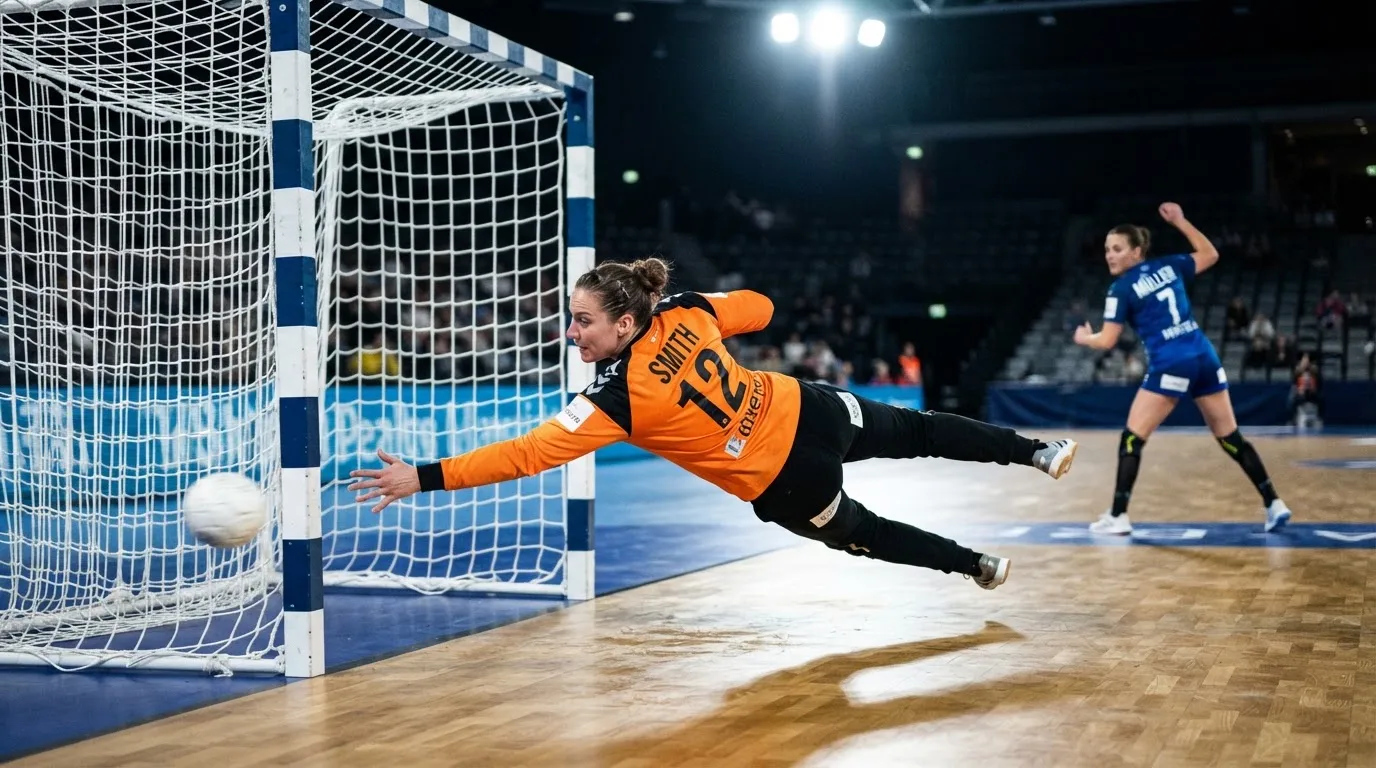
That is the case for staking on live rather than pre-match on a sport this short. The stake is the same £10 either way; what differs is the price the slip is filled at. On a fast-moving live book the price lags the reality for ten, twenty, sometimes thirty seconds, and that window is where the value sits. Outside it, the margin does what the margin always does.
The cash-out trap on a draw-heavy league
Handball draws are not football draws. A regulation draw in men’s top-flight handball is rarer than a regulation draw in football, and the draw line in a tight match tends to drift rather than shorten. A punter who has backed the draw and is watching the game go to overtime will see the cash-out value drop hard in the last two minutes of normal time, because the market knows the draw carries more weight in extra time. A partial cash-out at half-time, leaving the rest running into overtime, is one way to manage that. Another is to back a two-way market that has no draw line at all, and to let cash-out sit untraded unless the lead changes by five or more.
Predictions, previews and the bankroll discipline that sits behind them
A handball prediction is a forecast. The page that publishes one is in the same trade as the bookmaker — both are pricing an uncertain event, and both are wrong half the time at the bottom of the league. What separates the punter from the bookmaker is information and discipline, in that order.
Information first: line-ups, injuries, suspensions, last-five form, head-to-head, home and away splits. The leagues a UK punter has the cleanest access to are the Bundesliga, the French Starligue, the Spanish Liga ASOBAL, the Danish Herre Ligaen and the Hungarian K&H Liga. Each of those feeds a Champions League group, an IHF World Championship cycle, and a European Championship every two years in even-numbered years. The women’s pyramid is thinner at the betting end but well-covered at the European Championship and the IHF Women’s World Championship.
Discipline second. The most useful thing a tipster does for the bankroll is not naming a winner — it is naming a stake. Flat staking — the same £10 on every selection — turns a 53% strike rate into a slow profit and a 47% strike rate into a slow loss. The Kelly criterion, used in fractions rather than full Kelly, is the academic version of the same idea: stake proportional to the edge, with the floor at zero stake if the edge is zero or negative. The simplest working version is to stake a fixed unit on every bet — say £10 — and to track return on investment per quarter. A punter whose ROI is negative over a hundred bets is paying for the bookmaker’s margin and not much else.
A note on “best bets” lists
“Best bets” is a phrase that ages badly. A shortlist published on a Friday for a Sunday card looks fresh on the Saturday morning and stale by kick-off, because the line-ups have moved, the suspensions have come in, and the prices have been re-formed. The longer a tipist’s horizon, the less their tip is worth to the punter reading it. The most honest tip is the one that names a stake and a price and a closing time, and then lets the price close itself.
That is also the test the bookmaker is failing if it cannot show the live price at the moment a punter hits the cash-out button. A live book is, in part, an honesty test.
Markets and the way odds are written for handball
A handball market looks like a football market from a distance. The bookmaker’s slip carries a 1X2 with home, draw and away, a totals line on the match total goals, a totals line on each team’s goals, an Asian or European handicap on the result, and a small pile of combination bets built from those legs. The shape of a price is the same shape: decimal odds written as the return per £1 staked, fractional odds written as the profit per £1 staked, and an American line on a US-facing book. The mechanics underneath are not the same.
A two-way market at evens (decimal 2.00, fractional 1/1) carries a margin of 0% if the bookmaker offers it for free and a margin of something larger if it does not. The bookmaker always charges for the privilege. The rule the price hides is this: the implied probability of every outcome, read off the decimal odds as 1/odds, sums to more than 100% on every market. The surplus is the bookmaker’s margin.
That is the arithmetic at the bottom of every price on the slip. It does not need the page to teach it — a punter can run it themselves — but it is worth stating once, because the rest of the page turns on it.
How the margin is built into an even price
A clean two-way market, no margin, has two prices at 2.00 each. The implied probability is 1/2.00 + 1/2.00 = 0.50 + 0.50 = 1.00, or exactly 100%. A bookmaker adds margin by knocking both prices down: at 1.90 / 1.90 the implied probability is 1/1.90 + 1/1.90 ≈ 0.5263 + 0.5263 ≈ 1.0526, or about 105.3%. The surplus over 100% is the margin — about 5.3% on this illustrative example, before any rounding.
The 1.90 / 1.90 example is illustrative only. Research gives no quoted handball price for this page, and the page prints no live price for a market that does not have a snapshot. The shape of the number is what matters: a margin in the low single digits is competitive for a top-flight handball 1X2, a margin in the mid-single digits is ordinary, and a margin in the high single digits is what a small book or an unfavoured league tends to charge. Three-way markets — 1X2 — carry more margin than two-way markets, because the bookmaker has to overprice three of them.
The margin compounds across a combination bet. A three-leg accumulator at three prices of 1.90 each has a combined margin that is roughly three times the margin on a single leg, less a small discount from the rounding. That is why combination bets feel generous on the slip and feel thinner on the bankroll.
What the punter reads off the price
A punter who wants to read a price has three working conversions. Decimal odds to fractional: subtract 1, then simplify. Decimal odds to implied probability: 1 divided by the decimal odds, expressed as a percentage. Fractional odds to decimal: divide the numerator by the denominator and add 1.
The most useful of those is the third. Reading the implied probability off every price on the slip, summing them across a market, and subtracting 100% gives the margin in a single subtraction. A punter who does that once a week on a familiar league learns which books price that league tight and which books price it loose. The pattern holds for handball the way it holds for football.
A worked margin on an even-money two-way line
A two-way market priced at 1.90 (decimal) / 1.90 (decimal), fractional 9/10 on both sides, is the example this page runs. The implied probability on each side is 1 / 1.90 ≈ 52.63%. The two implied probabilities sum to about 105.26%, and the margin is the surplus over 100%, so about 5.26% in round terms. Stated as a band: somewhere in the 5% to 5.5% region, depending on rounding, on a clean two-way book with no ringer prices.
That is a serviceable margin on a top-flight handball 1X2 quoted in a strong league. A bookmaker at 1.95 / 1.95 would carry a margin closer to 2.5%; a bookmaker at 1.85 / 1.85 would carry a margin of about 8%. The honest reading is that a 1.90 / 1.90 line is the working middle of the market, and a punter who wants a sharper number shops the price across two or three books before staking.
The point of the calculation is not the number itself — a margin is a snapshot, and the snapshot moves with the live book. The point is that a margin is a number a punter can compute from the prices on the slip without telling anybody what the prices are.
Three-way markets and overtime
Handball draws are a complication. A regulation-time draw in top-flight men’s handball sits somewhere around 5% to 10% of matches depending on the league, lower than in football. The bookmaker’s three-way 1X2 has to price the draw in, and the draw line carries the widest margin in the market. A punter who can find a two-way home/away market without the draw — most books offer one on selected events — pays a smaller margin and gives up the overtime cushion.
Overtime itself is the structural reason a three-way market exists. A regulation draw leads to two five-minute overtime periods and then, if the draw persists, a penalty shootout. The bookmaker treats overtime as part of the match for settling purposes, so a 1X2 bet on the regulation result may be settled on the regulation result and the draw line may be settled on whether the match goes to overtime, depending on the bookmaker’s rules. A punter who does not want to think about that can back a two-way market and let the bookmaker’s rules sort it out. A punter who does want to think about it reads the bookmaker’s settled-on-rules before staking.
Tournaments, leagues and what UK bookmakers actually price
Handball at the betting end is a winter sport. The Bundesliga, the Starligue, the Liga ASOBAL and the Scandinavian leagues run from September to May, with Champions League group stages through the autumn and the knockouts in the spring. The IHF World Championships run every odd-numbered year for men and every odd-numbered year for women, with the men’s event a biennial fixture since 1995. The European Championships sit in the even-numbered years. The Olympic handball tournament has been a permanent fixture since Munich 1972 on the men’s side and since Montreal 1976 on the women’s side.
Denmark is the reigning men’s world champion from the 2025 tournament; France holds the women’s title from 2023. The Olympic handball tournament for 2026 sits inside the wider Olympic programme on whatever schedule the IOC and the IHF have published. A punter’s working calendar is the IHF one, and the betting calendar on a UK book follows it within a season or two.
At the club end, the men’s Champions League is the best-priced competition: four groups of six or eight, then knockouts through the spring. The women’s Champions League runs alongside it on a smaller screen. The EHF European League is the second tier and is thinly priced on most UK books. Domestic cups are sparsely priced. Lower-division handball is almost unpriced outside the Bundesliga and the Starligue, and a punter who wants a Bundesliga reserve match or a Spanish second-tier fixture has a thin menu.
What UK bookmakers publish on a top-flight handball weekend is roughly twenty to thirty pre-match markets on a marquee match and ten to fifteen on a quieter one. The live book on the same matches is roughly twice that, depending on the bookmaker’s trading depth. A Bundesliga derby carries more markets than a friendly international.
A note on women’s handball
Women’s handball is the better-priced women’s team sport in many UK books, in the sense that the line is more reactive and the live book is closer to a clean line. The Champions League women, the IHF Women’s World Championship, and the European Championship women are all priced on the bigger books. A punter who knows one women’s league well is well-positioned; a punter who knows the men’s Bundesliga well has more depth to work with. The same is true of every team sport the bookmakers price.
The ten UK-licensed bookmakers with a handball screen
Ten operators hold a Gambling Commission remote licence that covers a real-events betting product and serve customers in Great Britain. Each runs a sportsbook that prices at least some handball fixtures in pre-match and live, and each one has at least one feature that sets it apart in the comparison. The reviews below cover the licences, the payments, the welcome offer and the bet-building and live-betting features that materially change the experience of placing a handball bet.
| Operator | Licence (UK Gambling Commission) | What the operator’s own terms state on the handball key |
|---|---|---|
| 10bet | Remote licence 043173-R-322899-023 — Blue Star Planet Limited | Sportsbook covers football, tennis and horse racing; Cash out, Bet Builder and Live Streaming are published features. |
| Midnite | Remote licence 101839-R-342850-001 — Midnite Limited | Site cites licence 101839; in-play events, an acca builder, popular accas and price boosts with maximum-stake limits are published. |
| Smarkets | Remote licence 039173-R-319366-011 — Smarkets (Malta) Limited | A betting intermediary; UK open-bank deposits are instant from £10 to £10,000; UK debit card deposits instant from £10 to £15,000. |
| Bet Ahoy | Remote licence 100094-R-341742-003 — Bet Ahoy Ltd | Welcome offer made up of a £5 sports single and a £5 accumulator on a £10 qualifying bet. |
| Betfred | Remote licence 039544-R-319290-010 — Petfre (Gibraltar) Limited | Sports, casino and games app covers 21 sports and over 2,000 casino-style games. |
| BetMGM | Remote licence 039198-R-319450-029 — LeoVegas Gaming PLC | Welcome offer for new UK customers who deposit and place a qualifying bet is four £10 free bets on specified bet types. |
| Spreadex | Remote licence 008835-R-104580-022 — Spreadex Limited | Combines fixed-odds and spread betting in one app; FCA-regulated for spreads, Gambling Commission for fixed odds. |
| Betmaster | Remote licence 065699-R-339929-002 — BM Solutions GB Ltd | App covers football, cricket, horse racing, NFL and eSports including League of Legends and Dota 2. |
| DAZN Bet | Remote licence 048756-R-327274-019 — DZBT Limited | Deposits from £5 by debit card, Apple Pay, Paysafecard, Trustly and Skrill; from £20 by PayPal; no published processing fee. |
| Kalooki Sportsbook | Remote licence 057730-R-333396-005 — Kalooki Sportsbook Limited | Operated by Kalooki Sports Book Ltd (company number 12938274); a GAMSTOP member. |
That table is a licence table, not a ranking. The numbers across the top are Gambling Commission remote licence references; the right-hand column is what each operator’s own site publishes on its own terms. The Commission’s public register is the place to verify the licence detail; the table is a summary of what the register and the operator’s own site carry between them.
10bet — a multi-feature sportsbook with a thin on-screen line on handball
10bet runs a sportsbook that publishes Cash out, Bet Builder and Live Streaming as standing features and covers the major UK-facing sports with depth. The on-screen handball product is what a mid-tier book carries: a top-flight European match will get a workable pre-match menu, a quieter match will get a thin one. The Bet Builder works across most markets and is the feature a punter building a same-game multi on a Bundesliga derby will reach for first. The welcome offer is published on the operator’s own terms; this page describes it qualitatively, since every offer’s small print — minimum odds, expiry, payment-method exclusions — differs from the headline. The verdict on 10bet for handball is that it suits a punter who wants a familiar UK-facing sportsbook with a published Bet Builder and is happy to take a mid-tier market depth on the sport.
Midnite — the modern UK sportsbook with a clear acca builder and a price-boost stack
Midnite’s site cites Gambling Commission licence 101839, displays in-play markets, an acca builder, popular accas and price boosts with published maximum-stake limits. The published welcome offer is a £5-or-more qualifying bet at EVS (decimal 2.00) or greater within 14 days of sign-up, settled as £25 in free bets and 50 free spins valid for 7 days. The product reads as a modern UK sportsbook: clean navigation, an acca builder that holds together, and a price-boost feed that updates through the day. Midnite excels for accumulator bettors; it offers a solid sportsbook and a user-friendly interface that handball fans often find convenient for quick in-play decisions.
Smarkets — a betting exchange with sharp prices on the top-flight events
Smarkets is a betting intermediary under Commission licence 39173, which is the exchange category. UK open-bank deposits are instant from £10 to £10,000; UK debit card deposits are instant from £10 to £15,000. Withdrawals on the betting intermediary settle inside six hours from £10 up to £100,000. The point of an exchange on a handball screen is the price — an exchange carries a smaller margin than a traditional sportsbook on the events it prices, and the back/lay mechanics give a sharp punter a way to trade out of a position rather than relying on the bookmaker’s cash-out. The downside is the depth: an exchange on a quiet handball match can be one or two orders deep, and the price can move sharply on small stakes. Smarkets provides an exchange model; for those who prefer trading positions over simple bet slips, it is a primary choice for market-driven betting.
Bet Ahoy — a sportsbook with a simple, low-stakes welcome package
Bet Ahoy’s published welcome package is a £10 qualifying stake split between a £5 sports single and a £5 accumulator, returning £10 in free bets to the two qualifying legs. The structure is simple, the qualifying price is published on the operator’s terms, and the seven-day expiry on the free bets is the small print a punter reads before claiming. The verdict is that Bet Ahoy suits a punter looking for a low-friction first bet and a clean interface, on handball or on anything else the book covers.
Betfred — the longest-running UK-facing sportsbook with the deepest sport coverage
Betfred’s sports, casino and games app is published by Done Brothers (Cash Betting) Ltd and covers 21 sports plus over 2,000 casino-style games. The Sports, Casino & Games app is the broader product; the sportsbook carries a deep pre-match and live offering on the major UK-facing sports, and the Betfred name is the brand the high-street punter recognises from the shops. Betfred is a long-standing high-street name. Its handball coverage is part of a broad range of sports, making it a reliable option for those who prefer an established UK operator.
BetMGM — the UK-facing arm of a US-facing brand with a free-bet welcome
BetMGM’s UK sportsbook is operated by LeoVegas Gaming PLC under Commission licence 39198. The published welcome package for new UK customers who deposit £10 or more and place a sports bet within 7 days is four £10 free bets, structured as two football accumulators of four or more selections and two sports multiples of two or more, valid for 7 days with published minimum odds and an opt-in. The free-bet expiry and minimum odds are the small print that turns the headline into a real number. BetMGM brings a structured free-bet bonus and a platform that blends US expertise with current UK market standards. It is well-suited for those looking for a contemporary sportsbook experience.
Spreadex — fixed odds and spread betting in one app, with one FCA and one Gambling Commission licence
Spreadex holds a Gambling Commission remote licence for fixed-odds betting and is separately regulated by the FCA for spread betting. The app combines the two products: fixed odds on the major sports alongside spread betting on the same fixtures, with one-click, auto and partial cash out, a Bet Builder that works across fixed odds and spreads, and live streaming on UK and Irish horse racing, greyhounds, tennis, NFL and selected football. The risk that sits inside spread betting is that losses can exceed the deposit, and the operator’s own terms say so. Spreadex uniquely combines fixed-odds and spread betting within one app. It is ideal for players who want to handle both styles of wagering on the same handball fixture.
Betmaster — a sportsbook covering football, cricket, horse racing, NFL and eSports
Betmaster’s app is published by BM Solutions GB Ltd and covers football, cricket, horse racing, NFL and eSports including League of Legends and Dota 2. The sports list is the working list: eSports alongside the conventional UK-facing sports. Betmaster caters to both conventional sports and eSports fans. It offers a straightforward interface that includes standard pre-match and live handball markets.
DAZN Bet — a sportsbook with a low deposit floor and a wide payment-method menu
DAZN Bet’s deposits start at £5 by debit card, Apple Pay, Paysafecard, Trustly and Skrill, and at £20 by PayPal, with no published processing fees. The payment-method menu is wider than most UK-facing sportsbooks, and the £5 deposit floor is the lowest in this comparison. DAZN Bet features an accessible £5 minimum deposit. It is a practical choice for punters looking for payment flexibility and a standard, clean sportsbook interface.
Kalooki Sportsbook — a UK-incorporated sportsbook with a clean licence line and a GAMSTOP membership
Kalooki Sportsbook is operated by Kalooki Sports Book Ltd, a UK company registered under number 12938274, licensed by the Gambling Commission under account 57730, and is a GAMSTOP member. The product is a UK-facing sportsbook with a clean regulatory footprint: the licence holder is named on the operator’s own site, the company number is on Companies House, and the GAMSTOP membership is the customer-protection signal a UK punter looks for. The verdict is that Kalooki Sportsbook is the book a punter who values a clearly stated UK licence and a clean corporate footprint will favour, with a sportsbook product that sits in the mid-tier of this comparison.
The legal frame a UK punter places a bet inside
The Gambling Commission licenses the whole commercial market in Great Britain under the Gambling Act 2005. A bookmaker whose remote facilities are used in Great Britain needs a Commission licence wherever it is based — that has been the rule since the Gambling (Licensing and Advertising) Act 2014 — and the Commission’s public register is the place to verify a licence by business name, trading name, domain or account number. Northern Ireland sits outside the 2005 Act and runs on its own older law; a Great Britain licence does not extend to a Northern Ireland customer, and the page writes “GB-licensed” rather than “UK-licensed” for that reason.
There is no statutory list of permitted sports or markets. An operator holds a licence for a category — remote general betting standard (real events), remote general betting standard (virtual events), remote general betting limited, remote pool betting, or remote betting intermediary — and offers markets under its own rules and the Licence Conditions and Codes of Practice (LCCP). Handball sits inside remote general betting standard (real events), which is the category every operator in this comparison holds.
Identity verification has been a hard requirement before a customer’s first deposit or first bet since 7 May 2019, including with a free bet or bonus. The credit-card ban for gambling in Great Britain took effect on 14 April 2020 and covers credit-card-funded payments through an e-wallet; debit cards and bank-based payments are not covered. A financial vulnerability check is in force on a rolling 30-day deposits-minus-withdrawals threshold of £150 since 28 February 2025, and is a public-record check rather than an income check. A separate financial-risk-assessment scheme was announced in a Commission article on 7 July 2026 in a staged plan with no published start date, so the page writes “announced, staged, no start date” rather than “in force”.
Bonus terms are inside the LCCP and the CAP Code, not the Gambling Act itself. Wagering requirements on bonuses are capped at 10x since 19 January 2026, and mixed-product promotions — an offer that requires gambling on two or more product types such as betting, casino, bingo and lottery — are banned. Whether the 10x cap applies to free bets with no wagering condition, and any cap on the money value of a bonus, are not established in the published material, and the page does not write a number that research does not carry.
The player pays no tax on betting winnings in Great Britain. General Betting Duty is the operator’s tax on gross profits, currently 15%, and a new remote betting rate of 25% applies within it from 1 April 2027; until then the remote rate stays at 15%. The rate change is a policy paper, not a price change on the slip, and the page does not write that operators will pass duty on through odds.
What the protection looks like in practice
GAMSTOP is the national multi-operator online self-exclusion scheme and a mandatory licence condition for online operators since 31 March 2020. Self-exclusion periods are six months, one year, five years, or five years with auto-renewal, and after the minimum period the exclusion stays in place for a further seven years unless the customer asks GAMSTOP to remove it. GAMSTOP covers online sites and apps; betting shops use a separate service. A GB-licensed operator is bound by the 10x bonus cap, by the financial vulnerability check, by the credit-card ban, by the verification-before-first-bet rule and by the LCCP marketing conditions; a non-GB operator is bound by none of those.
Responsible gambling and the help that sits behind the screen
A GB-licensed bookmaker carries safer-gambling tools as part of its licence conditions: deposit limits, time-outs, self-exclusion via GAMSTOP, reality checks, and access to the National Gambling Helpline via GamCare and the wider support network of GambleAware, NHS gambling clinics and Gamblers Anonymous. A punter who is worried about their own play, or about someone else’s, is reading the wrong page; the help that matters is on GamCare, on the National Gambling Helpline and on the NHS. A punter who is shopping the price of a handball bet is reading the right page, and the responsible-gambling frame is the reminder that a sportsbook is not a substitute for any of that.
Deposit limits are an RTS 12 requirement. Operators must offer a gross deposit limit on a fixed time frame, with the first changes having applied since 31 October 2025 and a second phase postponed to 30 September 2026. The state does not set the number; the punter sets it on their own account, and the bookmaker applies it. The framework is the same at every GB-licensed bookmaker in this comparison, and the only difference between them is the surface — how the limit is set, what time frames are offered, and how the change is confirmed.
The licensed side of the market is the side that carries the protection. An unlicensed operator carries none of it: no GAMSTOP coverage, no Commission complaints route, no approved dispute-resolution body, no British consumer redress if funds are withheld, and no obligation to apply the 10x bonus cap or the £150 vulnerability check. A punter who bets with an unlicensed operator is not committing an offence under the published material, but is losing the protections the licensed side carries. The page writes that as the trade it is, and does not write it as a moral judgement.
Crypto, e-wallets and the payment-method map
Crypto deposits are not established for the licensed side of the UK market in the published research. The page does not write that a GB-licensed bookmaker accepts bitcoin, ethereum or any other coin by name, because the published material does not carry a fact on that subject. What the published material does carry is a payment-method menu at the operator level: debit cards, bank transfers, Apple Pay, PayPal, Skrill, Trustly, Paysafecard, and the operator’s own choices beyond those. A punter who wants to fund an account in pounds will fund it through one of those rails; a punter who wants to fund an account in coin will not find a GB-licensed route in this comparison.
The credit-card ban matters for every payment method on this page. Credit-card-funded payments through an e-wallet are inside the ban; debit-card-funded payments through the same e-wallet are not. A punter who funds an account through a card that turns out to be a credit card is funding outside the rules, and the bookmaker’s KYC check is the place that catches it.
Identity verification is the other rule that meets the payment screen. Since 7 May 2019 a GB-licensed operator has to verify the customer’s name, address and date of birth before the first deposit or first bet, including with a free bet or a bonus. The verification is a hard requirement, and the bookmaker cannot waive it. A punter looking for an anonymous account does not find one on the GB-licensed side of this comparison.
Bonuses, free bets and the small print a punter reads before claiming
A welcome offer at a GB-licensed bookmaker is a marketing package with a wagering requirement, an expiry, a minimum odds line, and a payment-method exclusion list. The 10x wagering cap that took effect on 19 January 2026 is the headline rule on the bonus side: no bonus term requires more than ten times the bonus amount in qualifying bets, and a mixed-product promotion that asks the punter to combine betting with casino, bingo or lottery is banned. The cap is on the wagering multiple, not on the size of the bonus; a £500 bonus can carry a £5,000 turnover requirement, and a £10 bonus can carry a £100 turnover requirement.
A free bet is a different thing. A free bet settles at the profit only; the stake is not returned on a winning free bet. A £10 free bet at decimal odds 2.50 returns £15 in profit and zero in stake, for a total return of £15. The marketing term “free” hides the stake forfeit, and a punter reading the small print reads it before claiming. An acca-insurance offer that refunds a losing accumulator as a free bet is a refund in kind, not in cash, and carries the same stake forfeit on the refund leg.
A bookmaker’s small print on a welcome offer is the most-read piece of small print the punter will encounter. The expiry — typically 7 or 14 days from the time the free bet is credited — is the most consequential term after the wagering multiple. A free bet that expires before the punter has placed it is a free bet that paid the bookmaker rather than the punter. The payment-method exclusion list is the second-most consequential: a deposit made through an excluded method (typically Skrill, Neteller or Paysafecard) voids the welcome offer, and the punter loses both the bonus and the qualifying stake in some cases. The published material does not carry a payment-method exclusion list at the operator level for this comparison; the page reads it as a feature of the small print, not a number to print.
The honest framing is that a welcome offer is a marketing package, and the price of the package is the wagering multiple, the minimum odds, the expiry, the payment-method exclusion list, and the forfeit of the free-bet stake. A punter who reads those terms before claiming reads the offer correctly. A punter who reads the headline and claims reads the marketing and not the offer.
A verdict on the comparison as a whole
Ten operators hold a Gambling Commission remote licence that covers a real-events betting product. Six of them — 10bet, Midnite, Bet Ahoy, Betfred, BetMGM, DAZN Bet — sit on the conventional sportsbook model, with a sportsbook product priced in pounds and a payment-method menu that runs through cards, banks and the standard e-wallets. Smarkets sits on the betting-intermediary model and carries the sharpest prices on the events it covers. Spreadex sits on the dual fixed-odds-and-spread model and is the only operator in this comparison regulated by both the FCA and the Gambling Commission. Betmaster carries an eSports line alongside the conventional sports. Kalooki Sportsbook carries a UK-incorporated corporate footprint and a clean regulatory line.
The honest choice between them is not “the best bookmaker”. It is the bookmaker that fits the punter’s list: an acca-builder punter lands on Midnite, an exchange-style punter lands on Smarkets, a spread-betting punter lands on Spreadex, a low-deposit-floor punter lands on DAZN Bet, a US-rooted product punter lands on BetMGM, a long-running UK sportsbook punter lands on Betfred. Each operator suits a particular punter, and each operator suits a different kind of punter less well. That is the shape of the comparison, and the page is honest about it.
Frequently asked questions
Is a handball a foul in betting?
No. In betting terminology a “handball” is a foul committed by a footballer who handles the ball with their hand or arm. A handball fixture is the team sport played on a 40 by 20 metre court with seven players on each side, two thirty-minute halves, and goals three metres wide and two metres high. The two uses of the word are unrelated.
Does a handball count as a foul in betting?
It does, in football. In football betting, a handball is a foul committed by a player who handles the ball with their hand or arm, and bookmakers price markets on fouls, cards and other in-match events that include handling offences. In handball, the team sport, the term does not apply.
Does handball count as a foul in betting?
The two uses of “handball” remain separate in betting vocabulary. A “handball” foul is a footballing offence and is priced inside the football markets on a bookmaker’s slip. A “handball” match is the indoor team sport played on a 40 by 20 metre court and is priced inside the handball markets.
How can it be checked that a bookmaker holds a Gambling Commission licence?
The Gambling Commission’s public register is the whole test. It can be searched by business name, trading name, domain or account number, and lists the licence type, the licence holder and the trading names the licence covers. The licence number on a bookmaker’s own site should match a record on the register; a mismatch is a sign the licence is held by a different entity than the one trading under that name.
How is the return on a bet worked out from the stake and the odds?
The return is the stake multiplied by the decimal odds. The net profit is the stake multiplied by (decimal odds minus one). On a £10 stake at decimal odds 2.50 the return is £25 and the net profit is £15. A combination bet’s return is the stake multiplied by the combined odds, where the combined odds are the product of the leg odds.
What is the bookmaker’s margin and how can it be seen in the odds?
The margin is the surplus of the sum of the implied probabilities over 100%. The implied probability of an outcome at decimal odds is 1 divided by the odds; on a market with two outcomes priced at 1.90 / 1.90 the implied probabilities are about 52.63% on each side, summing to 105.26%, and the margin is approximately 5.0%, while the overround is 5.26%. The same arithmetic works on a three-way market, where the three implied probabilities sum to more than 100% and the surplus is the margin.
US & other team sports – Grey Hound
Content created by the «Grey Hound» team
