
In-play betting sites in the UK: how the market really costs the bettor
 Available in US
Live betting has moved from the periphery to the centre of a British online sportsbook. A punter who only ever places a wager before kick-off now shares the in-play lobby with a much larger group: phone-first customers on the train, second-screen viewers watching a 4.30 at Wolverhampton, and the older account-holder who uses cash out to lock in a profit rather than ride a 1-0 lead to the whistle. The page below looks at that market the way a bettor should, which is as a cost problem first and a product question second. Odds, market depth, cash out, streaming and the safer-gambling scaffolding all sit inside a price, and a price sits inside a margin. Begin with the fundamentals, then walk through the British legal frame, the responsible-gambling duties the Commission enforces, the mechanics of live betting and cash out, and the ten licensed brands that research carries for this comparison. The closing worked example puts a stake through a price and shows the arithmetic the rest of the page relies on.
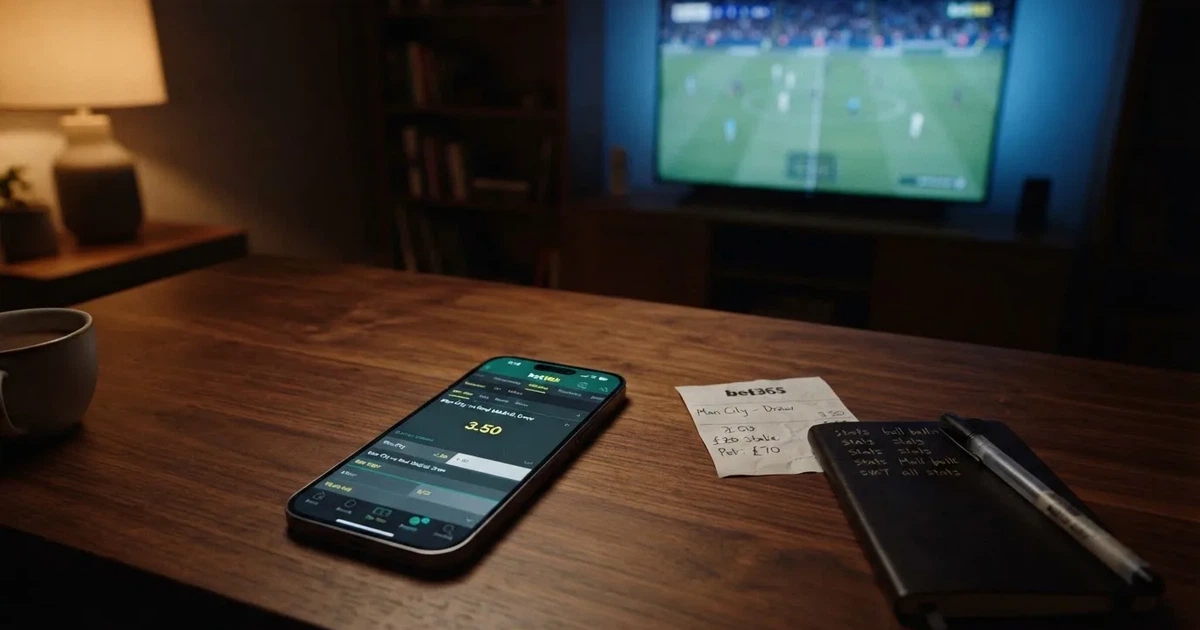
Data current as of 27 October 2026 and verified against the Gambling Commission’s public register of remote operating licences.
What in-play betting actually is, and why the price moves the way it does
In-play betting, also called live betting, lets a bettor place a new wager after an event has started and while it is still running. The market updates as the game moves, and the price offered at any second reflects what the trading team thinks the rest of the match is now worth. A goal in the first ten minutes, a red card, a rain delay on a grass court, a horses-for-courses greyhound coming out fast: each event is a new input, and the screen redraws. Pre-match betting prices the same event once and lets it run; in-play prices the same event many times in a single afternoon, which is why the bets look smaller and the temptation to keep adding looks larger.

The mechanics are the same. A bet is a contract at a stated price; if the selection wins, the stake returns plus winnings at those odds; if it loses, the stake goes. What changes in-play is the number of variables in the price. A pre-match 1X2 on the Premier League is built from a probability estimate, a margin and a bookmaker’s view of the money that will come; an in-play 1X2 is that, plus the live score, the time left, the cards shown, the substitutions made, the corner count and the trading team’s read of where the next goal is most likely to come from. The price will not sit still because the inputs do not sit still. The punter who treats in-play like a faster pre-match market tends to over-bet; the punter who treats it as a separate product with its own rhythm tends to keep a tighter grip on stake size.
Two consequences follow, and they shape everything else on this page. First, in-play prices carry a wider margin than their pre-match equivalents, which is one reason the marketing copy that calls a price a “boost” needs reading carefully. Second, settlement depends on data feeds, and a feed can lag or a market can be suspended, which is why every British bookmaker writes into its terms that in-play bets are accepted at the price displayed at the time of placement and that the firm may void a bet if a price is clearly out of line. None of this is a British rule by statute; it sits inside each operator’s own terms and its licence conditions, which is the shape British regulation takes in this corner of the market.
How a market is priced: margin, overround and what the price is hiding
A bookmaker does not offer true odds. It offers true odds minus a margin that pays the firm’s costs, funds the marketing and, in Great Britain, contributes to the General Betting Duty that the operator, not the punter, pays to HMRC. The way to see the margin is to look at a three-outcome market such as full-time result (home, draw, away) and add up the implied probabilities the three prices imply. A perfectly fair book would sum to 1.00, or 100%; a real book sums to more than that, and the excess is the margin. The bigger the overround, the less of every pound staked the book returns across all outcomes in the long run. A 5% margin market returns 95p of every pound on average, before the operator’s own costs and before any promotion. A 7% margin market returns 93p. The number a punter sees on a price card is a number, but the number behind it is a margin, and the margin is the honest comparator between two bookmakers and between two markets at the same firm.

This is why an in-play price that “looks” generous has to be read with the market beside it. A boosted 3/1 (4.00 decimal) on the next goal in a 0-0 game is only a bargain if the rest of the in-play book on that game is built on a similar margin to its pre-match version. Often it is not, because the book has widened to protect the firm against the next goal being scored before the screen has refreshed. The trade is not between the boosted price and a fair price; it is between the boosted price and a tighter pre-match price that the punter is no longer able to take.
What “live” really means for the punter’s timing
A live bet is a bet on a price that will not exist in a second. Cash out widens that window by offering a settlement in real time rather than at the final whistle, but cash out is a separate product, and it is dealt with in its own section. For the moment, the practical lesson is timing. The longer a punter waits for the “right” price in-play, the more information the book has had time to act on, and the more the book has had time to act on the punter. The bettor’s edge, where there is one, sits in the first few seconds after an event in the match, not in the minute the price has settled. That is also the window in which a market is most likely to be suspended, which is its own kind of cost.
The British legal frame: what a Gambling Commission licence actually buys
Every brand listed on the comparison further down holds a remote operating licence from the Gambling Commission, the regulator set up under the Gambling Act 2005 and sponsored by the Department for Culture, Media and Sport. The Act covers Great Britain — England, Scotland and Wales. Northern Ireland runs on its own, older law, and a GB licence does not regulate a brand there. Since the Gambling (Licensing and Advertising) Act 2014 an operator whose remote facilities are used in Great Britain needs a Commission licence wherever the company is based, so a Curaçao, Maltese or Gibraltar incorporation is not a substitute. The Commission’s public register, searchable by business name, trading name, domain or account number, is the test of whether a brand is licensed to take a GB customer’s bet.
The licence is the entry ticket, not a guarantee of value. A licensed remote bookmaker is one the Commission has judged fit to operate: financially sound, with policies on anti-money-laundering, customer interaction and social responsibility, and signed up to GAMSTOP for online self-exclusion. It does not mean the odds are better, the cash-out is more generous or the live markets deeper. What it means is that the firm’s house rules sit inside a regulatory perimeter, and that the customer has somewhere to complain if the firm breaks them. None of that changes a margin. The punter pays the margin and gets the regulator’s oversight, and the price of one is not the price of the other.
Identity, age and the cost of the first deposit
A licensed British online bookmaker cannot accept an anonymous bet. Since 7 May 2019 the rules have required name, address and date of birth to be verified before a customer can deposit or gamble, including when the bet is paid for with a free bet or bonus. The minimum age is 18. A credit card cannot be used for gambling in Great Britain, including a credit-card-funded e-wallet transfer. Debit cards and bank-based payments are not caught by that rule. None of this is the punter’s choice; it sits in the licence conditions and codes of practice (the LCCP) the Commission publishes. The cost to the punter is friction at sign-up and a slower first withdrawal, both of which the licensed firms carry in roughly equal measure.
What the licence does not do
The licence does not cap stakes, does not cap losses and does not set a maximum bet size. Operators set their own stake limits, which is why a maximum on a price-boosted selection can be as low as a fiver on one brand and as high as several hundred on another. The licence does not set a list of permitted markets either: an operator holds a licence for a category (remote general betting standard for real events is the relevant one here) and offers markets inside its own rules and the LCCP. The Commission does not licence advertising; that runs through the ASA’s CAP and BCAP codes, with social-responsibility rules in the LCCP sitting on top.
In-play betting has no statutory carve-out and no British prohibition. GB bookmakers offer it, and the conditions sit in the operator’s terms and in its customer-protection duties. It would be wrong to call that “unrestricted” and it would be wrong to call it a special British rule. It is a product, governed by the same licence as the pre-match product, with the same consumer-protection rules and the same data-feed risks any live product carries.
The point about Northern Ireland and the offshore brand
The Act covers Great Britain. A brand licensed by the Commission can accept customers from Northern Ireland only if it also holds the relevant local registration, and a Northern Irish customer looking for an in-play bookmaker needs to check the local position as well as the GB one. An offshore brand with no GB licence is not a legal option for a customer based in Great Britain, and the firm’s house rules apply in place of the Commission’s oversight. The practical difference is straightforward: a GB-licensed brand carries GAMSTOP, an approved dispute-resolution route, the £150 financial vulnerability check when it applies, the 10x bonus wagering cap and the Commission’s enforcement behind its promises. An offshore brand carries none of those, and a customer whose funds are withheld has fewer routes to recover them. The law aims at the operator, not the punter, but the punter pays the cost of a thinner protection regime in the form of unresolved complaints.
Responsible gambling: what a licensed bookmaker has to put on the table
Every GB-licensed online operator is a member of GAMSTOP, the national multi-operator self-exclusion scheme. Once a customer registers with GAMSTOP, every licensed online bookmaker and app they try to open an account with is required to refuse the application and to close any existing account. The minimum exclusion is six months, with one year, five years and a five-year auto-renewing period also available. After the minimum term, the exclusion stays in place for a further seven years unless the customer asks GAMSTOP to remove it. GAMSTOP covers online sites and apps only; a betting shop uses a separate in-shop self-exclusion arrangement.
Alongside GAMSTOP, the LCCP requires licensed remote operators to make a set of safer-gambling tools available to every customer. The list is not a menu the firm can pick from: the conditions state what each tool does, when it must be offered and how it must be surfaced. In practice, the tools a British punter should expect to find on a licensed site include:
- Deposit limits, set by the customer on a fixed time frame (daily, weekly or monthly), with a cooling-off period before an increase takes effect and immediate effect for a decrease. The first stage of the Commission’s remote technical standards on deposit limits has applied since 31 October 2025, with a second phase postponed to 30 September 2026, and whether the second phase is live is not established.
- Reality checks, which are timed pop-ups that show the customer how long they have been logged in and what their net position is, with the option to leave the session or carry on.
- Time-out, a short self-exclusion of between one day and six weeks taken from the customer’s account page, separate from a GAMSTOP registration.
- Product restrictions, which let the customer turn off categories of product on the account (casino, slots, sports betting or specific markets) without closing the account.
- Self-exclusion from the operator, typically for a minimum of six months, the longest of the in-house routes and the one a customer takes when they want a single firm to refuse their business.
- A player profile test, an opt-in questionnaire on gambling behaviour the firm uses to tailor the safer-gambling prompts.
- Links from the safer-gambling page to GamCare (which runs the National Gambling Helpline), GambleAware, NHS gambling clinics, Gamblers Anonymous, Gambling Therapy and the Betting and Gaming Council.
A financial vulnerability check, in force since 30 August 2024 under LCCP condition 3.4.4 and operational since 28 February 2025, applies to a remote customer whose deposits minus withdrawals cross £150 in a rolling 30-day window. The check looks at public records (bankruptcy, county court judgments, IVAs and the like) and is not a credit-reference check and not an income check. Financial risk assessments — the “affordability checks” of the press — have been announced in a staged plan published on 7 July 2026, with no start date. Write them as announced, staged and without a start date, not as live.
The cost of this scaffolding, for a punter who manages their own play, is small: an extra page at sign-up, the occasional reality-check pop-up and a moment to confirm a deposit-limit change. For a punter whose play has stopped being manageable, the scaffolding is the thing that catches them, and that scaffolding exists only because the brand is licensed. The offshore brand that does not carry it has a thinner product page, not a better one.
What the marketing cannot do
The CAP Code’s section 16 sets the rules the non-broadcast advertising has to follow, with the BCAP Code doing the same for broadcast. Marketing for gambling must be socially responsible, must not be of strong appeal to under-18s, and no one who is or seems to be under 25 may be featured gambling or playing a significant role in the ad, with an exception for marketing placed inside a venue where a bet can be made. That rule is about who can appear in the ad; it is not about who can bet. The promotion rules in force since 19 January 2026 cap wagering requirements on bonuses at 10x (a £10 bonus at 50x needs £500 of bets; under the cap no more than £100 of turnover before withdrawal) and ban mixed-product promotions such as “bet on football to get free spins” that pull a customer across product types. Whether the cap applies to free bets with no wagering condition, and any cap on the value of a bonus, are not established and are not the same question. The “whistle-to-whistle” rule is an industry code rather than statute: since 1 August 2019, betting ads have not been shown on TV from five minutes before a live sporting event to five minutes after it, before the 9pm watershed, with horse and greyhound racing excluded.
Live betting and cash out: how the in-play product really works
The in-play lobby is the screen a bookmaker rebuilds every few seconds, the price is the number the trading team has just published, and the bet is a contract the firm will honour at the price the punter saw at the moment of placement. The mechanics of a single in-play bet are the same as a single pre-match bet: a stake at a price, a return if the selection wins, the stake lost if it does not. The difference is operational, not contractual. The punter needs a working app, the book needs a working data feed, and a gap in either produces a voided bet or a refusal to take one, and the small print of every British bookmaker’s terms makes that plain.
The depth of an in-play market varies enormously. A Premier League fixture at half-time may carry dozens of selections across the next goal, the method of the next goal, the total, the corners, the cards, the player to score and the result; a Conference North game in midweek may carry only the match result and the next goal. The depth of the book is a function of how much money the firm expects to take on the game, and that is a function of how much attention the game gets. A bookmaker does not have to offer any market on any event, and most will not offer an in-play market where the data feed is poor or the liquidity thin. Where the market is offered, the price is wider than the pre-match version, because the book is wider.
Cash out: the mechanic and the small print
Cash out lets a bettor take an early settlement on a bet that is still running, at a price the firm quotes at the moment the punter presses the button. The price the firm offers reflects what the bet is now worth to it, not what the bet would return at the final whistle. On a winning position, cash out lets the punter lock in a smaller profit rather than ride a 1-0 lead to the end. On a losing position, it lets the punter recover a fraction of the stake rather than lose it all. The size of the offer depends on the live price of each leg, the time to the close of the market and the firm’s own spread on the cash-out transaction. The firm’s spread is the cost the punter is paying for the convenience, and the size of that spread is rarely published.
Cash out is a feature the firm can take away at any moment. DAZN Bet states in its help pages that cash-out availability is not guaranteed and that bets stand if cash out is unavailable. William Hill writes that cash out is not available on each-way bets and is not always available on accumulators, and that the firm does not guarantee availability. One UK-facing sportsbook’s published terms state that cash out is unavailable during market suspension and may fail if odds change or a market is suspended during the cash-out delay. The trade is between the punter’s wish to lock in a price and the firm’s right to refuse the request. The punter’s only protection is the screen showing “cash out available” at the moment the button is pressed; after that, the firm treats the bet as settled at the offered price.
There are three flavours of cash out on a British licensed site. Full cash out settles the bet at the offered price. Partial cash out lets the punter take a slice of the offered value and leave the rest of the stake running. Auto cash out, where the firm offers it, lets the punter set a rule (“settle this bet automatically if the cash-out value reaches £50”) and walks away. Each flavour adds the firm’s spread to the price, and each flavour can be turned off by the firm at any moment. The punter who treats cash out as a guaranteed right is over-paying for the convenience, because the firm has reserved the right to refuse.
Markets that ride alongside in-play: bet builder, accumulators, streaming
A bet builder, sometimes called a same-game multi, lets the punter combine markets from a single event into one bet at multiplied odds. Coral’s builder, for example, covers match result, goalscorers, total goals and corners across more than 100 football leagues. bet365’s Bet Builder+ combines markets from one event into a single bet and works both pre-match and in-play. The product exists because the margin on a multi-leg bet is wider than the margin on each leg priced alone, and the punter pays that wider margin in exchange for the chance of a bigger return. In-play, the builder refreshes as the underlying market refreshes, and a leg can disappear from the builder if the firm suspends the underlying market, which is a real risk during a goal-mouth scramble.
A streaming service is not a betting product, but it is the screen a lot of in-play betting is decided on, and a licensed bookmaker’s streaming terms sit inside its licence conditions. William Hill’s WHTV streaming, for example, requires a funded account or a bet in the last 24 hours, with live racing requiring a bet of at least £1 on a qualifying race; its separate Betting TV service shows selected UK and US horse racing and UK greyhounds free. Spreadex streams UK and Irish horse racing, greyhounds, tennis, NFL and selected football through its app. Unibet runs Unibet TV. bet365 streams events worldwide, alongside its Bet Tracker, Match Live and a Live Golf Tracker. Streaming is a way the firm adds value to its in-play lobby, and it is a way the firm collects the data its trading team uses to set the next price.
Spread betting on a sporting index: a different product, with a different regulator
A spread bet on a sports index, where the bettor buys or sells at a stated spread and the return is a multiple of the spread times the stake, is a different product from a fixed-odds bet, and the regulator is the Financial Conduct Authority for financial spread bets and the Gambling Commission for fixed-odds bets. Spreadex, one of the brands on the list further down, is regulated by the FCA for spread betting and by the Commission for fixed-odds betting, and its homepage states that spread betting losses can exceed the deposit. The cost of a spread bet is not the stake; it is the size of the loss the index can produce, and the loss can be larger than the punter put down. A bookmaker that offers both fixed odds and spread betting is two products in one app, with two regulators behind them and two different cost profiles to manage. The fixed-odds side carries the same rules as the rest of the market. The spread side is its own risk, and the punter who treats it as a fixed-odds bet with a wider margin has misread the product.
How to read a price: payout, return and the worked example the rest of the page leans on
A pre-match price and an in-play price are both decimal odds, which is the format British online bookmakers use on their apps and websites. A fractional price such as 5/2 is the British high-street format and converts to a decimal price of 3.50 by dividing 5 by 2 and adding 1. A price of evens (1/1) is 2.00 in decimal. The arithmetic of a single bet is the same whichever format the price is shown in, and it is the arithmetic every punter should be able to do in their head.
Take a £10 single at decimal odds of 3.50. The return is the stake multiplied by the price, so £10 × 3.50 = £35. The net profit, which is what the punter actually wins over and above the stake, is the stake multiplied by the price minus one, so £10 × (3.50 − 1) = £10 × 2.50 = £25. The £35 return includes the £10 stake, and the £25 profit does not. A bet that loses returns nothing: the stake goes, the winnings are zero, the return is zero and the profit is a negative £10. The same arithmetic works for a fractional price: a £10 single at 5/2 returns £35 and pays £25 profit, exactly the same as the decimal 3.50.
A combination bet multiplies the prices. A double at decimal odds of 3.50 and 2.00 is a single bet at combined odds of 7.00, so a £10 double returns £70 and pays £60 profit. A treble at 3.50, 2.00 and 1.50 is a single bet at combined odds of 10.50, so a £10 treble returns £105 and pays £95 profit. A bet that loses any leg loses the whole stake; the combination is one bet, not three, and the price of one is the product of the prices of all. A bet builder that combines four markets from one football match into a single bet is a combination bet on four legs, with the same arithmetic. The wider the margin on each leg, the wider the margin on the combination, which is why an eight-leg accumulator is a wider-margin product than a single — and why the same stake on a treble returns more on average than the same stake split across three singles, but loses more often, and why a bookmaker’s marketing tends to push accumulators harder than singles.
Worked example: a £10 single at 3.50
The arithmetic is a band, not a single figure, because the in-play market is wider than the pre-match one and the margin shifts during the event. A pre-match price of 3.50 on a three-outcome market at a 5% margin sits inside a book of about 1.30 / 3.50 / 9.00, which sums to an implied probability of 0.769 + 0.286 + 0.111 = 1.166, a 16.6% overround across the three outcomes and a margin of about 14% on this book, not 5%. The 5% margin number is the long-run average across the whole event, not the margin on this individual price. The honest way to read the worked example is as a band: a £10 single at 3.50 returns £35 if it wins and pays £25 profit, and the bookmaker’s margin on the three-outcome book sits between roughly 5% and 15% depending on when the bet is placed and how the live market is moving. The return number is exact; the margin number is a band. Treat the band as the cost the punter is paying for the right to take the price.
How the comparison is built, and what the columns mean
The ten brands below are listed in a set order, not in a ranking. Each holds a remote operating licence from the Gambling Commission, each is a member of GAMSTOP, and each is described on its own terms rather than in the round. The columns the comparison uses are the Gambling Commission remote licence number and licence holder, which is the test of whether a brand is licensed to take a GB customer’s bet, and what the operator’s own terms state on the key’s subject, which is the test of what the customer actually gets. A column has been added by the writer for the kind of cash-out the brand offers, because that is the single most visible in-play feature across the licensed set. The table is a snapshot of the terms the firms publish; a feature can be added or withdrawn at any time, and the table is no substitute for the firm’s own help pages.
| Brand | Gambling Commission remote licence and licence holder | What the operator’s own terms state on in-play and cash out | Cash-out shape |
|---|---|---|---|
| DAZN Bet | 048756-R-327274-019, account 48756; DZBT Limited | Cash Out, Bet Builder, daily bet boosts and in-play betting; cash-out availability is not guaranteed and bets stand if it is unavailable. | Full, on selected markets |
| William Hill | 039225-R-319373-015, account 39225; WHG (International) Limited | Cash Out not available on each-way bets and not always available on accumulators; availability not guaranteed. | Full and partial on selected markets |
| London Bet | 066162-R-340278-004, account 66162; Thistle Bet Limited | App combines football, tennis, horse racing, greyhounds, darts, golf, cricket, NFL, NBA, MLB, snooker with Pragmatic Play casino slots and live in-play betting. | Full on selected markets |
| Bet Ahoy | 100094-R-341742-003, account 100094; Bet Ahoy Ltd | Pre-match and in-play Bet Builder across 11 sports; Early, Partial and Auto Cash Out; up to 800 live markets on Premier League fixtures. | Early, partial and auto |
| Swifty Sports | 058957-R-334734-006, account 58957; Swifty Global (UK) Ltd | Best Odds Guaranteed, Cash Out on markets including horse racing and football, daily price boosts, live streaming and in-play betting; Bet Builder listed as coming soon. | Full on selected markets |
| Spreadex | 008835-R-104580-022, account 8835; Spreadex Limited | One-click, auto and partial cash out, Bet Builder across fixed odds or spreads, and live streaming of UK and Irish horse racing, greyhounds, tennis, NFL and selected football. | One-click, auto, partial |
| Betboro | 044181-R-324363-007, account 44181; Webmedia Development N.V. | In-play markets and cash-out on football, racing and tennis, boosted odds on selected singles from £10 stakes, and responsible-gambling tools. | Full on selected markets |
| Fitzwilliam Sports | 048760-R-335434-009, account 48760; SBKI Limited | Phone and live chat with the office open 09:00 to 21:00, Monday to Sunday, with messenger replies generally within 90 seconds. | Full on selected markets |
| Unibet | 045322-R-324275-019, account 45322; Platinum Gaming Limited, Gibraltar | Bet Builder, daily Uniboosts, Unibet TV live streaming, in-play betting, Best Odds Guaranteed on horse racing and Cash Out on thousands of markets. | Full and partial on thousands of markets |
| Kalooki Sportsbook | 057730-R-333396-005, account 57730; Kalooki Sportsbook Limited | Instant withdrawals by bank transfer within minutes, Best Odds Guaranteed on UK and Irish horse racing, in-play betting, daily boosts and extra place races. | Full on selected markets |
The licence column is the test of legality. The cash-out column is the test of the shape of the firm’s offer. The in-play column is the firm’s own description of its product, which is the only description the licence conditions treat as definitive. Where a column is short, the short column is the honest answer: the brand publishes less, not that the brand offers less.
The ten brands, set against the comparison
The ten reviews below move in the same order as the table. Each is a description of what the firm offers, what the licence covers, and what the in-play product looks like in practice. The verdict at the end of each block answers a different question, because each block is about a different firm and a different mix of features.
DAZN Bet
DAZN Bet holds a remote betting licence (real events) under Gambling Commission account 48756, licence number 048756-R-327274-019. The brand’s published help pages state that the site offers Cash Out, Bet Builder, daily bet boosts and in-play betting, and that cash-out availability is not guaranteed and bets stand if it is unavailable. The honesty of that small print is the point: the firm is not promising a feature it cannot always deliver, and the punter who reads it knows to set the cash-out button as a convenience, not a right. The brand sits inside a larger media business, which is the source of its in-play content and the reason its football coverage is wide.
For whom it suits: a punter who wants a familiar media brand behind the betting product, a daily price boost to chase and the option to cash out singles. Against it: a punter who needs partial or auto cash out, neither of which the help pages promise. The bet builder covers football rather than the longer tail of sports, and the live markets follow the football calendar more than the racing calendar. The firm meets all British regulatory standards, though the market coverage is narrower than the prominent branding might lead a punter to expect.
William Hill
William Hill runs on a remote general betting standard (real events) licence held by WHG (International) Limited under Gambling Commission account 39225, the licence number 039225-R-319373-015. The brand’s help pages make plain that Cash Out is not available on each-way bets and is not always available on accumulators, and that availability is not guaranteed. The streaming product, WHTV, requires a funded account or a bet in the last 24 hours, with live racing requiring a bet of at least £1 on a qualifying race; Betting TV is a separate service that shows selected UK and US horse racing and UK greyhounds free. The two-stream structure is a way of segmenting the customer, with a paid bettor getting the wider feed and a casual viewer getting the racing-only free feed.
For whom it suits: a punter who wants a long-established brand with deep racing markets, a streaming product tied to live betting and a clear cash-out policy that does not pretend to be a right. Against it: a punter who wants partial or auto cash out, neither of which the help pages confirm. The brand carries the cost of being a household name, which is a wider marketing footprint and a higher bonus spend, and the punter pays that cost in the form of a margin that sits at the wider end of the licensed set on the markets the brand promotes hardest. This is a large firm running a standard product under a clear policy, with in-play depth strongest where racing markets intersect with football ones.
London Bet
London Bet is authorised for real events by a remote betting licence, Gambling Commission account 66162, licence number 066162-R-340278-004. The brand’s app combines sports betting across football, tennis, horse racing, greyhounds, darts, golf, cricket, NFL, NBA, MLB and snooker with Pragmatic Play casino slots and live in-play betting. The combination of a sportsbook and a casino in a single app is now the standard shape for a UK-licensed brand, and the published help pages do not single out cash out on the sports side. The product mix is wide, and the depth of the in-play book on football is reasonable, though the racing depth is shallower than a racing-led brand.
For whom it suits: a punter who wants a single app for a wide mix of sports and a casino tab for the gaps between events. Against it: a punter who wants a racing-led product, a deep live market on the smaller leagues or a partial-cash-out feature, none of which the help pages confirm. The operator adheres to all mandatory British safety protocols, and the in-play lobby is better suited to a casual multi-sport punter than a dedicated racing or football specialist.
Bet Ahoy
Bet Ahoy uses a remote general betting licence for real events, with Gambling Commission account 100094 and licence number 100094-R-341742-003. The brand’s app offers pre-match and in-play Bet Builder across 11 sports, plus Early, Partial and Auto Cash Out, and up to 800 live markets on Premier League fixtures. The cash-out shape is the most fully-featured on the list: early cash out is a different product from full cash out, because it lets the punter settle before the standard cash-out window opens, and partial and auto cash out add the convenience features the rest of the licensed set tends to leave out. The trade is that the wider the cash-out menu, the wider the firm’s spread on each settlement.
For whom it suits: a punter who wants the most fully-featured cash-out product on the licensed set, with a bet builder that covers 11 sports rather than the single-sport builder most brands offer. Against it: a punter who wants a deep racing product, a streaming feed or a brand name they have heard of, none of which Bet Ahoy carries. The price the punter pays for the cash-out shape is the firm’s spread on each settlement, and the bet builder is wide rather than deep. Bet Ahoy is the specialist for a punter who prioritises the cash-out feature, with a product set designed to offer as many exit points as possible.
Swifty Sports
Swifty Sports is permitted by a remote general betting licence for real events, with Gambling Commission account 58957 and licence number 058957-R-334734-006. The brand’s app offers Best Odds Guaranteed, Cash Out on markets including horse racing and football, daily price boosts, live streaming and in-play betting, with Bet Builder listed as coming soon. The combination of Best Odds Guaranteed on racing, a cash-out product that covers the two biggest sports, a daily price boost and live streaming is a familiar racing-led shape, and the brand is a smaller version of a William Hill or a Coral rather than a new product. The “coming soon” on the bet builder is the one line in the small print a punter who wants a same-game multi should weigh.
For whom it suits: a punter who wants Best Odds Guaranteed on racing, a cash-out product that covers horse racing and football, daily price boosts and live streaming in a single app. Against it: a punter who needs a bet builder today, a deep live market on the smaller football leagues or a partial-cash-out product, none of which the help pages confirm. The operator operates fully within British regulatory requirements, and the in-play portfolio is explicitly racing-led.
Spreadex
Spreadex is licensed for real events with a remote general betting licence, under Gambling Commission account 8835 and licence number 008835-R-104580-022. The brand is regulated by the FCA for spread betting and by the Gambling Commission for fixed-odds betting, and its homepage states that spread betting losses can exceed the deposit. The app combines fixed-odds and spread betting in one product, with one-click, auto and partial cash out, Bet Builder across fixed odds or spreads, and live streaming of UK and Irish horse racing, greyhounds, tennis, NFL and selected football. The dual-product shape is the firm’s distinguishing feature, and the spread side is a different risk from the fixed-odds side, with losses that can run beyond the deposit.
For whom it suits: a punter who wants both fixed-odds and spread betting in a single app, with one-click, auto and partial cash out, a bet builder that works across both products and a streaming feed that covers the racing and the NFL. Against it: a punter who only wants fixed-odds betting, who is uncomfortable with a product where the loss can exceed the deposit, or who wants a deep football-only live market. The brand is licensed and the protection regime is the standard British one, and the spread side is its own risk that the punter has to manage separately from the fixed-odds side. Spreadex distinguishes itself by operating two separate products under two regulators, and the punter should note that the spread-betting side is a financial product with risk profiles distinct from fixed-odds betting.
Betboro
Betboro operates via a remote general betting licence for real events, with Gambling Commission account 44181 and licence number 044181-R-324363-007. The brand’s UK site offers in-play markets and cash-out on football, racing and tennis, boosted odds on selected singles from £10 stakes, and the standard set of responsible-gambling tools. The boosted-odds product, with a £10 minimum stake, is a way of tying the boost to a real betting account rather than a free-bet-token punt, and the punter pays the cost of a wider margin on the boosted selection in exchange for the headline price. The site is a smaller international brand with a UK-facing product, and the live markets follow the football calendar more than the racing calendar.
For whom it suits: a punter who wants boosted odds on singles, a cash-out product that covers the three biggest sports, and a smaller international brand with a UK-facing product. Against it: a punter who needs partial or auto cash out, a bet builder or a streaming feed, none of which the help pages confirm. The operator is fully compliant with British safety and licensing conditions, and the product functions as a streamlined alternative to the major mainstream bookmakers.
Fitzwilliam Sports
Fitzwilliam Sports runs on a remote general betting standard (real events) licence held by SBKI Limited under Gambling Commission account 48760, the licence number 048760-R-335434-009. The brand’s homepage states that phone and live chat are available with the office open 09:00 to 21:00, Monday to Sunday, with messenger replies generally within 90 seconds. The phone-led customer-service shape is the firm’s distinguishing feature, and the long opening hours are a way of catching a customer whose account is in trouble rather than a customer who wants to bet. The published help pages do not single out the cash-out product, the streaming feed or the bet builder, and the live-market depth is narrower than the racing-led brands.
Those seeking phone-based customer service with extensive opening hours, an Irish-influenced racing product, and a fully licensed experience under British regulations will find this operator a viable choice. Those requiring deep live markets, extensive streaming, integrated bet builders, or partial cash-out options will find the help pages silent on these features. The brand is licensed and the protection regime is the standard British one, and the in-play offer is narrower than the rest of the licensed set. The brand’s focus on service-led delivery means it is tailored to punters who prefer phone-based assistance over digital self-service.
Unibet
Unibet runs on a remote general betting standard (real events) licence held by Platinum Gaming Limited, Gibraltar, under Gambling Commission account 45322, the licence number 045322-R-324275-019. The brand states that it has operated since 1999, and its UK site offers Bet Builder, daily Uniboosts, Unibet TV live streaming, in-play betting, Best Odds Guaranteed on horse racing and Cash Out on thousands of markets. The Uniboosts are a daily price-boost product, the Unibet TV feed is a streaming product on the same model as WHTV, and the cash-out product is the widest of the licensed set. The combination is the most fully-featured mainstream product on the list, and the price of a wider product is a wider marketing spend, which the punter pays in the form of a margin that sits at the wider end of the licensed set on the markets the brand promotes hardest.
For whom it suits: a punter who wants the most fully-featured mainstream product on the licensed set, with a bet builder, daily price boosts, a streaming feed, Best Odds Guaranteed on racing and a cash-out product that covers thousands of markets. Against it: a punter who wants a smaller brand with a tighter marketing footprint, a racing-led product or a partial-cash-out product that works on accumulators. The brand is licensed and the protection regime is the standard British one, and the in-play product is the broadest on the list. Mainstream punters will find this platform acts as the industry benchmark for feature density.
Kalooki Sportsbook
Kalooki Sportsbook is operated by Kalooki Sports Book Ltd (company number 12938274), licensed by the Gambling Commission under account number 57730, the licence number 057730-R-333396-005, and is a GAMSTOP member. The brand’s homepage advertises instant withdrawals by bank transfer within minutes, Best Odds Guaranteed on UK and Irish horse racing, in-play betting, daily boosts and extra place races. The instant-withdrawal shape is the firm’s distinguishing feature, and the Best Odds Guaranteed product is the racing-led bettor’s benchmark. The combination is a smaller racing-led brand with a modern payments product, and the price of a smaller brand is a narrower live market on football and the smaller leagues.
For whom it suits: a punter who wants instant withdrawals by bank transfer, Best Odds Guaranteed on UK and Irish racing, daily boosts and a racing-led product. Against it: a punter who needs a bet builder, a streaming feed or a partial-cash-out product, none of which the help pages confirm. The honest read is that Kalooki Sportsbook is the payments-led racing brand on the licensed set, and the punter who wants their winnings in minutes rather than hours is the punter the firm is built for.
What the brand-by-brand view shows
Three patterns are visible across the ten brands. First, every one of them is licensed and a GAMSTOP member, and the protection regime is the same; the difference between the brands is the product, not the regulation. Second, the cash-out shape is the most variable feature on the list, with Bet Ahoy the most fully-featured and the rest ranging from full cash out only to full and partial; the punter who needs partial or auto cash out has a narrower choice and pays for it. Third, the in-play depth is a function of the firm’s marketing footprint and its streaming product, with Unibet, William Hill, bet365 (which the comparison does not include, but which research carries separately), Spreadex and Swifty Sports carrying the widest live books and the streaming feeds that support them; the smaller brands carry narrower books and rely on the data feed rather than the stream.
The pattern a punter should weigh is the cost pattern, not the feature pattern. A wider feature list tends to mean a wider margin on the markets the brand promotes hardest, because the marketing spend is recovered out of the overround. A narrower feature list tends to mean a tighter margin on a smaller market, because the brand is competing for a smaller customer. The trade is between a bigger book with more cash-out shapes and a smaller book with a tighter price, and the punter’s choice depends on whether the convenience of cash out is worth the cost of the wider margin. The honest read is that neither is the better product; they are different products for different punters, and the comparison is the tool that lets the punter pick.
The honest framing, before the questions
The licensed set is a single product under a single regulator, and the differences between the brands are differences of execution rather than of substance. A punter who picks the cheapest cash-out spread and the tightest margin is picking a product on cost; a punter who picks the most fully-featured cash-out shape and the widest live market is picking a product on convenience; a punter who picks the brand with the streaming feed they watch is picking a product on habit. None of those is the wrong choice, and the comparison above is the tool that lets the punter see which one they are making. The cost number is the worked example that sits behind the comparison: a £10 single at 3.50 returns £35 and pays £25 profit, and the margin on the book sits between roughly 5% and 15% depending on the market. The rest is a matter of taste.
Frequently asked questions
How do in-play betting and cash out differ from a pre-match bet?
A pre-match bet is a contract at a price set before the event; an in-play bet is a contract at a price set while the event is running, with the price updating as the market moves. Cash out is a separate feature that settles the bet early at a price the firm quotes at the moment the punter presses the button, and the firm reserves the right to refuse the request if the market is suspended. In-play and cash out sit inside the same fixed-odds product as a pre-match bet, with the same rules on stake, return and profit, and the same margin.
How is the return on a bet worked out from the stake and the odds?
For a single bet the return is the stake multiplied by the decimal odds, and the net profit is the stake multiplied by the odds minus one. A £10 single at 3.50 returns £35 and pays £25 profit. A combination bet multiplies the odds of the legs into one price, so a double at 3.50 and 2.00 is a single bet at combined odds of 7.00, and a £10 double returns £70. The arithmetic is the same for fractional odds once the price has been converted to decimal.
How can it be checked that a bookmaker holds a Gambling Commission licence?
The Commission’s public register, on its website, can be searched by business name, trading name, domain or account number, and lists the licence categories, the licence holder and the trading names under the licence. The comparison table above carries the account number and the licence holder for each brand, and a punter can match those against the register to confirm the brand is licensed to take a GB customer’s bet. A domain ending in .co.uk is not, on its own, evidence of a licence; licensed brands use .com as well as .co.uk.
Which tools for controlling play does a licensed bookmaker have to offer?
A licensed remote bookmaker has to offer deposit limits on a fixed time frame, reality checks, time-out, product restrictions and self-exclusion, alongside a link to GamCare and the National Gambling Helpline. It has to be a member of GAMSTOP, which is the national multi-operator self-exclusion scheme. A financial vulnerability check applies to a customer whose deposits minus withdrawals cross £150 in a rolling 30-day window, and the check looks at public records rather than a credit file. Financial risk assessments have been announced in a staged plan with no start date.
How do fractional odds such as 5/1 convert to decimal odds such as 6.00?
A fractional price a/b converts to a decimal price of a ÷ b + 1. A 5/1 price is 5 ÷ 1 + 1 = 6.00, a 5/2 price is 5 ÷ 2 + 1 = 3.50, and a 1/1 price (evens) is 1 ÷ 1 + 1 = 2.00. The arithmetic is the same whichever format the price is shown in, and the return on a winning bet is the stake multiplied by the decimal price.
Are betting winnings taxed in Great Britain, and who pays General Betting Duty?
Betting winnings are not taxed on the punter in Great Britain. General Betting Duty is the operator’s tax, currently 15% on gross profits, with a new remote rate of 25% applying from 1 April 2027 within it, while remote bets on UK horse racing, self-service betting terminal bets, pool betting and in-person betting stay at 15%. Until 1 April 2027 the remote rate stays at 15%. This is general information and not tax advice; a professional gambler should ask HMRC or an adviser. The Commission’s statutory levy is a separate charge from General Betting Duty, and is not a tax on the punter.
Bet types & in-play – Grey Hound
Content created by the «Grey Hound» team
