
Online chess betting in Great Britain: where it sits, what it costs
 Available in US
Data current as of 27 October 2026, checked against the Gambling Commission’s public register.

Chess is a niche market inside a niche. Most of the betting public walks past it on the way to football and horse racing, and the bookmakers who bother to price it tend to be the larger ones with a deep enough sportsbook to carry it without dedicating staff. That makes the choice narrower than for a mainstream sport, and it also makes the differences between paying attention and not paying attention larger. The odds carry a margin that punishes guesses, the events are few and far between, and a chess match that drifts into a long endgame offers almost nothing to bet on once it starts.
The angle of this page is choice — which paths exist for a British bettor, which bookmaker each path suits, and what each path costs once the marketing has been peeled back. The mechanics of the bets themselves are covered first, because nothing else makes sense without them. Then the events themselves — what is on, what is not, and where the bookmaker’s menu typically runs out. Then the comparison of the ten licensed bookmakers who carry chess. Then the surrounding picture: the legal frame, safer gambling, mobile apps, in-play play, and the strategies the tipsters sell. The last block is a FAQ of the questions every newcomer asks.
How a chess bet actually works, and what the odds are doing
The shape of a chess betting market
A chess match produces one of three outcomes, a White win, a Black win, or a draw, and the standard match market reflects that: 1 for White, 2 for Black, X for the draw. Chess results are recorded as 1–0 for a White win, 0–1 for a Black win and ½–½ for a draw. Most online bookmakers collapse the match market into two prices by treating the draw as a stake returned — “Draw No Bet” — for those who want to back a colour without taking the stalemate risk.
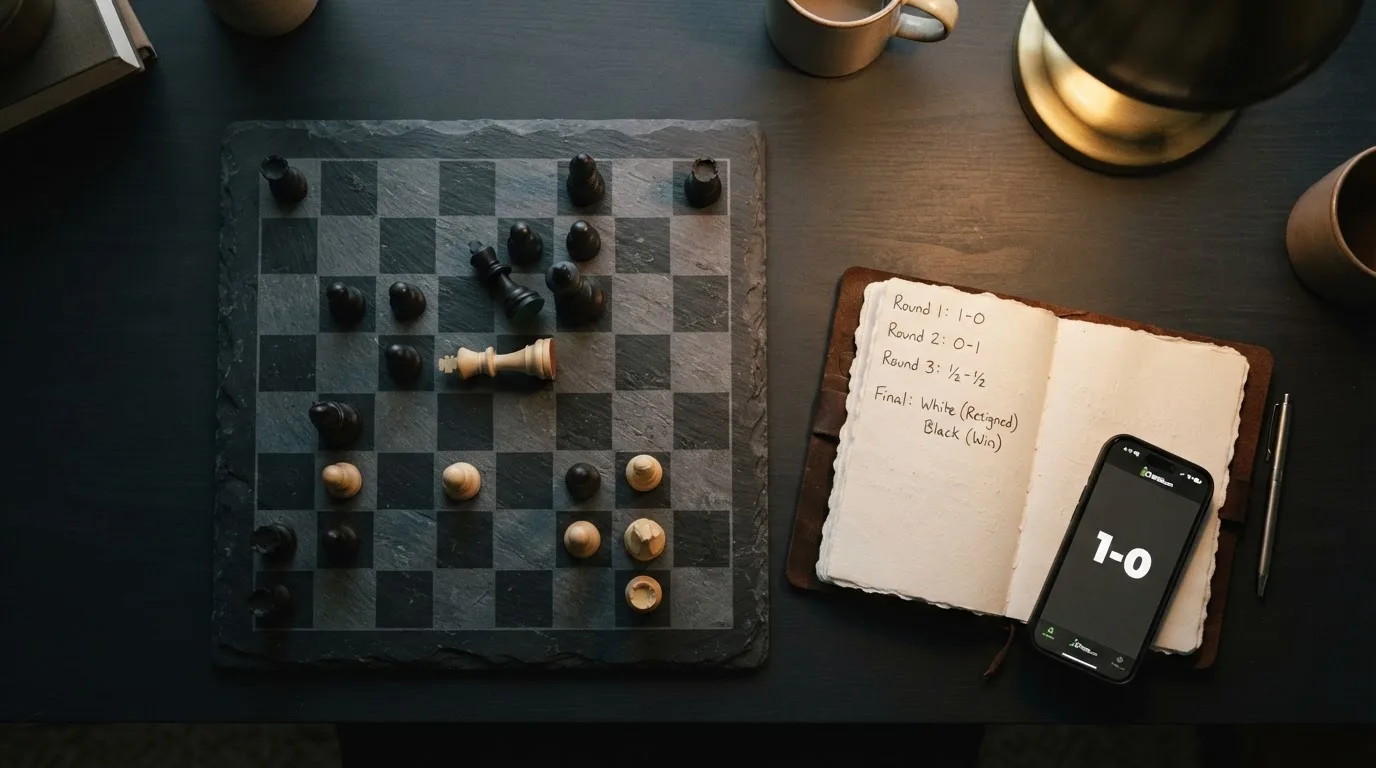
Beyond the match, the menu is smaller than for a ball sport. Outright tournament winner is the bread and butter: an outright on the Candidates, the World Championship, the Grand Chess Tour, the British Championship. Long-shot outrights are tempting precisely because the field is thin — twenty or thirty named players, often fewer in the elite events — and a price of 25/1 on a serious grandmaster does not always mean what it looks like it means. Head-to-head matchups between named players are common on the bigger events, where one side plays one game with White and one with Black. The bookmaker settles them on the regulation games; tie-break escapes are 1–0 to the named winner, or the bookmaker’s own house rule.
There is no spread, no handicap, no total goals equivalent. There is no handicap applied to pieces. A small number of bookmakers will offer an over/under on the number of moves in a game, but the market is thin enough that you will mostly see the main market and the outright. The more exotic props the American sportsbooks carry — “first piece taken”, “first checkmate move” — are not standard at British bookmakers.
What a price means, in numbers and in pence
British bookmakers carry odds in fractional form by default, and the modern site converts to decimal alongside. Five-to-one means five pounds of profit for every pound staked, so a £10 stake returns £60 in total — £50 profit plus the £10 stake back. Eleven-to-four, written 11/4, is £2.75 profit per £1. Evens, written 1/1 or EVS, is £1 of profit per £1 staked. Decimal odds convert from the fractional form by dividing the numerator by the denominator and adding one: 5/1 is 6.00 decimal, 11/4 is 3.75, evens is 2.00. The return is stake × decimal odds; the profit is stake × (decimal odds − 1).

That arithmetic is what every bettor has to internalise, because the margin sits inside it. Take an illustrative two-way market at decimal odds 1.90 / 1.90. The reciprocal of 1.90 is roughly 0.5263, and the sum of the reciprocals across both outcomes is about 1.0526. The reciprocal of that sum is about 0.9505 — the payout share. That is 95.05% of every unit staked returned across all outcomes in the long run, and the difference, 4.95%, is the margin. As a band: a perfectly priced even-money two-way market would pay out at 1/odds₁ + 1/odds₂ = 1, so 1.90 / 1.90 leaves a margin in the region of 5%, give or take, depending on how the rounding falls. The closer the prices are to even money, the closer the margin sits to that 5% figure; the further out the prices go, the more the bookmaker’s margin tends to drift upward.
For a three-way market the same arithmetic applies with three reciprocals added instead of two, and the margin is higher. A typical chess match market at 1.50 / 3.50 / 5.00 — White, draw, Black — has a reciprocal sum of 0.667 + 0.286 + 0.200 = 1.153, so a payout share of about 87% and a margin of about 13%. Three-way markets are always wider in margin than two-way markets on the same event for the simple reason that the bookmaker has three outcomes to balance, and a third of the price always sits against the draw.
The practical consequence is sharp. On a wide field — a Candidates tournament with eight players priced from 2/1 to 100/1 — the sum of the reciprocals regularly exceeds 1.30, sometimes 1.40, which means the bookmaker is keeping 30–40% of every unit staked. The price on each player is fair by elite-tournament standards only if the bettor accepts the field’s inherent long-shot problem: long prices always carry more margin than short ones, and chess outrights are no exception. Comparing one bookmaker’s price to another’s is worth doing on a one-off match, and almost not worth doing on a long-shot outright, because the prices tend to cluster within a tick or two and the real edge sits in how much of the field the bettor is willing to back.
What an accumulator does, and what it does to the margin
An accumulator — called a treble at three legs, an acca at four or more in British usage — multiplies the decimal odds of each leg into a single price. Three legs at 1.80, 2.20 and 1.95 produce a combined price of about 7.72. The return is stake × 7.72, so a £10 acca pays back £77.20 if all three legs win. Each leg pays its stake forward into the next one; a losing leg takes the whole bet down.
The margin compounds in the same direction. A single leg priced at 1.80 carries a margin that depends on the other side of that market, but on average the bookmaker is keeping somewhere between 3% and 8% of every unit staked on most football and tennis. Multiply three such legs together and the margin grows — three 6% margins multiply into roughly a 17% effective margin on the combined bet. That is why short-price accas at the front of the bookmaker’s coupon carry worse value than they look, and why a price boost on a famous accumulator rarely makes it good value once the boosted leg is combined with three normal-priced legs.
Bookmakers know this and price accordingly, which is why an acca insurance offer — get your stake back if one leg lets you down — looks generous until the bettor works out that the insurance applies only to the stake, only to accumulators of a certain size, and only as a free bet whose own stake is not returned. The offer is structured so that the bettor loses on average across both the original bet and the insurance bet, but in a way that feels like the bookmaker is taking the loss. It is the bookmaker’s margin doing the work, dressed up as generosity.
Price boosts and best odds guaranteed
A price boost is a selected bet whose price the bookmaker has improved above the market price. The improvement is funded out of the bookmaker’s marketing budget, not out of its margin. The advertised price often sits closer to the true price than the original did, which is the point — the boosted price looks generous because it is, but it is generous against the bookmaker’s own margin, not against the bettor’s expectation. Two boosts a month on big events is a typical cadence.
Best odds guaranteed — BOG in British usage — is a different offer, and it is mostly a horse-racing offer. William Hill pays Best Odds Guaranteed on UK and Irish horse racing from 8 AM on the day of the race, on both single and multiple bets; it does not apply to ante-post, tote or pari-mutuel bets. Chess is not horse racing, and BOG does not transfer across, so the chess bettor is paying the price shown at the time the bet is struck. That is the rule for every sport except horse racing at the larger bookmakers, and a small minority will run a BOG on greyhounds as well.
Each-way bets and why they are rare on chess
Each-way betting splits the stake into two equal bets: one on the win, one on the place. The place terms vary by sport and by operator. Horse racing is the natural home — place terms of a quarter or a fifth of the win odds are standard. Each-way bets are rare on chess outrights because there is no “place” market in the same sense as a horse race; a player either wins the tournament or does not. Some bookmakers will offer each-way on a small number of outrights with one-fourth of the field being paid a fraction of the win odds, but it is the exception, and the place terms are short.
Cash out, and what it really costs
Cash out settles a bet before the event has finished, at a price the bookmaker sets live. The price is built out of the current state of the event and a margin on top. On football and tennis it is widely used, and the bettor who cashes out a winning accumulator a leg early gives up a chunk of the eventual return in exchange for locking in a profit before the last leg is played. On chess, cash out exists at the larger bookmakers on selected markets during a match — the price drifts as the position develops — but the market is thinner than for a ball sport, and the cash-out price offered can sit further from the true price than the same bookmaker’s cash-out on a Premier League match.
Free bets, and what is in the small print
A free bet is a token the bookmaker credits to a new or existing customer, typically as part of a welcome offer. The stake is usually not returned with a winning free bet — Sky Bet free bets, for instance, expire 30 days after crediting, can be used only on single or each-way markets (not multiples) excluding virtuals, are non-withdrawable and do not return the stake with winnings. A £25 free bet at odds of 3/1 wins £75, not £100. That distinction is the entire point of the small print.
The headline offers run between £15 and £40 in free bets across the licensed British bookmakers, on stakes of £5 to £20. Midnite credits £25 in free bets and 50 free spins to new customers who bet £5 or more on pre-match odds of EVS (2.0) or greater within 14 days of sign-up, valid for 7 days. Unibet offers £40 in free bets when a new customer bets £20 at minimum odds of 2.0 (1/1), with the free bets expiring within 7 days of issue for GB customers using a debit card or instant bank transfer. BetGoodwin’s sports welcome offer is “Bet £10 & Get £15 in Free Bets”, made up of a £5 sports bet, a £5 acca and a £5 Sub-Cover bet. BetMGM credits four £10 free bets — two football accumulators of 4+ selections and two sports multiples of 2+ — on deposit of £10 or more and a sports bet within 7 days, valid for 7 days with minimum odds and opt-in required.
The expiry windows are tight. Seven days is the common clock, and a free bet sitting unused at the end of the window is gone. The minimum odds rule cuts out betting on the favourite and stacking one short-price leg on another — most bookmakers set the floor at evens or 1/1, which is a decimal price of 2.00. The free bet is one bet, not a series, and the stake does not return. On a £25 free bet at 5/1 the bettor wins £125 of which £25 is the stake the bookmaker never paid, so the net is £125 in profit. The point of the offer is not what the bettor wins, it is the difference between the free bet’s true value and its headline value — for a £25 free bet at 3/1 on a market with a 90% payout share, the expected value is roughly £25 × (3 − 1) ÷ 3 × 0.90 = £15, which is what the offer is actually worth on average, not £25.
What chess the bookmaker is pricing, and where the calendar runs out
The events that matter, and the calendar that drives them
The chess calendar is built around FIDE — the International Chess Federation, the world governing body of chess, which publishes the rules in its Handbook. A chess game is played on an 8×8 board of 64 squares, with each player controlling 16 pieces. The professional circuit is anchored by the World Championship cycle, with the Candidates tournament every one to two years feeding the World Championship match. Wilhelm Steinitz, the first universally recognised World Chess Champion, claimed the title in 1886; Gukesh Dommaraju won the title in 2024.
Beyond the elite, the calendar carries the Grand Chess Tour, the Norway Chess event, the Tata Steel tournament, the Sinquefield Cup, the London Chess Classic, the Champions Chess Tour online events, and a long tail of open and invitational events with varying bookmaker coverage. The British bookmaker’s chess menu is at its deepest during a World Championship year and thinnest during the gaps between Candidates cycles, when the events on offer are often too far below the elite tier for outright betting to carry a meaningful market.
The markets the British bookmaker typically runs
For a World Championship match or a high-profile tournament, the menu is at its widest: outright winner, each-way on a place if the field permits, head-to-head matchups on the round, and the live match market. For a mid-tier event the menu is likely to be outright only. For a long-tail open, the bookmaker is unlikely to offer anything at all.
Live in-play on chess is offered by the larger bookmakers and is the most volatile part of the menu. The price on a player drifts as the position on the board develops — a blunder, a won pawn, a passed pawn into a rook endgame — and the bookmaker’s algorithm re-prices within seconds. The bettor who has watched the position can act faster than the bookmaker updates in some cases, which is the genuine edge in-play offers on chess. That edge is short and rare: the larger bookmakers’ in-play engines are not slow, and a 50-tick move is the kind of mispricing that gets corrected inside a minute on the bigger sites.
Where the menu typically runs out
The menu runs out for the bettor who wants prop bets. There are no handicap markets of the kind football carries. There is no total points equivalent. The number of moves in a game is offered at a minority of bookmakers and is the closest the market comes to a totals line, but the offering is sparse. A bettor who wants anything more granular than outright, head-to-head, match winner and the in-play re-prices has usually come to the wrong sport.
The menu runs out for the bettor who wants bets during the game that go beyond the live match market. There is no live game-by-game betting inside a multi-game match at most British bookmakers — the live menu is match-level, not game-level, because the bookmaker has priced the match as a single event and the game-by-game sub-market is too thin to support a deep book.
Ten licensed bookmakers reviewed for chess
What “licensed” means here
Every brand in this section is on the Gambling Commission’s public register against a remote general betting standard (real events) licence for Great Britain. The Commission is a non-departmental public body sponsored by the Department for Culture, Media and Sport; the register is the whole test of who holds a licence. Searchable by business name, trading name, domain or account number, the register is the document to check if a brand’s licence status is in doubt. A licence means the brand has passed the Commission’s checks, takes part in GAMSTOP, accepts the £150 financial vulnerability check, falls under the 10x bonus wagering cap, and is bound by the LCCP social responsibility code.
A licensed brand is not automatically a deep chess bookmaker, and a deep chess bookmaker is not automatically licensed. The two are separate facts. Every brand here is licensed; the chess offering varies.
Comparison of the ten
| Brand | Gambling Commission licence | Operator on the Commission’s register | Chess-playing site remarks |
|---|---|---|---|
| Midnite | 101839 (Midnite Limited) | Midnite | In-play events, acca builder, price boosts with maximum-stake limits |
| Tote | 54779 (TDCO Limited) | tote.co.uk | Pool-betting heritage; chess coverage carried during major events |
| BetGoodwin | 2927 (Goodwin Racing Limited) | betgoodwin.co.uk | Racing-led sportsbook; chess included where the calendar warrants |
| Sky Bet | 67370 (SBG Sports Limited) | Sky Bet | Full sportsbook with singles, each-way and multiples across major events |
| Unibet | 45322 (Platinum Gaming Limited, Gibraltar) | unibet.co.uk | Long-running European sportsbook; chess priced on the elite circuit |
| bet365 | 55148 (Hillside (UK Sports) ENC) | bet365 | In-play and live streaming of events worldwide, plus Bet Builder+ |
| 10bet | 43173 (Blue Star Planet Limited) | 10bet.co.uk | Football, tennis and horse racing priced; Cash out, Bet Builder, Live Streaming |
| Betfred | 39544 (Petfre (Gibraltar) Limited) | Betfred | 21 sports priced across the sportsbook; long-standing UK high-street name |
| BetMGM | 39198 (LeoVegas Gaming PLC) | betmgm.co.uk | Full sportsbook; multiple-style welcome offer reflects US parentage |
| NetBet | 39170 (Netbet Enterprises Limited) | NetBet | Daily Boosts, Profit Boosts and free bet offers; Bet Builder with dynamic odds |
The licence is the floor of the comparison; the chess offering varies. Every brand here is licensed for real-event remote betting, every brand takes part in GAMSTOP, every brand is bound by the £150 financial vulnerability check and the 10x bonus cap. None of that tells you how deep the chess menu goes on any given week.
Midnite
Midnite’s site cites Gambling Commission licence 101839 and shows in-play events, an acca builder, popular accas and price boosts with maximum-stake limits. The welcome offer is the £25 free bets and 50 free spins offer on a £5 qualifying bet at EVS or greater within 14 days, with the free bets valid for 7 days. Midnite is a younger brand than the high-street names on this list, with a sportsbook built around the in-play product rather than the ante-post form. For chess, that means the in-play match market is the strength and the ante-post outright can be thin in the gaps. The bettor who wants to back a player mid-game and trade out of a position that has turned against them gets a usable product here.
The verdict: best for the bettor who plans to be live during a World Championship match and wants the in-play menu to be there when the position shifts. Less suited to the outright-only ante-post bettor who wants a deep tournament field to back into.
Tote
Tote sits on Commission account 54779, run by TDCO Limited, with a heritage in pool betting that the modern Tote site has extended into fixed-odds sports. Chess coverage at Tote runs during the elite events, and the pool-betting infrastructure gives the brand a different angle on a multi-runner event than a fixed-odds bookmaker. Where the brand differs is in the bet types it carries — pool betting on a tournament outright is offered alongside fixed-odds, and the dividend structure differs from a normal book. For the bettor who understands pool betting, that is the draw; for the bettor who wants fixed-odds only, it is one extra menu to learn.
The verdict: the alternative path. The bettor who already pools bets on horse racing gets a familiar structure on chess outrights; the fixed-odds bettor has less reason to switch.
BetGoodwin
BetGoodwin runs on Commission account 2927, held by Goodwin Racing Limited, with a sports welcome offer of “Bet £10 & Get £15 in Free Bets”, made up of a £5 sports bet, a £5 acca and a £5 Sub-Cover bet. The brand sits in the racing-led corner of the UK sportsbook market and the chess coverage reflects that — present during the bigger events, absent in between. The Sub-Cover bet is a structure specific to BetGoodwin and worth understanding before the qualifying bet is placed: a £5 stake splits across multiple markets the bookmaker selects, and the payout rule differs from a standard single.
The verdict: a sound second bookmaker for the chess bettor who already has a primary racing-led account. Not the place to start if chess is the main sport.
Sky Bet
Sky Bet holds Commission account 67370 through SBG Sports Limited, and the brand’s free bet terms are the most quoted in the British market — free bets expire 30 days after crediting, can be used only on single or each-way markets (not multiples) excluding virtuals, are non-withdrawable and do not return the stake with winnings. Those terms are the cleanest in the comparison because they are stated plainly on Sky Bet’s own support pages, and the bettor who reads them once knows what the offer is. The sportsbook is broad and the in-play menu is mature.
The verdict: the bettor who values clear small print and a long free-bet window over the headline value. The terms are honest, the window is generous, and the stake-not-returned rule is the same as every other licensed bookmaker.
Unibet
Unibet has operated since 1999, with the UK site run by Platinum Gaming Limited in Gibraltar under Gambling Commission account 45322. The sports welcome offer is £40 in free bets on a £20 qualifying bet at minimum odds of 2.0 (1/1), with the free bets expiring within 7 days for new GB customers using a debit card or instant bank transfer. Unibet is a European-scale sportsbook with deeper outright coverage on the chess elite circuit than the high-street-led brands, partly because the brand’s heritage is in the Scandinavian markets where chess coverage is more developed than in the British one.
The verdict: the best outright coverage of the ten for a serious chess bettor. The 7-day free-bet window is tight, and the debit-card-or-instant-bank-transfer payment rule is a small restriction that catches out the e-wallet user. Otherwise the deepest outright field.
bet365
bet365 is the official global betting partner of the UEFA Champions League and its app is the most downloaded sports betting app in the UK. The brand carries Bet Builder+, combining markets from one event into a single bet pre-match and in-play, Super Boosts, Winnings Boosts on Bet Builders and selected singles, daily Bet Boosts, in-play betting and live streaming of events worldwide, plus Bet Track, Match Live and a Live Golf Tracker for following bets in play. The breadth of the in-play and live streaming infrastructure is the largest in the comparison, and the chess bettor gets the same infrastructure on the World Championship match as the football bettor gets on the Champions League.
The verdict: the bettor who wants every event priced and every market available. The deep in-play and streaming product is the largest on the page; the price is what the market sets and the bookmaker does not pad it with marketing boosts as aggressively as some of its competitors.
10bet
10bet’s sportsbook covers football, tennis and horse racing, with Cash out, Bet Builder and Live Streaming. The brand sits on Commission account 43173 through Blue Star Planet Limited. The chess offering is part of a broader sportsbook whose mainstays are the three core sports, and the chess menu reflects that — present during major events, thinner than the larger sportsbooks in between. Cash out and Live Streaming on the in-play product are the draws.
The verdict: a usable second bookmaker for a bettor whose primary account is elsewhere. The Cash out and Live Streaming combination is the better part of the offer; the chess outright depth is not the reason to choose 10bet.
Betfred
The Betfred Sports Casino & Games app is published by Done Brothers (Cash Betting) Ltd and covers 21 sports plus over 2,000 casino-style games, with the sportsbook on Commission account 39544 held by Petfre (Gibraltar) Limited. Betfred is a long-standing UK high-street name, and the sportsbook carries the breadth that implies — 21 sports is more than most of the comparison. The chess menu is part of that breadth and is competitive on the major events; the in-play menu is solid. The Football Acca Boost is a separate offer, covering accas of 2 or more legs with each selection at 1/5 or bigger, with a boost from 3% on a double up to 200% on 20 or more legs, a maximum boost of £10,000 per online bet, running until 30 May 2027.
The verdict: the high-street name with a broad sportsbook. Chess is not the headline, but the menu is solid and the Football Acca Boost is the cleanest in the comparison for the acca bettor.
BetMGM
BetMGM’s UK sports welcome offer is four £10 free bets on a £10 deposit and a sports bet within 7 days, with two football accumulators of 4+ selections and two sports multiples of 2+, valid for 7 days with minimum odds and opt-in required. The UK site runs on Commission account 39198 through LeoVegas Gaming PLC. The brand is the British arm of the US BetMGM operation, and the welcome offer reflects that — four free bets across two accumulators and two multiples is a structure aimed at the bettor who wants to spread their free-bet stake across more than one bet type.
The verdict: the bettor who plans to use free bets across multiple bet types. The four-bet structure is unusual in the British market and is the cleanest fit for the bettor who would otherwise split their own stake across an acca and a single.
NetBet
NetBet Sport offers Daily Boosts, Profit Boosts and free bet offers, a Bet Builder with instant dynamic odds, and sports stats for major leagues. The brand runs on Commission account 39170 through Netbet Enterprises Limited. NetBet is a mid-scale European sportsbook with a competitive free-bet and boost offering and a Bet Builder whose dynamic odds differentiate it. The chess menu is part of a broader product and is present on the major events.
The verdict: the boost-led sportsbook. Daily Boosts and Profit Boosts are the differentiator, and the Bet Builder’s dynamic odds are a small but useful product edge. The chess depth is not the reason to choose NetBet; the boost structure is.
The legal frame: what a Gambling Commission licence means
The Gambling Act 2005 and the point-of-consumption rule
The Gambling Act 2005 is the statute that governs commercial gambling in Great Britain. Since the Gambling (Licensing and Advertising) Act 2014 an operator whose remote facilities are used in Great Britain needs a Commission licence wherever it is based, under sections 33 and 36 of the 2005 Act as amended. A Curaçao, Maltese or Gibraltar licence is not a substitute for a Commission licence. Northern Ireland is outside the 2005 Act and has its own older law — write “Great Britain licence” or “GB-licensed”, never that a GB licence regulates Northern Ireland.
There is no state monopoly and no cap on the number of licences. The categories are remote general betting standard (real events), remote general betting standard (virtual events), remote general betting limited, remote pool betting and remote betting intermediary (the licence for betting exchanges). Every brand in this comparison holds a remote general betting standard (real events) licence for Great Britain.
Verifying a licence
The Commission’s public register is the whole test. Search by business name, trading name, domain or account number. The register carries the licence number, the categories covered, the licence holder, the trading names, and the registered domain. A brand whose domain does not match the register’s domain is a flag. A brand with no register entry at all is operating without a licence, and the section on offshore covers what that means. The register entry changes over time as licences are added, varied, surrendered or revoked, so the date of the check matters. Today’s check and a check six months apart can return different statuses for the same entry.
Min age, identity and the first deposit
The minimum age is 18. Name, address and date of birth are verified before a customer can deposit or gamble — since 7 May 2019, including with a free bet or bonus. That is why no licensed site runs an anonymous sign-up, why the first deposit takes longer than the second, and why a fresh account at a new bookmaker carries a small amount of friction that an unlicensed offshore site does not. The verification is the cost of being licensed.
What may be bet on, and what is not
No statutory list of permitted bets or markets exists. An operator holds a licence for a category and offers markets under its own rules and the Licence Conditions and Codes of Practice (LCCP). In-play betting is offered by GB bookmakers; the controls are the operator’s licence conditions and customer-protection duties, and it is wrong to write that in-play is “unrestricted” as a legal conclusion. Esports are treated like any other event; virtual events are a separate licence category; bets on politics, TV shows and novelty markets are offered by GB bookmakers and no statutory prohibition was found. Spread betting that is not a financial product is inside General Betting Duty; off-course pool betting on horse or dog racing is a separate licence and duty.
The betting tax
The player pays no tax on betting winnings in Great Britain. General Betting Duty is the operator’s tax on gross profits, currently 15%; from 1 April 2027 a new remote betting rate of 25% applies within it, while remote bets on UK horse racing, bets on self-service betting terminals in licensed premises, pool betting and in-person betting stay at 15%. Spread betting has its own rates (3% financial, 10% other). Until 1 April 2027 the remote rate stays at 15%; whether operators pass duty on through odds is not established, and a bettor should never be told that the duty is on their stake.
The offshore alternative
A GB licence is compulsory at the point of consumption. Providing gambling facilities in Great Britain without the licence the Act requires is an offence under section 33 of the 2005 Act, aimed at the operator. No offence aimed at a customer who merely bets on an unlicensed site was found. The bettor’s loss is the loss of protection: no GAMSTOP coverage, no Commission complaints route, no approved dispute-resolution body, no British consumer redress if funds are withheld, and not bound by the 10x bonus cap or the £150 vulnerability check. Enforcement against unlicensed operators is disruption, not blocking — cease-and-desist notices, search-engine referrals, work with registrars, hosts and payment providers. The framing is honesty, not fear: a licensed site means checks, limits, GAMSTOP, the bonus cap, and verification before the first bet; an unlicensed site means none of those protections and possible loss of funds. Neither is “the safe choice” by default.
Safer gambling: what a licensed site is required to do
GAMSTOP and the self-exclusion register
GAMSTOP is the national multi-operator online self-exclusion scheme and a mandatory licence condition for online operators since 31 March 2020. Self-exclusion periods are six months, one year, five years, or five years with auto-renewal, and after the minimum period the exclusion stays in place for a further seven years unless the customer asks GAMSTOP to remove it. GAMSTOP covers online sites and apps; betting shops use a separate service. A customer who has self-excluded through GAMSTOP is blocked at every GB-licensed online bookmaker for the period, and the exclusion is not lifted on request mid-period. The cover is total at the licensed set and zero at the unlicensed one.
The £150 financial vulnerability check
A financial vulnerability check — LCCP condition 3.4.4, in force since 30 August 2024 — applies to licensed remote betting when a customer’s deposits minus withdrawals exceed £150 in a rolling 30 days. The check has applied since 28 February 2025. It is a public-record check (bankruptcy, county court judgments), not an income check and not a credit reference check. Financial risk assessments — the “affordability checks” of the press — are announced in a staged plan with no start date; the correct framing is “announced, staged, no start date”, never “in force”.
Deposit limits and the customer’s choice
Operators must offer a gross deposit limit on a fixed time frame — that is the RTS 12 deposit limit requirement. The first changes have applied since 31 October 2025, a second phase was postponed to 30 September 2026, and whether that second phase is live is not established. There is no state-set deposit or loss ceiling for betting: the limits are the customer’s choice. The bookmaker offers the mechanism and the customer sets the limit.
Help: where a bettor gets it
GamCare runs the National Gambling Helpline. GambleAware funds treatment and research. NHS gambling clinics operate in several regions. Gamblers Anonymous runs local groups. A licensed bookmaker links to them; Fitzwilliam Sports, for example, links to GambleAware, GamStop and Gamblers Anonymous from its home page. An unlicensed site has no such requirement.
The credit card ban
Credit cards are banned for gambling in Great Britain since 14 April 2020, LCCP condition 6.1.2, including credit-card-funded payments through an e-wallet. Debit cards and bank-based payments are not covered by the ban. A bettor who tries to deposit with a credit card at a licensed site is blocked at the point of payment; the same bettor at an unlicensed site is not.
Advertising rules
Advertising is not licensed by the Commission; it runs through the CAP Code (non-broadcast) and BCAP Code (broadcast), enforced by the ASA, alongside the LCCP marketing conditions. CAP Code section 16 requires marketing to be socially responsible, not of strong appeal to under-18s, and not to feature anyone who is or seems to be under 25 gambling or playing a significant role. Promotion rules in force since 19 January 2026 cap wagering requirements on bonuses at 10x — a £10 bonus at 50x needs £500 of bets; under the cap no more than £100 of bets is required — and ban mixed-product promotions that require gambling on two or more product types. “Whistle-to-whistle” is an industry code: since 1 August 2019 betting advertisements are not shown on TV from five minutes before a live sporting event to five minutes after it, before the 9pm watershed (horse and greyhound racing excluded). The Premier League clubs’ withdrawal of gambling sponsorship from the front of matchday shirts from 2026/27 is voluntary, not law.
Mobile and the app experience
What a chess betting app needs to do
A chess betting app needs three things to be useful: a deep enough sportsbook to carry chess on the elite events, an in-play interface that re-prices quickly when the position shifts, and a stable log-in and cashier. Most of the licensed bookmakers’ apps deliver all three because the apps are built for football and tennis, and a chess betting app that is good for football is good for chess. The app stores rate the sports betting apps heavily, and the highest-downloaded are the largest sportsbooks. bet365’s app is the most downloaded sports betting app in the UK, and that scale tells the bettor something about the in-play infrastructure that a smaller operator cannot match.
Touchscreen, browser and the bet slip
Modern sportsbook apps are built around the bet slip as a side panel: select a market, the slip populates, the stake and the potential return appear live as the bettor types, the bet is confirmed with one tap. On a touchscreen the bet slip is faster than a browser-based cashier, and the multi-leg accumulator builder is most usable as an app feature. For chess, the touchscreen bet slip pays off on accumulators and on cashing out a winning match bet in-play before the position turns.
Browser-based and the fallback
A mobile browser at a licensed bookmaker is a usable fallback for the bettor who does not want to install an app. The bettor who is on holiday with a borrowed handset, or who is using a work laptop, can place a chess outright at any licensed site through the browser without installing anything. The in-play product is less usable in the browser than in the app, and the bettor who plans to trade a chess position in real time should install the app rather than rely on the browser.
Live chess betting and what makes it different
The pace of a chess match
A chess match is not a ball sport. A game lasts from an hour to six hours, with classical time controls, and the position drifts slowly until it does not. A blunder can re-price a player inside a minute; a quiet middlegame can leave the prices unchanged for forty moves. The in-play engine on a chess match has to handle both — the quiet stretch and the sudden shift — and the better engines do, the worse ones leave the prices stale.
In-play betting: live chess betting, in-play chess betting
The larger bookmakers offer live chess betting and in-play chess betting on World Championship matches and the elite events. The menu at that level is match-level — the price on each player to win the match drifts as games are won and drawn — and the in-play price often sits closer to a true reflection of the match state than the pre-match price. A bettor who watches the position and the live feed can act on a mispricing the bookmaker’s algorithm has not corrected; the gap is rarely bigger than a few seconds on the larger sites and is larger at the smaller ones.
Cash out during a chess match
Cash out on a chess match exists at the larger bookmakers, but the menu is thinner than on football. The cash-out price the bookmaker offers reflects the current match state and the bookmaker’s margin, and the price offered can sit further from the true price than the cash-out the same bookmaker offers on a Premier League match. The bettor who wants to trade a chess position in real time is better served by the live match market than by cashing out, because the cash-out price contains the bookmaker’s safety margin on top of the live price. On a smaller site the cash-out price can be a third away from the live market, which is the cost of using cash out where the in-play book is thin.
Live streaming and the chess feed
The larger bookmakers offer live streaming of events worldwide, and the chess feed is part of that infrastructure. A live video stream of a World Championship game with a price overlay and the bet slip open is the cleanest in-play product on offer. The smaller bookmakers do not run a live stream for chess, and the bettor at the smaller site gets the in-play price without the live feed. For the bettor who acts on the position, the live feed is what makes the edge usable.
Predictions, tips, and the strategy that speaks to the bankroll
What chess analysis betting means
Chess analysis betting is the practice of using engine analysis — Stockfish, Leela, the open-source chess engines that have grown strong enough to outrank every human grandmaster — to inform a bet on a chess match. The analysis is the bettor’s edge: an engine evaluation of the position tells the bettor whether a player is winning, drawing, or losing, and a price the bookmaker is slow to update is a price that can be acted on. The practice is legal; it is the same as using a statistical model for a football match, and the bookmakers do not prohibit it. The line is sharp: a bettor using analysis is reading the same position the bookmaker’s algorithm is reading, only faster.
Chess betting tips and the tipster market
Chess betting tips are sold by tipsters on the same model as football tipsters: a subscription, a telegram channel, a record of past picks. The honest framing is that no tipster can predict the outcome of an individual chess game with certainty, and a record of past picks does not establish a future edge. The same applies to chess betting strategies: a staking plan, a bankroll management scheme, a “system” that wins — none of them changes the underlying odds the bookmaker sets, and a strategy that worked against one bookmaker’s price last month is not guaranteed to work against the same bookmaker’s price this month. The bookmaker’s margin sits inside every price, and a system that does not move the bettor’s price-to-margin ratio does not move the bettor’s long-term return.
Bankroll management and the discipline that matters
Bankroll management is the part of a chess betting strategy that does matter. Setting a fixed stake as a percentage of the bankroll, refusing to chase losses with a higher stake, refusing to bet outside the bankroll — each specialist allocates approximately the same way. The discipline matters because the chess calendar has long gaps and short peaks, and a bettor who overcommits during a World Championship match and then has no bankroll for the next tournament has not managed the bankroll. The discipline is not a system that wins; it is the practice that stops a system that loses from wiping out the bankroll.
What the page will not do
The page will not name a winner. A World Championship match outcome is decided over weeks, and a tip who names a winner on the eve of the match is selling certainty they cannot have. The arithmetic of a chess bet is what this page is for; the prediction of an outcome is what a tipster is for, and the tipster’s prediction is not worth the stake the bettor places on it.
Calculation: what the bookmaker’s margin looks like on a single price
Take an illustrative two-way market at decimal odds 1.90 / 1.90, with the stake and the prices as the only inputs. The reciprocal of 1.90 is approximately 0.5263, and the sum of the reciprocals across both outcomes is approximately 1.0526. The reciprocal of that sum is approximately 0.9505 — that is the payout share. The difference between 1.0000 and 0.9505, approximately 4.95%, is the margin. As a band: a perfectly priced even-money two-way market has a margin of 0%, and a market priced at 1.90 / 1.90 sits in the region of 5%, give or take, depending on how the rounding falls. The condition is that the price is exactly even on both sides; on a real match market the two sides are rarely exactly even, and the margin drifts higher as the imbalance grows. A three-way chess match market — 1.50 / 3.50 / 5.00 for example — carries a margin in the region of 13% for the same reason: three outcomes to balance, and a third of the price always sits against the draw.
The arithmetic belongs to the writer, and the result is what the bettor sees in the long run: 95 pence of every pound returned on a balanced two-way market, 87 pence on a three-way market, the rest kept by the bookmaker. The price on the screen is the price the bettor pays; the price in the long run is the price the bookmaker pays out. The gap is the margin.
Frequently asked questions on online chess betting
Where to bet on chess?
The British bookmakers with a remote general betting standard (real events) licence that carry chess on the elite events — World Championship, Candidates, the Grand Chess Tour, the major opens — are the practical answer. The brands reviewed on this page are the licensed set in that order, and the depth of the chess offering varies by brand. Unibet and bet365 carry the deepest outright fields on the elite circuit; the racing-led bookmakers carry chess during the major events and thin out in the gaps; the rest carry enough to bet on the World Championship match but not enough for a year-round outright portfolio. The Commission’s public register is the document to check a brand’s licence status against.
Can you bet on chess?
Yes, at any GB-licensed online bookmaker that prices it. There is no statutory list of permitted sports or markets in Great Britain; an operator holds a licence for a category and offers markets under its own rules and the LCCP. Chess is priced by most of the larger licensed bookmakers during the elite events and by some of the smaller ones in the gaps. The minimum age is 18 and identity is verified before the first deposit.
How to bet on chess?
Open an account at a GB-licensed bookmaker, complete the identity check, deposit with a debit card or bank-based payment (credit cards are banned for gambling), pick an event from the chess section, select a market — outright winner, head-to-head, match winner — enter the stake, confirm the bet. Fractional odds are the British default; decimal odds are shown alongside. The return is stake × decimal odds; the profit is stake × (decimal odds − 1). A winning £10 bet at 5/1 (decimal 6.00) returns £60 in total, of which £50 is profit.
How can it be checked that a bookmaker holds a Gambling Commission licence?
The Commission’s public register is the test. Search by business name, trading name, domain or account number; the register entry shows the licence number, the categories covered, the licence holder and the registered domain. The register changes over time as licences are added, varied, surrendered or revoked, so the date of the check matters. A licence number quoted on the bookmaker’s own site is one data point; a register entry is the proof.
How is the return on a bet worked out from the stake and the odds?
Multiply the stake by the decimal odds: a £10 stake at decimal 6.00 returns £60 in total. The profit is the stake multiplied by (decimal odds − 1): £10 × 5 = £50. At fractional odds, the profit is the stake multiplied by the fraction — £10 at 5/1 returns £50 of profit plus the £10 stake. For an accumulator the decimal odds of each leg multiply together into one price, and the return is stake × combined price; a losing leg takes the whole bet down. Free bets do not return the stake with a win: a £25 free bet at 5/1 wins £125, not £150, because the £25 stake is the bookmaker’s, not the bettor’s.
What is the bookmaker’s margin and how can it be seen in the odds?
The margin is the slice of every pound staked the bookmaker keeps, on average, across all outcomes of a market. It sits inside the prices the bookmaker offers and is invisible at the level of a single bet. The arithmetic is the sum of the reciprocals of the decimal prices across a market, minus one — the overround — while the margin is the overround divided by the sum of the reciprocals. For a two-way market at 1.90 / 1.90, the sum of reciprocals is 1.0526; the overround is 5.3% (94.7% payout share) and the margin is 5.0%. A three-way market carries a higher margin — roughly 13.2% on a 1.50 / 3.50 / 5.00 chess match market — for the same reason that the bookmaker has three outcomes to balance. The margin is what makes the bookmaker’s offer a long-term losing one for the bettor who backs randomly; a bettor who reads the prices and acts on mispricings is taking the bettor’s edge against the margin.
Tennis, darts & cue sports – Grey Hound
Content created by the «Grey Hound» team
