
American football betting tips: building a bet from the numbers, not the noise
 Available in US
Data current as of 27 October 2026. Licensing checks against the Gambling Commission’s public register.

American football is a stop-start game whose scoring rarely resembles the flow on the field. A bookmaker’s price on the Super Bowl reflects a six-point touchdown, a one-point kick, a two-point conversion, a three-point field goal and a two-point safety, and a single drive can flip ten points in under a minute. Reading the market, then, means reading a sport where the lead is fragile and the margin lives in the price. This guide is a how-to, not a tip sheet: it explains the shape of the odds, the cost hidden inside them, and the toolkit a British punter has to work with — from in-play markets to a £10 free bet, from a spread-bet stake to a GAMSTOP self-exclusion. No pick is promised. The page is what the comparison found.
Live American football betting: timing the whistle
Live, or in-play, betting turns the four quarters of an NFL game into a continuous market. Every drive resets prices, every injury timeout is a price move, and a single defensive touchdown can swing the spread by three or four points before the broadcaster has cut back from the replay. UK bookmakers lean into the format heavily because the NFL’s commercial profile is global and the audience here is concentrated in late-evening kick-offs: a Sunday night game starts around 01:15 GMT during the regular season, and live markets stay liquid for most of the four-hour broadcast.
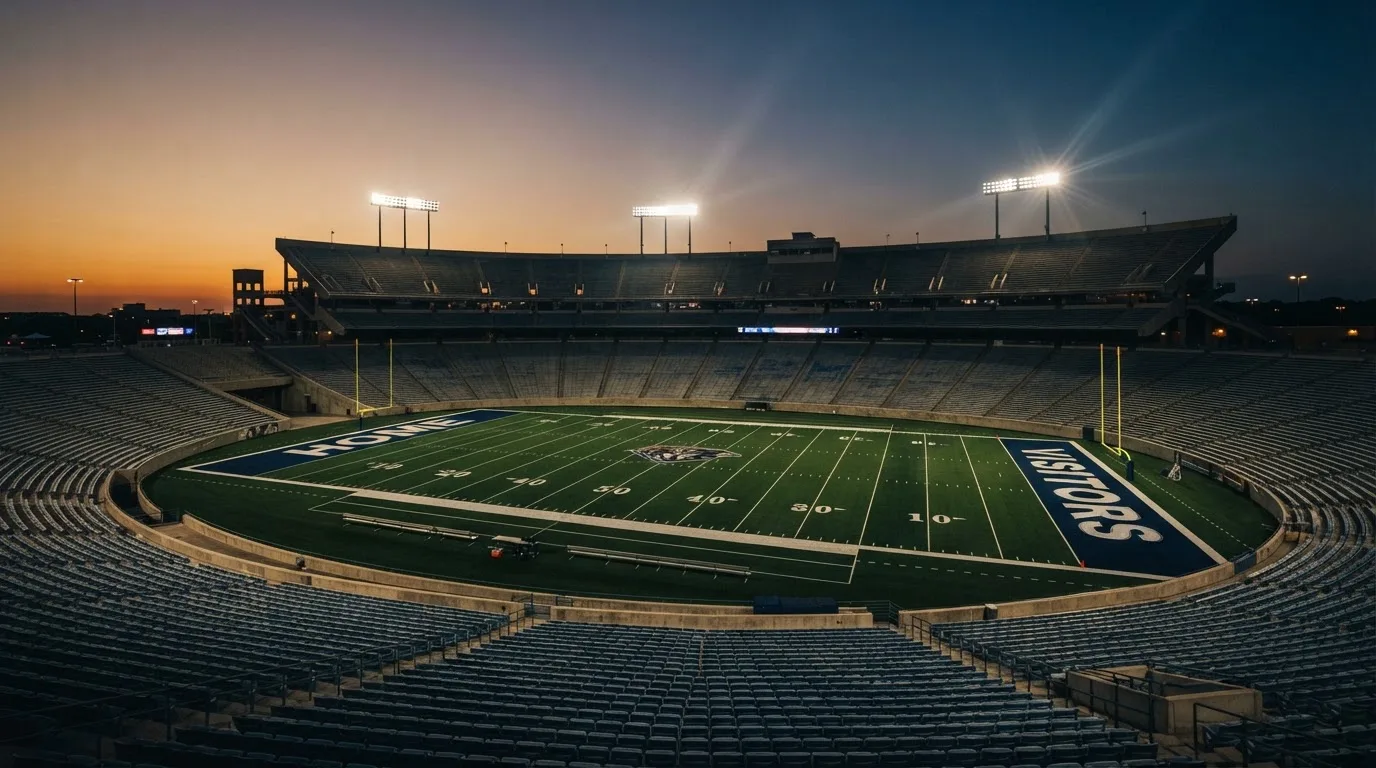
A live bet differs from a pre-match bet in two ways a punter feels immediately. First, the market is faster — the bookmaker’s algorithm reprices after each play, often before the stadium has reset for the next snap, so the price a punter saw five seconds ago may already be gone. Second, the margin in-play is usually wider than the pre-match margin. Bookmakers protect themselves against a sharper information flow: when a quarterback is sacked and limps off, the algorithm only knows the sack, not the limp, and a wider margin buys the firm a few seconds of uncertainty. The trade-off for the punter is access — you can back a side after a bad start that you would not have backed pre-match — but the cost of that access is paid through the price, not a fee.
Cash out is the second live tool. It lets a punter close a bet before the final whistle at a price the bookmaker sets, locking in profit or capping a loss. The math is the same as any other price: cash out reflects the live odds, which reflect the live margin, which is wider than pre-match. A bet that “cashes out for a profit” has not beaten the market — the bookmaker has simply offered a fraction of the back price to take the position off its books. The smaller the live margin at the moment of cash out, the closer the offer sits to true value. BetVictor, 10bet, Fitzdares, DragonBet and Unibet all carry cash out, and the feature is increasingly the default rather than the differentiator it was five years ago.
Where live betting is genuinely useful is in the markets the pre-match price cannot price at all. A first-drive touchdown scorer market has no pre-match analogue. A next-play conversion market settles before the ball is snapped. These are micro-markets, settled in seconds, and they exist because the broadcaster’s camera gives the bookmaker information the punter has too. A punter’s edge in that environment comes from knowing the game — the personnel groupings on third down, the offence’s tendency on first-and-goal — not from reacting faster than the algorithm.
In-play on American football has a specific market quirk: quarter and half lines. The bookmaker offers a separate spread and total for each quarter and for the first half, settled at the whistle. These markets move sharply after a big play, and a punt on a fourth-quarter total can be decided by a single kneel-down that bookmakers knew to expect. Cash out at the end of the third quarter is often a more honest trade than holding the bet to the whistle.
Predictions and strategy: how a tip is built
A “tip” in American football is the published form of a piece of analysis. Behind every tip is a model — sometimes a spreadsheet, sometimes a gut feel dressed in spreadsheet language — and every model is a set of weights applied to a set of inputs. The most reliable inputs are the ones that update slowly: roster quality, offensive and defensive line play, special-teams efficiency, coaching tendencies in close games. The least reliable are the ones that update fastest: last week’s score, the mood of a locker room after a bad loss, a quarterback’s hamstring. A tip that hangs on a fast-moving input is a tip that ages by the hour.

Value is the second concept every punter needs before a tip is worth taking. A price is a value bet when it exceeds the true probability of the outcome, with the bookmaker’s margin already stripped out. If a side has a 55% chance of winning and the bookmaker’s price implies 50%, the price is 5% too short and the bet loses in the long run even when it wins. The trick is that nobody knows the true probability — that is the whole point. A model gives an estimate, a price gives a market view, and the gap between them is the bettor’s edge. Sometimes the edge exists. More often it does not, and the punter is paying the bookmaker for the privilege of having a position on the game.
Bankroll discipline is what separates a punter who survives losing streaks from one who chases them. A flat stake of 1-2% of the bank on any one bet is the convention; some serious bettors stake smaller, some larger, but the figure is set before the game and does not change with the score. A punter who raises the stake to “win it back” after a loss is no longer staking — they are paying the bookmaker’s margin twice, on the original bet and on the recovery bet. The arithmetic of a 5% margin is unforgiving: a bankroll that bets 10% of itself on a coin-flip at 1.90 prices loses 5% of every bet in expectation, and the bankroll halves in roughly fourteen losing bets at that size.
No tip is ever certain. The bookmaker is paying for the right to be wrong, and the punter is paying the bookmaker for the privilege of holding a position. A tip that promises certainty is a tip that is selling something the tipster does not own. The honest framing of a tip is “this is what the numbers say, and the numbers are wrong sometimes”. Anyone who tells you otherwise is selling you a position they would not hold with their own bankroll.
Form, statistics and line-ups are the three inputs that survive a long losing run. A team’s recent form — the last four to six games — is the standard window, long enough to smooth out one bad game and short enough to capture a trend. Statistics, particularly yards per play, success rate on early downs and third-down conversion rate, describe what the team is doing well and what the team cannot do at all. Line-ups, especially on the offensive and defensive lines, decide whether the statistics from earlier in the season still apply. A right tackle out for the season changes every other number on the page.
A staking plan, a value check and a model — those three are the difference between a punter and a tipster. The punter has a process; the tipster has a column. A column pays the same whether the tip wins or loses, and the punter’s bankroll pays only when the bet wins. Choose the side of the trade whose income depends on the outcome.
American football bet types and odds: reading the price
The three markets that carry the bulk of American football liquidity are the moneyline (which side wins), the spread (a handicap, expressed in whole or half points) and the total (the combined score, over or under a line set by the bookmaker). Each settles differently, each has a different margin, and each suits a different kind of punter.
The moneyline is the simplest market: pick the winner, get paid at the price. A heavy favourite produces a short price — the New England Patriots at 1.20 to beat a struggling opponent — and a punter laying £100 to win £20 is paying a 5-6% margin to hold a position the model thinks is a near-certainty. Upsets in the NFL happen at roughly 30% per season, so the model and the price agree most weeks; the punter is paying for the convenience of holding a position on the team that wins more often than it loses. The market is least useful as a value bet and most useful as a parlay leg.
The spread is the market American football was made for. A bookmaker sets a line of, say, Kansas City -3.5 against Buffalo: Kansas City must win by four or more for the bet to land. The half-point eliminates the push — a tie on the spread — and the punter’s job is to estimate the true margin between the teams, compare it to the line, and decide which side of the line sits above its true probability. The margin on a spread is usually tighter than the moneyline because the bookmaker is balancing action on both sides of the line rather than pricing one team against the field. A bettor who reads the game as a two-score Kansas City win takes -3.5; a bettor who reads it as a one-score win takes Buffalo +3.5.
The total is the third leg of the standard American football trifecta. The bookmaker sets a line — over/under 47.5 points, for example — and the punter decides whether the two offences will combine for more or fewer than that number. Totals move with weather, with injuries to starting quarterbacks and with the pace the bookmaker expects from each offence. A total is settled on the combined score, including overtime, and a game that goes to overtime is decided by a single field goal in most seasons. Punters who specialise in totals tend to watch pace-of-play data and red-zone efficiency more closely than any other input.
A push is a market outcome that needs its own paragraph. When the spread lands exactly on the line — Kansas City wins by three against a -3 line — the bet is void and the stake is returned. Most spreads and totals are quoted in half-points to avoid the push, but a whole-point line is offered occasionally and the push is a real outcome. Sky Betting & Gaming’s American football rules state that a handicap or total landing exactly on the line is a push, with stakes returned, unless a tie is offered as a separate selection. The punter’s defence is to read the line carefully before placing.
An accumulator, or acca, multiplies the prices of two or more selections into one combined price. A £10 acca on three teams at 1.80, 1.90 and 2.00 returns £10 × 1.80 × 1.90 × 2.00 = £68.40 if all three win. The stake is lost if any one leg loses. The margin on an acca is the product of the margins on each leg, so a three-leg acca at 5% per leg carries an effective margin closer to 14% — the bookmaker is paid on every leg, and the punter is exposed to the compounded cost. Acca insurance — a stake returned if one leg loses — is a separate product, and the fine print on the maximum refund and the minimum number of legs is where the cost lives.
A bet builder is the same-game equivalent of an acca: a punter combines two or more selections from a single match — the moneyline, the total, a player prop — into one bet at combined odds. The margin on a bet builder is the product of the margins on the components, and the bookmaker tends to build in a wider margin than the equivalent multi-game acca because the selections are correlated. A bet on the favourite to win and the total to go over is not the same as two independent bets: the two outcomes share a common cause. Midnite’s app offers an acca builder, popular accas and price boosts, and the maximum-stake limit is set per boost rather than per bet.
A betting exchange is a peer-to-peer market where one punter backs an outcome and another lays it. The price is set by the matching of back and lay bets, and the exchange takes a commission on net winnings rather than a margin on the price. The result is a tighter margin — often 1-2% rather than the 5-7% of a traditional bookmaker — at the cost of liquidity. An exchange is a strong choice for a popular market like the Super Bowl and a weak choice for a niche market like the CFL. British punters access the major exchanges under a betting intermediary licence; a remote betting intermediary licence is the Gambling Commission’s separate category for the format.
Spread betting is a separate product, not a betting market, and it sits inside a different regulatory box. A spread bet is a wager on whether a number — total points, a player’s passing yards, the margin of victory — is higher or lower than a range the bookmaker quotes. A stake of £10 per point on a total points spread of 45-48 wins or loses £10 for every point the actual total is above or below 48 or below 45. The upside is unlimited: a 60-point total pays £120 on a £10 stake. The downside is also unlimited: a 30-point total costs £150. Spreadex is regulated by the Financial Conduct Authority for its financial spread betting and by the Gambling Commission for fixed-odds betting, and it states that spread betting losses can exceed the deposit. Sporting Index offers Total Goals, Winning Favourites and Race Index spread products alongside its fixed-odds sportsbook.
American football tournaments and fixtures: the calendar that drives the price
American football is played almost year-round in the United States, but the British punter’s calendar concentrates around four windows. The NFL regular season runs from early September to early January, with 17 games per team across an 18-week schedule and the postseason extending into February. The Super Bowl — Super Bowl LX was played on 8 February 2026 at Levi’s Stadium in Santa Clara, with the Seattle Seahawks beating the New England Patriots 29-13 and Kenneth Walker III named MVP — is the largest single-event market on the British bookmaker’s NFL calendar, and the price is set a week or more in advance of the kick-off. The College Football Playoff runs from late December into January and carries its own set of markets, often with thinner liquidity than the professional game. The Canadian Football League runs from June to November, with rule differences (three downs, a larger field, a 20-second play clock) that produce a different scoring profile and a different set of totals.
The NFL has 32 teams, 16 in the American Football Conference and 16 in the National Football Conference, and 14 teams — seven per conference — reach the single-elimination playoffs. The conference structure matters to a punter because the Super Bowl price is built from the conference championship prices, and a late-season injury to a starting quarterback moves the AFC line before it moves the Super Bowl line. The 17-game regular season means a punter tracking form has a larger sample than in any other major American sport, and the form window — the last four to six games — covers a third of the schedule.
The scoring in the NFL is what gives the sport its distinctive market shape. A touchdown is worth six points, an extra-point kick is one, a two-point conversion is two, a field goal is three and a safety is two (awarded to the defence). A seven-point margin is the most common in the NFL because the extra point is the most common conversion after a touchdown, and the spread market is calibrated around the fact that a field goal is the smallest unit of scoring that decides a game. A punter who understands why the -3 line is set where it is has a more useful model than one who treats the spread as a black box.
Professional and college games last 60 minutes in four 15-minute quarters, but the broadcast runs closer to three hours because of stoppages, timeouts, reviews and the half-time break. A live market in the fourth quarter can move on a play that takes 12 seconds of game time and 90 seconds of clock time, and the punter watching at home is no slower than the bookmaker’s algorithm in those moments. The market is genuinely live in the final two minutes, and the price the punter sees is a fair price on the play that just happened.
The American football betting market in the UK is dominated by the NFL. College football is offered by most major bookmakers but with thinner liquidity, and the CFL is a niche product. XFL and USFL — the spring leagues that have launched and folded in recent years — appear briefly on some books and disappear as quickly. The punter looking for value outside the NFL is looking in a small market with wider margins and lower maximum stakes.
Top UK bookmakers for American football
A shortlist of ten UK-licensed bookmakers for American football is built from one criterion above all: the operator must hold a Gambling Commission remote licence for general betting on real events. Every brand below does, and the Commission account number is the receipt. A licence is not a recommendation and a ranking is not a licence — several of these firms hold the same licence category and offer the same markets at slightly different prices. The point of a shortlist is to give the punter ten places to check, not ten opinions about which one is best.
The table below lists the ten operators in the order the comparison sets out, with the Gambling Commission account number and licence holder as the verification trail. The third column carries the operator’s own statement on the market or feature that defines its American football offering, as the firm’s published terms state it. “No data” in the third column means the firm’s published terms do not state a position on that subject; it does not mean the firm does not offer the market. The punter checks the Wettprogramm — the betting programme — on the day.
| Brand | Gambling Commission remote licence | Operator’s own statement on American football |
|---|---|---|
| BetVictor | 039576-R-319370-028 (BV Gaming Limited) | Best Odds Guaranteed on UK and Irish horse racing, plus Smart Stats and a BetFinder tool |
| 10bet | 043173-R-322899-023 (Blue Star Planet Limited) | Cash out, Bet Builder and Live Streaming on the sportsbook |
| Lottoland | 038991-R-319408-020 (EU Lotto Limited) | Casino, lottery betting, sports betting and scratchcards on a single platform |
| Bet600 | 044731-R-323941-016 (Tyche Tech Limited) | Best Odds Guaranteed on horse racing — SP paid if bigger than the price taken |
| Sporting Index | 027343-R-308898-011 (Sporting Index Limited) | Fixed-odds and spread-betting products on a single account |
| BetTom | 064959-R-339314-003 (Bet Tom Limited) | Sports welcome offer for new customers, 18+ |
| Geoff Banks | 054095-R-330366-010 (GB Sports Advisors Limited) | Live in-play and ante-post prices on future events |
| Star Sports | 009177-R-104555-019 (Star Racing Limited) | Independent bookmaker with virtual sports, casino and live casino |
| Fitzdares | 000400-R-103839-030 (Fitzdares Limited) | Cash out, accumulators, Lucky 15s, specials and antepost on American football |
| DragonBet | 064908-R-339041-003 (DragonBet Ltd) | Cash out both in-play and pre-match, plus live streaming of racing |
BetVictor
BetVictor is the longest-established name on the list and carries a Commission account that predates the 2014 remote-licensing reform. Its American football market is built around the NFL: full moneyline, spread and total coverage on every regular-season game and the postseason, plus player props on the marquee matchups. The Best Odds Guaranteed promotion is on horse racing, not American football, and Smart Stats is a form-tool the punter uses before placing. BetVictor’s edge is product depth: a regular-season game carries hundreds of markets, and the price the punter sees is usually within a point of the wider market. For a punter who wants one account for football, racing and American football, BetVictor is the default.
10bet
10bet’s sportsbook covers football, tennis and horse racing alongside American football, and the in-play product is a clear part of the pitch. Cash out, Bet Builder and Live Streaming are stated on the App Store listing. 10bet’s appeal is the live offering: the bookmaker pushes in-play markets aggressively during the NFL Sunday slate, and a punter who plans to bet through the game rather than before kick-off gets a tighter live product here than at a horse-racing-led firm. The price is competitive on the spread and total but rarely the best in the market, and a punter who shops the line will often find a half-point better elsewhere.
Lottoland
Lottoland is a different kind of firm: its primary product is lottery betting, with the sportsbook as a complement. The Commission licence is for general betting on real events and the sportsbook covers American football alongside football and tennis, but the depth of the NFL market is not the same as a dedicated sportsbook. A Lottoland account suits a punter who plays the lottery and wants a one-wallet solution for the occasional NFL bet; a punter betting the NFL weekly will find more markets and tighter prices at a sportsbook-led firm.
Bet600
Bet600 is a newer name on the list, with a Commission account issued in the last few years, and its pitch is the Best Odds Guaranteed offer on horse racing. For American football, Bet600 offers a full sportsbook with moneyline, spread and total markets, but the firm’s identity is racing-first. The punter’s reason to hold a Bet600 account is the same as the punter’s reason to hold any second account: a price-shop on a single game is a price-shop across firms, and Bet600’s line on an NFL spread will sometimes sit a half-point better than the first book the punter checks.
Sporting Index
Sporting Index is a spread-betting specialist, licensed for fixed-odds and spread products on a single account. The American football offering is built around total-points spreads and a small fixed-odds book on the main markets. The new-customer offer is a £10 fixed-odds bet at minimum odds of 1/2 unlocking three £10 fixed-odds free bets, three £5 Total Goals spread bets, three £5 Winning Favourites spread bets and a £1 Race Index spread bet; the qualifying bet cannot be placed in play or cashed out early. A punter who wants exposure to spread products alongside the fixed-odds book will find the combination here. A punter who wants only fixed-odds American football is paying for a product they will not use.
BetTom
BetTom’s sports welcome offer for new customers is 50% back as a free bet of up to £50, matched by 50% back as free slot funds of up to £50 for casino play. The sportsbook covers American football at the standard depth — moneyline, spread, total, a small set of player props — and the firm’s identity is value-led: a new-customer offer, regular price boosts and a smaller book than the listed leaders. A punter who bets the NFL weekly will find the market depth limiting and the price not consistently the best; a punter who bets the occasional marquee game and values the welcome offer will find the account earns its place.
Geoff Banks
Geoff Banks is a small, independent bookmaker with a Commission account under GB Sports Advisors Limited. The App Store listing cites live in-play prices and ante-post prices on future events, and the firm’s identity is personal service: a smaller book, run by a named individual, with a client list that has been built over years. The American football market is not the deepest on the list, and the maximum stakes are lower than a major bookmaker’s. A punter who values a personal relationship with a bookmaker over market depth is the audience; a punter betting the NFL weekly will outgrow the account.
Star Sports
Star Sports describes itself as the UK’s leading independent bookmaker, with virtual sports, casino and live casino alongside the sportsbook. The American football market is the standard independent-book market: full coverage of the NFL regular season and the postseason, with the marquee player props on the Sunday night and Monday night games. The firm’s identity is independence: a Commission account held by Star Racing Limited, a UK-licensed operation, with a book that the punter negotiates at the higher stakes. A punter betting five figures on a single game is the audience; those looking for standard weekly stakes will find competitive prices on major NFL markets, though niche prop liquidity can be thinner.
Fitzdares
Fitzdares positions itself as a premium betting app, and the American football market is built around the marquee matchups. The App Store listing cites cash out, accumulators, Lucky 15s, specials and antepost markets on horse racing, football, tennis, rugby, cricket, golf and American football, with in-play live odds. Fitzdares’ appeal is the form of the product: a clean app, a tight market on the headline games, and a small set of specials that a punter will not find on a mass-market book. The depth is not the deepest on the list, but the price on the markets it offers is competitive.
DragonBet
DragonBet is a Welsh-facing bookmaker with a Commission account under DragonBet Ltd. The pitch is the cash-out product: cash out both in-play and pre-match, and live streaming of racing. The American football market is standard: full coverage of the NFL regular season and the postseason, with the marquee player props on the Sunday and Monday games. DragonBet’s appeal for an American football punter is the cash-out product and a Welsh-focused service the firm does not push outside the principality. A punter who wants a local bookmaker with a Commission licence and a clean cash-out product is the audience.
What the bookmaker’s margin costs: a worked example
The margin is what the bookmaker keeps of every unit bet on a market. The bookmaker builds a margin into the price by shortening every outcome below its true odds, and the punter pays the margin on every bet whether the bet wins or loses. The standard calculation is the inverse: a market’s payout share is 1 ÷ (1/odds₁ + 1/odds₂ + … + 1/oddsₙ) summed over every outcome, and the margin is 1 minus the payout share.
Take an illustrative two-way market priced at 1.90 and 1.90 — both outcomes the same price, as a bookmaker would set for a coin-flip NFL spread at the standard juice. The implied probability of each outcome is 1 ÷ 1.90 = 0.5263, or 52.63%. Adding the two outcomes gives 1.0526, or 105.26% of the market. The margin is the excess over 100%, or 5.26%. The bookmaker keeps roughly 5.26p of every pound staked across the two outcomes; the punter receives, in expectation, 94.74p of every pound staked.
The margin moves with the price. The same two-way market at 1.95 and 1.95 produces an implied probability of 51.28% per outcome, a total of 102.56%, and a margin of 2.56% — a tighter book, where the punter is paying less for the position. The same market at 1.85 and 1.85 produces an implied probability of 54.05% per outcome, a total of 108.11%, and an overround of 8.11% — a wider book, where the punter is paying more. The bookmaker sets the price; the punter chooses whether to pay it.
In American football, the spread and total markets typically run a margin of 4-5%, the moneyline can run 5-7% on a heavy favourite, and the player-prop markets can run 8-12% because the bookmaker is pricing a smaller pool of information. The exchange, where peer-to-peer matching sets the price and the exchange takes a commission on net winnings, typically runs 1-3% on the most liquid markets. The punter who values the lowest margin plays the spread on the exchange, accepts the lower liquidity on the niche markets, and checks the commission terms before placing.
The 5.26% margin on a coin-flip market at 1.90 is the kind of figure that gets quoted as a single point. In practice, the margin moves with the price the punter sees, and the punter sees different prices at different times. The honest framing is a band: a two-way market at 1.90 carries a margin of roughly 5.3%, a two-way market at 1.95 carries a margin of roughly 2.6%, and a two-way market at 1.85 carries a margin of roughly 8.1%. The punter’s job is to read the price and work out the margin before placing.
Crypto and anonymity: the offshore question
A British punter looking for anonymous play or crypto deposits is looking outside the licensed market. The Gambling Commission’s regime requires a name, an address and a date of birth before the first deposit, and no licensed operator accepts anonymous play. The licensed firms take debit cards and bank-based payments, and a credit card is banned for gambling in Great Britain. Whether a licensed operator accepts cryptocurrency deposits is not established in the Commission’s published material; the registered firms describe their payment methods in their own terms.
An offshore operator offering crypto deposits and anonymous play is offering a different product. The site holds a Curaçao, Maltese or Gibraltar licence — none of which is a substitute for a Commission licence for a customer in Great Britain. The Gambling (Licensing and Advertising) Act 2014 requires a Commission licence wherever the operator is based if the remote facilities are used in Great Britain, and a Curaçao, Maltese or Gibraltar licence is not a substitute. The bet itself is not a customer offence: the Commission has not, in the published material, named an offence for a customer who bets on an unlicensed site, and the framing is the loss of protection rather than a criminal charge.
The loss of protection is real. An unlicensed site does not contribute to GAMSTOP, and the multi-operator self-exclusion scheme does not cover the account. The site is not subject to the Commission’s complaints process and is not bound by the approved alternative-dispute-resolution route. The 10x cap on bonus wagering requirements does not apply, the £150 financial vulnerability check does not apply, and the British consumer-protection route for withheld funds is not available. The site may still be a perfectly good site — there are honest offshore operators — but the punter is paying the margin on the bet and the absence of the protections on top.
The honest framing of the crypto and anonymity question is: the licensed market verifies identity, blocks credit cards, caps bonus wagering at 10x, and offers GAMSTOP; the unlicensed market does none of those things. Neither is the safe choice by default. A punter who values anonymity above the British protections knows which side of that trade-off they are on; a punter who values the protections does not.
Bonuses and free bets: what the offer is worth
A “free bet” is a bookmaker credit that settles a winning bet at the returns only, with the stake not paid back. A £10 free bet on a 2.00 outcome returns £10 in profit, not £20 in returns, because the £10 stake is the bookmaker’s. A “cash bonus” is a credit that pays the stake back as well as the profit, and a £10 cash bonus on a 2.00 outcome returns £20 — the same as a £10 cash bet at the same price. A “price boost” is a single-market enhancement, where the bookmaker raises the price on one outcome for a limited stake. A “risk-free” bet is usually a free bet credited if the first bet loses, and the “risk-free” framing is a marketing word: the stake is not refunded in cash, and the punter is paying the margin on the original bet to receive a free bet in return.
The value of a free bet whose stake is not paid back is calculated as: value = free-bet amount × (odds − 1) ÷ odds × payout share. The free bet is worth more at higher odds and on markets with a tighter margin. A £10 free bet at 4.00 on a market with a 95% payout share is worth £10 × 3.00 ÷ 4.00 × 0.95 = £7.13. The same free bet at 2.00 on the same market is worth £10 × 1.00 ÷ 2.00 × 0.95 = £4.75. The free bet is an instrument with a calculable value, and the punter who redeems it at 4.00 captures more of that value than the punter who redeems it at 2.00.
The wagering requirement is the cost of a cash bonus. The Commission’s promotion rules, in force since 19 January 2026, cap the wagering requirement on bonuses at 10x — a £10 bonus with a 50x requirement is no longer lawful, and the cap is £100 of bonus cash that needs to be wagered. The qualifying turnover is the bonus base — the bonus alone, or the bonus plus the deposit, depending on the operator’s terms — multiplied by the wagering factor. A £50 bonus at 10x with a bonus-plus-deposit base means £1,000 of qualifying bets, and a punter staking £10 per bet needs 100 bets to clear the requirement. The cost is the market’s margin over those 100 bets, and a 5% margin on £1,000 is £50 in expected loss — the bonus has been paid for in full.
A bet booster — the punter receives a small price enhancement on a specific selection — is the most efficient bonus form because there is no wagering requirement. The boost is paid in cash, the stake is paid back, and the punter keeps the profit. The trade-off is the size: a 5% boost on a £10 bet is worth 50p, and the punter is paying the bookmaker’s attention in return. A price boost is not a free bet; it is a discount on one position.
Acca insurance — a stake returned if one leg of a multi-leg acca loses — has the same shape. The refund is usually a free bet, and the maximum refund is set per promotion. A £10 acca with acca insurance at a maximum £10 refund returns the stake as a free bet if one leg loses, and the free bet is then redeemed at the value calculated above. The cost of acca insurance is built into the margin on each leg, and the punter is paying for the insurance whether they claim it or not.
The honest framing of a bonus is the value the punter extracts, not the headline the bookmaker promotes. A 100% deposit match up to £200 with a 10x bonus-plus-deposit wagering requirement on slots is a bonus that costs the punter roughly £200 in expected loss to extract. The same £200 matched as a free bet on a sport the punter would have bet anyway is a bonus that costs the bookmaker the free-bet value. The bookmaker has set the offer; the punter has decided whether the offer is worth the cost.
Legality: the British regulatory frame
American football betting in Great Britain is regulated by the Gambling Commission under the Gambling Act 2005, which covers England, Scotland and Wales; Northern Ireland sits outside the Act and has its own older law. The Gambling (Licensing and Advertising) Act 2014 made a Commission licence compulsory at the point of consumption: an operator whose remote facilities are used in Great Britain needs a Commission licence wherever it is based, and a Curaçao, Maltese or Gibraltar licence is not a substitute. Providing gambling facilities in Great Britain without the licence the Act requires is an offence under section 33 of the Gambling Act 2005 — up to 51 weeks’ imprisonment, a fine up to level 5, or both on summary conviction, and six months in Scotland — and the offence is aimed at the operator, not the customer.
The Commission’s public register is the test of who holds a licence. The register is searchable by business name, trading name, domain or Commission account number, and a brand on the register is licensed; a brand not on the register is not. The register can be checked on the day a bet is placed, and a punter who is unsure about a brand should check before depositing. Licensed operators use .com as well as .co.uk, so the domain alone proves nothing; the register is the receipt. Quote no count of licensed operators without its access date.
The licence categories for the firms on this page’s shortlist are all “remote general betting standard (real events)”. Other categories the Commission issues include remote general betting standard (virtual events), remote general betting limited, remote pool betting, and remote betting intermediary (the licence for exchanges). A licence for one category does not cover another: a pool-betting licence is not a fixed-odds licence, and a limited licence is not a general one. The punter should check the categories on the register, not just the licence status.
Financial spread betting is regulated by the Financial Conduct Authority, not the Commission. Spreadex is regulated by the FCA for its spread-betting products and by the Commission for its fixed-odds products, and the FCA’s regime is closer to a financial-services regime than a gambling one. A punter using a spread-betting product on an American football total is on a different regulatory platform from a punter using a fixed-odds product, and the protections differ. The Spreadex site states that spread-betting losses can exceed the deposit; the Commission’s general-betting licence does not.
The age and identity rules are the most visible part of the British frame. A punter must be 18 or over, and name, address and date of birth are verified before a customer can deposit or gamble — since 7 May 2019, and including with a free bet or bonus. Credit cards are banned for gambling in Great Britain since 14 April 2020, including credit-card-funded payments through an e-wallet. There is no state-set stake or deposit ceiling: the Commission does not publish a maximum bet, and operators set their own maximum stakes and may restrict customers.
A financial vulnerability check, under LCCP condition 3.4.4 in force since 30 August 2024, applies to licensed remote betting when a customer’s deposits minus withdrawals exceed £150 in a rolling 30 days (since 28 February 2025). It is a public-record check — bankruptcy, county court judgments — not an income check and not a credit-reference check. Financial risk assessments (the “affordability checks” of the press) have been announced in a staged plan — the Commission published an article on 7 July 2026 — with no start date. Write “announced, staged, no start date” and not “in force”. A deposit limit is a customer’s choice, set on the operator’s safer-gambling page; the first changes to the Commission’s Remote Technical Standards on deposit limits applied on 31 October 2025, a second phase was postponed to 30 September 2026, and whether it is live is not established.
The tax frame is the operator’s, not the customer’s. The player pays no tax on betting winnings in Great Britain — general information, not tax advice; a professional gambler should ask HMRC or an adviser. General Betting Duty is the operator’s tax on gross profits, currently 15%; from 1 April 2027 a new remote betting rate of 25% applies within it, while remote bets on UK horse racing, self-service betting-terminal bets in licensed premises, pool betting and in-person betting stay at 15% (HM Government policy paper of 26 November 2025). Until 1 April 2027 the remote rate stays at 15%. Whether operators pass duty on through odds is not established, and the page does not write that the player is charged duty.
Responsible gambling: the tools available
The British responsible-gambling frame is a set of operator-level tools backed by a Commission licence condition, plus a set of national services any punter can reach without going through the operator. The operator tools include deposit limits, time-outs, product restrictions, self-exclusion and reality checks. Unibet lists deposit limits, a Player Profile test, product restrictions and self-exclusion, with live chat support and links to BeGambleAware, GamCare, GAMSTOP, Gambling Therapy and the BGC. The standard set is broadly the same across licensed operators; the quality of the safer-gambling page varies.
GAMSTOP is the national multi-operator online self-exclusion scheme and a mandatory licence condition for online operators since 31 March 2020. A punter can register for six months, one year, five years, or five years with auto-renewal; after the minimum period, the exclusion stays in place for a further seven years unless the punter asks GAMSTOP to remove it. GAMSTOP covers online sites and apps; betting shops use a separate service. An unlicensed site is not in GAMSTOP, and a self-excluded punter who opens an account at an offshore site has not actually self-excluded.
GamCare runs the National Gambling Helpline, and the service is free and confidential. GambleAware funds treatment and research, the NHS runs gambling clinics across the country, and Gamblers Anonymous runs peer-support meetings. A punter who feels the betting has stopped being a choice can reach any of these services without going through the bookmaker. The link is on every licensed operator’s safer-gambling page; the link is not on most unlicensed operators’ pages.
The Commission’s view is that safer gambling is a shared responsibility between the punter, the operator and the regulator. The punter sets the budget, the operator enforces the limits the punter has set, and the regulator enforces the licence conditions the operator has agreed to. A punter who is not offered a deposit limit, a time-out or a self-exclusion tool is not on a licensed site.
Responsible gambling — the signs a punter is losing control
A punter who chases losses — raises the stake to “win it back” after a losing bet — is paying the bookmaker’s margin twice on the recovery bet. A punter who bets more than the bankroll allows is staking the rent. A punter who hides the betting from family or colleagues has crossed the line from a hobby into a problem. A punter who has tried to stop and cannot has crossed the line further. The single best diagnostic is the punter’s own answer to “would I be comfortable if my partner saw my betting history?”. If the answer is no, the punter has a problem, and the problem is not the betting — it is the hiding.
The services listed in the previous section are for that punter, and they are free, confidential and British. GamCare, GambleAware, the NHS gambling clinics and Gamblers Anonymous are the four names on the safer-gambling page of every licensed operator. A punter who is not sure whether the betting is a problem can call the helpline and find out; a punter who is sure does not need to be told which number to call.
Bonuses and promotions: the fine print
The headline number on a promotion is the least informative part. A “100% bonus up to £200” tells the punter the maximum credit; it does not tell the punter the wagering factor, the qualifying minimum odds, the deadline, the maximum bonus conversion, the markets that count and the markets that do not, or whether the bonus is paid as cash, free bet or free spins. The Commission’s promotion rules cap the wagering factor at 10x and ban mixed-product promotions — an offer that requires gambling on two or more product types — in force since 19 January 2026. A licensed operator’s bonus terms comply with those rules; an unlicensed operator’s bonus terms do not.
The qualifying bet is the bet the punter has to place to unlock the bonus. BetTom’s sports welcome offer is 50% back as a free bet of up to £50, matched by 50% back as free slot funds of up to £50 for casino play. The qualifying bet is the punter’s first sports bet, and the terms — the minimum stake, the minimum odds, the markets that count, the deadline — are on the promotion page. Sporting Index’s new-customer offer requires a £10 fixed-odds bet at minimum odds of 1/2, and the qualifying bet cannot be placed in play or cashed out early. The punter reads the terms before placing; the punter who does not read the terms is paying the bookmaker for the privilege of not knowing what the offer is.
A free bet is paid as a credit, and the stake is not returned with a win. A cash bonus is paid as a credit, and the stake is returned. A free-spin bundle is paid in spins on a slot, and the winnings are usually paid as a bonus with a wagering factor. A price boost is paid as an enhanced price on a single market, with a maximum stake. A refund is paid as a free bet or cash bonus when a specific event happens — an accumulator losing by one leg, a horse finishing second to the favourite — and the refund is usually capped. Each of these is a different instrument with a different value, and the punter extracts the value by knowing which instrument the promotion is.
The bet credit at BetVictor, the BetFinder at BetVictor, the Smart Stats at BetVictor, the price boosts at Midnite, the bet builder at Midnite, the popular accas at Midnite, the Best Odds Guaranteed at Bet600 — each is a separate product with its own terms, and the punter who treats them as a single “BetVictor experience” is missing the shape of the firm’s offer. A bookmaker is a bundle of products, and the bundle is more or less valuable depending on which products the punter uses.
The ten-bookmaker shortlist, read across the market
A shortlist is not a ranking. The ten firms listed are all licensed by the Commission, all offer American football, and all differ in the bundle of products they bring to the market. A punter who bets the NFL weekly needs depth and live coverage; BetVictor, 10bet, Fitzdares and Unibet are the depth-and-live tier. A punter who bets the occasional marquee game and values the welcome offer is in the BetTom and Lottoland tier. A punter who values an independent book or a personal relationship is in the Star Sports, Geoff Banks and DragonBet tier. A punter who wants spread products alongside fixed odds is in the Sporting Index tier. A punter who wants a one-wallet lottery and sportsbook is in the Lottoland tier.
A punter who bets on more than one bookmaker is in a stronger position than a punter who bets on one. A half-point on the spread across the books is a half-point, and the cost of a BetVictor account is a couple of minutes’ sign-up. A punter who checks two or three books on every bet pays less margin over a season than a punter who checks one. The Commission accounts above are the receipt for the licence; the bookmaker’s own Wettprogramm is the receipt for today’s price.
What the page leaves out
This page does not name a winner of any game, does not publish a tip, does not print a price, does not promote a bookmaker and does not direct a reader to sign up. The figures on the page are the figures the inputs gave: the 5% margin band, the £150 vulnerability check, the 10x wagering cap, the 25% remote duty from 1 April 2027, the 17-game NFL season, the 32 teams, the eight-point touchdown. None of these is a prediction, and none is a tip.
The punter who wants a tip wants something the page deliberately does not sell. A tip is a published opinion; a model is a private set of weights. The page is the second, the column is the first, and the punter is the one who decides which side of the trade to take. The licence is the receipt, the margin is the cost, the model is the edge, and the bet is the bet. The bookmaker will be there in the morning either way.
Frequently asked questions
How do you bet on American football in the UK?
Pick a bookmaker licensed by the Gambling Commission, register with name, address and date of birth, and place a bet on the moneyline (which side wins), the spread (a handicap in points) or the total (combined score over or under a line). Bets can be placed pre-match or in-play once the game has kicked off. A punter must be 18 or over, and credit cards are not accepted.
What is American football betting?
A wager on an outcome of an American football game — typically the NFL, the CFL, or the College Football Playoff. The most common markets are the moneyline, the point spread and the over/under total, with player props on passing, rushing and receiving yards. Bets settle at the final whistle, including overtime, and a handicap or total landing exactly on the line is a push.
Where can I find the best American football odds?
A shortlist of ten UK-licensed bookmakers is in the section above, with Commission account numbers on the public register. The price a punter sees moves with the time of day and the action on the game, and the punter who checks two or three books on every bet pays less margin over a season. A price-shop is the punter’s most reliable edge in a market with no useful model.
What is a value bet and why is no tip ever certain?
A value bet is a price that exceeds the true probability of the outcome, with the bookmaker’s margin already stripped out. The gap is the punter’s edge. No tip is ever certain because the true probability is an estimate, the price is the bookmaker’s view, and the bookmaker’s view is closer to right on average. A tip is the published form of an estimate; the punter who treats it as a fact pays the bookmaker the margin.
What is the bookmaker’s margin and how is it visible in the odds?
The margin is what the bookmaker keeps of every unit bet on a market, built into the price by shortening every outcome below its true odds. It is visible in the sum of the implied probabilities: a two-way market at 1.90 and 1.90 sums to 105.26%, and the 5.26% excess over 100% is the margin. The tighter the margin, the more the punter keeps of every pound staked.
US & other team sports – Grey Hound
Content created by the «Grey Hound» team
